


5th Sunday of Lent, Year C
First Reading: Isa 43:16–21
Second Reading: Phil 3:8–14
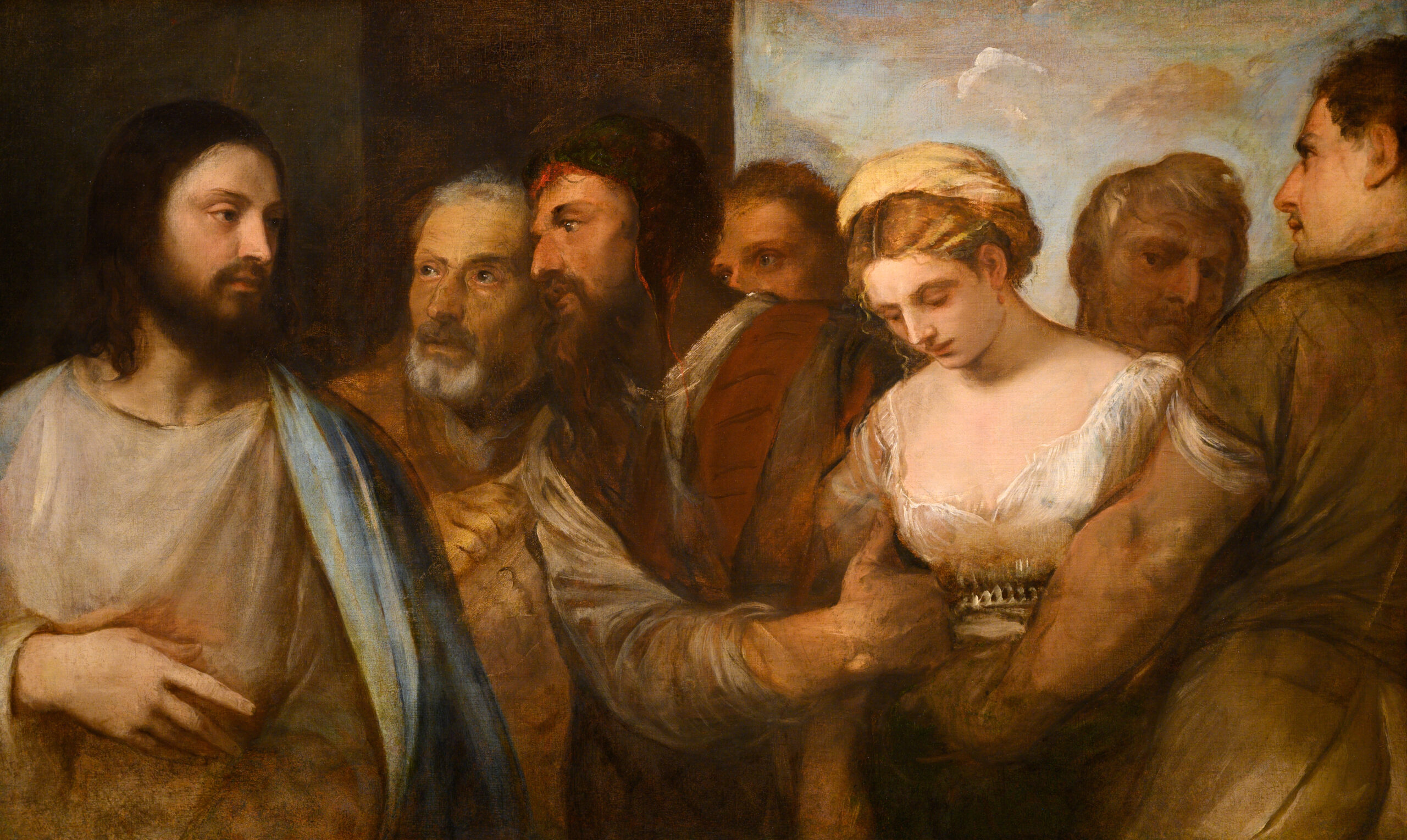
Gospel Reading: Jn 8:1–11
A woman has been caught committing adultery. Jesus drives away her accusers and asks, “Has no one condemned you? Neither do I condemn you.”
Throughout his public life, Jesus was compassionate and understanding to sinners. “It is mercy I desire, and not sacrifice,” he quoted. In the parable of the vineyard labourers, he promised to accept us no matter how late in life we turn to him.
“At the sight of the crowds, his heart was moved with pity,” for they were “like sheep without a shepherd.” At the end, he laid down his life for them; and “there is no greater love than this.”
However, side by side with this compassion, there ran an almost intolerable severity. “Go,” he said to the adulterous woman, “and sin no more.” He not only upheld the Commandments, but also extended them. “You have heard the commandment, ‘You shall not commit adultery,’” he said. “What I say to you is: anyone who looks lustfully at a woman has already committed adultery with her in his thoughts.”
He warned that we must enter the Kingdom of Heaven through the narrow door, for “many will try to enter and be unable.” He told us to count the cost of following him, because it might involve renouncing our loved ones, lopping off our hands and feet, and plucking out our eyes.
“For his sake I have suffered the loss of all things,” St. Paul says.
God the Father led the Israelites through the Red Sea but drowned the Egyptians. Like him, Jesus welcomed prostitutes but denounced Pharisees as hypocrites and vipers.
At the end of the world, Jesus said, he will say even to people who have eaten with him and listened to him teach: “I tell you, I do not know you.”
Some of his injunctions were so severe that his disciples asked in amazement, “Then who can be saved?”
God will forgive anything, but he will overlook nothing. He offers infinite compassion and untiring forgiveness for the past, but he demands nothing short of perfection for the future.
Christ’s compassion is directed toward raising up the fallen, not reassuring us that our fallen condition is acceptable. “You shall love the Lord your God with your whole heart, with your whole soul, and with all your mind,” he said. He will not accept a deliberate compromise.
As St. Thomas More put it, if we try to make a contract with him about what we will do and what we will not do to serve him, we will have to supply both signatures ourselves.
“And yet—this is the other and equally important side of it,” says C.S. Lewis. God, “who will, in the long run, be satisfied with nothing less than absolute perfection, will also be delighted with the first feeble, stumbling effort you make tomorrow to do the simplest duty…. God is easy to please, but hard to satisfy.”
How can we, mere humans—and fallen humans at that—hope to satisfy a God who demands perfection?
Listen to Christ’s answer: “You must be made perfect as your heavenly Father is perfect.” We do not have to become perfect on our own; Christ will do it for us, if we let him.
Our righteousness does not come from obeying the law, as St. Paul says, but through “faith in Christ”; it is “the righteousness from God based on faith.”
Our past failures should not discourage us or tempt us to despair, for God will forgive anything if we repent. “Do not remember the former things, or consider the things of old,” he says; “I am about to do a new thing.”
Though our sins be like scarlet, he will make them as white as snow. Then, like St. Paul, we can forget what lies behind and strain forward to what lies ahead, toward “the prize of the heavenly call of God in Christ Jesus.”
Father Hawkswell is again teaching “The Catholic Faith in Plain English,” with new insights, in both print and YouTube form, at beholdvancouver.org/catholic-faith-course. He is also teaching the course in person on Sundays (2 – 4 p.m. at the John Paul II Pastoral Centre, 4885 Saint John Paul II Way, 33rd Avenue and Willow Street, Vancouver) and Mondays (10 a.m. – noon in St. Anthony’s Church Hall, 2347 Inglewood Avenue, West Vancouver). The title of next week’s talk is How to Go to Confession.
Your voice matters! Join the conversation by submitting a Letter to the Editor here.







