
Feast of All Saints
First Reading: Revelation 7:2–4, 9–14
Second Reading: 1 John 3:1–3
Gospel Reading: Mt 5:1-12a
God made us to know, love, and serve Him in this world, and to be happy with Him forever in Heaven. Accordingly, he gave us a natural desire for happiness.
“We all want to live happily; in the whole human race there is no one who does not assent to this proposition, even before it is fully articulated,” says the Catechism of the Catholic Church.
God offers us this happiness as an utterly free gift: a favour, a blessing. Accordingly, we call it beatitude, from the Latin beatus, meaning “favoured” or “blessed.”
The “beatitudes” we hear in the Gospel Reading are so called because each one begins with the word “blessed.” Therefore, before we can understand them, we must clarify the meaning of that word.
Confusingly, we use the verb “bless” in two opposite senses. When we “bless” God we “praise,” “extol,” or “adore” Him, using “bless” in an “ascending” sense, as the Vatican document on blessing said. However, when we ask God to “bless” us, we use it in a “descending” sense.
In each sense, the past participle of “bless” is spelled “blessed”—but how should we pronounce it?
Like all English past participles that end in “ed,” it used to be two syllables (blessèd), but, starting in the 16th century, it gradually changed to one (blest). The two-syllable pronunciation has died out in everyday English, but it is still common in religious language.
The pronunciation is important, for, while “blessèd” originally meant the same as “blest,” it is now often taken to mean “holy, revered, consecrated.”
In her Magnificat, for example, Mary must have meant “All ages to come shall call me blest”—not “holy”—for she immediately explained why: because “God, who is mighty, has done great things for me.”
Similarly, when Jesus said that those who mourn are blest, he was saying not that unhappy people are holy, but that they are favoured. When he said that the poor in spirit are blest, He was saying not that poor people are holy, but that they have been given an advantage over the rich, for “it is easier for a camel to pass through a needle’s eye than for a rich man to enter the Kingdom of God.”
The first word in each beatitude, then, is “blest” or “favoured”—not “blessèd” or “holy.” To make that clear, I will spell it “blest.”
In his “beatitudes,” Jesus was describing his apostles, Pope Benedict XVI said: citizens of a conquered nation, waiting for the promised Messiah to come and deliver them; poor; sad; meek; hungry for justice; yet peaceable and merciful. But even more closely, he was describing himself, the peacemaker, the merciful one, persecuted because of his righteousness.
In the beatitudes, then, Jesus asserts that people like himself and his apostles are blest by God.
Now as long as we live on earth, we cannot help but feel an inner resistance to this assertion. The beatitudes point in the opposite direction to our spontaneous hunger and thirst for happiness in this world. They demand that we make a U-turn from the obvious direction.
We should not be surprised. Behind the beatitudes stands Christ, who is God, but who descended and emptied himself all the way to death on the cross. He did it out of love for us. And love, by its nature, runs counter to self-seeking.
“At the heart of the divine act of creation is the divine desire to make room for created persons in the communion of the uncreated Persons” of the Holy Trinity. And the nature of their communion is love. Love, therefore, is our beatitude.
Accordingly, God wrote into human nature the “vocation,” the “capacity,” and the “responsibility” of “love and communion,” making love “the fundamental and innate vocation of every human being.”
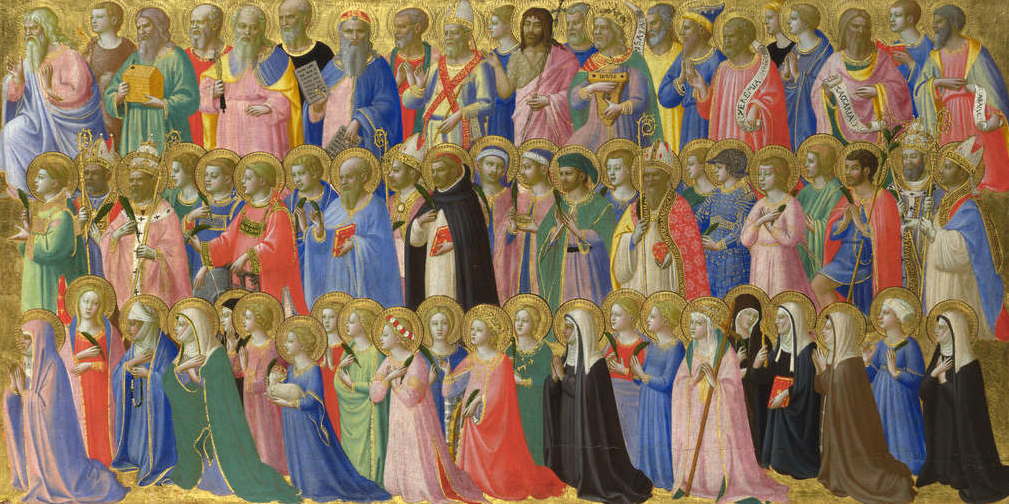
Those who have responded to it are the saints—known or unknown—whom we honour this Sunday.
Father Hawkswell is again teaching The Catholic Faith in Plain English, with new insights. The whole course is available in written form and, one session per week, in YouTube form at beholdvancouver.org/catholic-faith-course. Father is also teaching the course in person: on Sundays at 2:00 pm in the John Paul II Pastoral Centre, 4885 St John Paul II Way, Vancouver (33rd and Willow); and on Mondays at 10:00 am in St. Anthony’s Church hall, 2347 Inglewood Avenue, West Vancouver. The title of next week’s talk is “The Contradictions of Atheism.” No pre-registration is necessary.