
St. Luke is consistently fond of presenting events in pairs and contrasts. The Gospel of Luke pairs the Annunciation and the birth of John with that of Christ; it pairs Simeon and Anna at the Presentation; it balances Stephen the martyr-deacon with Philip the missionary-deacon (chapters 7-8); it sets the conversion of Paul alongside the conversion of Cornelius (chapters 9-10). Now, in chapter 12, two apostles are set before us: James and Peter — one martyred, one miraculously delivered. The contrast mirrors that between the martyrs who shed their blood and confessors who spent their lives giving witness; both are paths of apostolic fruitfulness, chosen differently by the same God.
Herod Agrippa — the third of the Herod dynasty to persecute God’s holy ones (after Herod the Great, who massacred the Holy Innocents, and Herod Antipas, who beheaded John the Baptist) – had James, the brother of John, executed by the sword. James thus becomes the first of the Twelve to be martyred.
Tradition holds that before returning to Jerusalem, James had preached the Gospel in Spain. After his martyrdom, his body was transferred there and eventually discovered by a hermit; the site of his burial became one of the three great pilgrimage destinations of the Middle Ages, alongside Rome and Jerusalem. The Camino de Santiago, walked by millions to this day, is the living legacy of that tradition. St. James is the patron saint of pilgrims.

This is fitting: the Lukan theme of ‘the Way,‘ of life as a journey and pilgrimage, finds expression in all three of the great medieval pilgrimage sites. Jerusalem and Rome are both settings of the Acts of the Apostles. Spain enters the story through the martyrdom of James in chapter 12. Life is indeed a pilgrimage, and our final destination is heaven.
Seeing that James’s execution pleased the opponents of the apostle, Herod arrested Peter during the days of Unleavened Bread. Peter was held under maximum guard: four squads of four soldiers, chained between two guards, with two more at the door. The scene is deliberately Passion-like: as Christ hung between two criminals, Peter lies between two soldiers; as Christ was in the darkness of death, Peter is in the darkness of the dungeon.
The Church’s response to this darkness is instructive. There was no plan, no human strategy. What did they do? They prayed — earnestly, persistently, together. St. Luke’s Gospel already gave us the pattern: ‘Being in agony, he prayed the more earnestly‘ (Lk 22:44). This is the model for every Christian facing darkness: not distraction, not despair, but more earnest prayer.
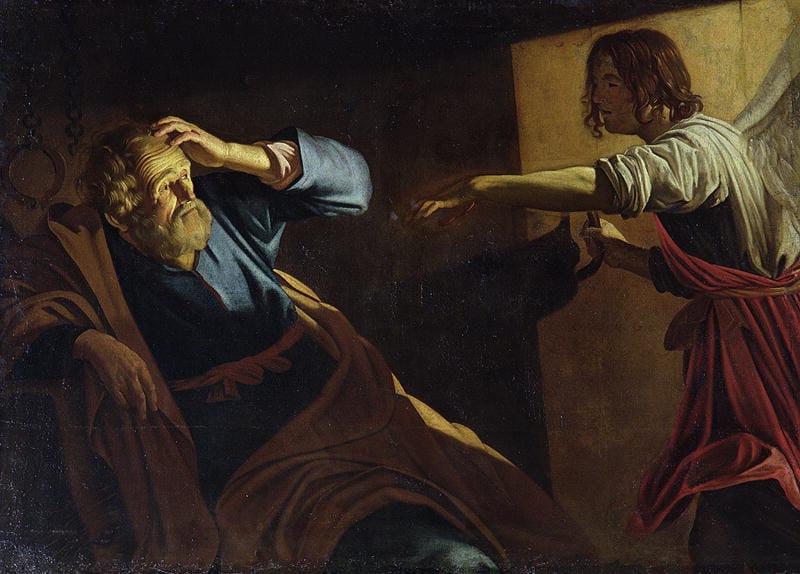
The angel’s action is also laden with symbolism. He strikes Peter on the side to wake him, recalling the lance that pierced the side of Christ. Peter, like one returning from death, barely comprehends what is happening; he thinks he is seeing a vision. The chains fall, the doors open on their own. When at last the angel departs, and Peter comes to himself, he goes to the house of Mary — the mother of John Mark — where the community is gathered in prayer.
The scene at the door is almost humorous, yet richly symbolic. The servant girl Rhoda hears Peter’s voice, is overcome with joy, and runs back without opening the door — leaving Peter still knocking outside. The community, told it is Peter, declares she is mad. This mirrors the Resurrection accounts: the holy women announced the risen Lord to the disciples, who dismissed their testimony as nonsense. Here, Peter, delivered from a kind of death, is likewise not believed at first. It is, as many Fathers have noted, a quiet icon of the Resurrection.
The community’s instinctive response — “It must be his angel” — reflects the early Church’s firm belief in personal guardian angels. Each of us has been entrusted to the care of a guardian angel; this has been the constant faith of the Church from its earliest days.
Peter, once inside, signals for silence, briefly explains what has happened, asks that word be sent to James (the Bishop of Jerusalem, not the recently martyred son of Zebedee) and to the brethren, and then departs. Again, characteristic Petrine humility: no dramatic announcement, no self-congratulation, simply a discreet handover of news to those who need to know.
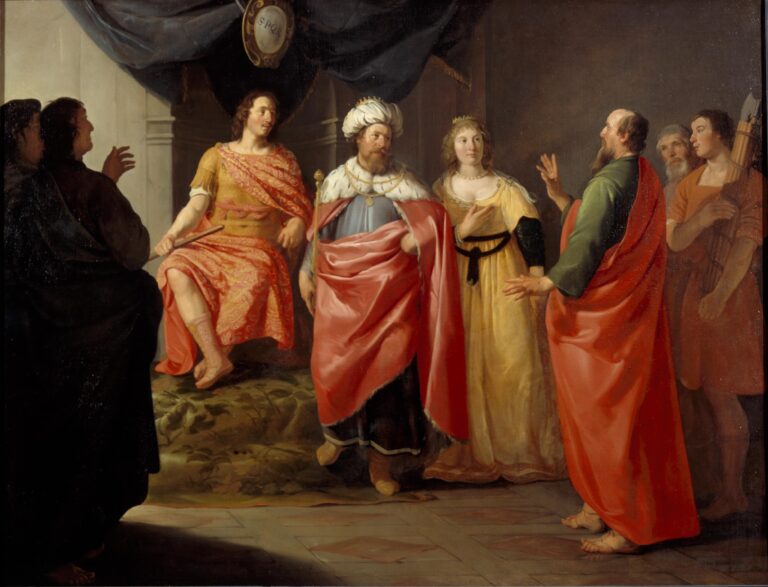
Chapter 12 closes with the death of Herod Agrippa. When the crowd proclaimed him a god, and he accepted their adulation, he was struck down at once. The contrast with the Apostles is sharp: when Paul and Barnabas were mistaken for gods at Lystra (Acts 14), they tore their garments in horror and cried out that they were only men. Herod accepted the deification – and paid for it with his life. The pattern Luke has traced throughout these chapters is confirmed: those who exalt themselves shall be humbled; those who humble themselves shall be exalted.
Your voice matters! Join the conversation by submitting a Letter to the Editor here.
一把劍,一位天使:
天主以不同方式揀選
聖路加一向喜歡以成對與對比的方式呈現記載。路加福音將耶穌與若翰的誕生並置;在奉獻耶穌於殿時,將西默盎與亞納並列;在宗徒大事錄中,他以執事兼殉道者斯德望與宣教執事斐理伯相對照(第7–8章);他把保祿的歸化與科爾乃略的歸化並置(第9–10章)。如今,在第12章中,兩位宗徒被擺在我們眼前:雅各伯與伯多祿 — 一位殉道,一位奇蹟般獲救。這樣的對比,正如殉道者以血作證與證道者以一生作證之間的差異;兩者都是宗徒結實的道路,卻由同一位天主以不同方式揀選。
黑落得阿格黎帕一世 — 黑落德王朝中第三位迫害天主聖者的人(在他之前是屠殺嬰孩的大黑落德,以及斬首若翰洗者的黑落德安提帕)— 用劍殺了若望的哥哥雅各伯。雅各伯因此成為十二宗徒中第一位殉道者。
依照聖傳所載,在返回耶路撒冷之前,雅各伯曾在西班牙宣講福音。他殉道後,遺體被運往當地,後來被一位隱士發現;他的安葬之地遂成為中世紀三大朝聖地之一 — 與羅馬和耶路撒冷齊名。至今仍有無數人行走的聖雅各伯之路(Camino de Santiago),正是這一傳統的活生生遺產。聖雅各伯也因此成為朝聖者的主保。
這十分貼切路加筆下「道路」的主題:人生是一段旅程,是一場朝聖。三大朝聖地皆與宗徒大事錄息息相關:耶路撒冷與羅馬是書中主要場景,而西班牙則因雅各伯在第12章的殉道而被納入。人生的確是一場朝聖,而我們的終點是天鄉。
看到雅各伯的處決令反對宗徒的人感到滿意,黑落德便在無酵節期間逮捕了伯多祿。伯多祿被置於最嚴密的看守之下:四班士兵,每班四人,被鐵鏈鎖在兩名士兵之間,門口還有兩名守衛。這一場景刻意帶有「苦難」氛圍:正如基督被釘在兩個強盜之間,伯多祿也躺在兩個士兵之間;正如基督在死亡的黑暗中,伯多祿也在牢獄的黑暗中。
教會對這黑暗的回應極具啟示性:沒有計畫,沒有策略。他們做了什麼?他們祈禱 — 懇切地、堅持地、共同地祈禱。路加福音早已給出典範:「他在極度恐慌中,祈禱越發懇切。」(路22:44)這是每位基督徒面對黑暗時的典範:不是分心,不是絕望,而是更懇切的祈禱。
天使的行動也充滿象徵意義。他拍打伯多祿的肋旁使他醒來 — 令人想起刺穿基督肋旁的長槍。伯多祿如同從死亡中甦醒一般,幾乎不明白發生了什麼;他以為自己見了異象。鎖鏈脫落,門自己打開。直到天使離去,伯多祿纔清醒過來,就往若望 — 號稱馬爾谷 — 的母親瑪利亞的家去,在那裏有好些人聚集祈禱。
大門的場景幾乎帶著幽默,卻富含象徵。名叫洛達的侍女聽見伯多祿的聲音,喜的沒有開門,就跑進去報告,讓伯多祿仍站在門外敲門。那裏的人聽說是伯多祿,卻說她瘋了。這與復活的記載相呼應:聖婦們向宗徒宣告復活的主時,他們也認為是無稽之談。如今伯多祿從某種「死亡」中被救出,他們起初同樣不信。正如許多教父指出的,這是一幅靜默的復活聖像。
那裏的人本能的反應 :「是他的天使。」 反映了初期教會對個人守護天使的堅定信仰。我們每個人都被託付給一位守護天使,這是教會自最初時代以來不變的信念。
伯多祿進屋後,示意大家不要作聲,簡短說明發生的事,並請他們把這些事報告給雅各伯(耶路撒冷的主教,而非剛殉道的載伯德之子)和弟兄們,然後便離開了。這再次展現伯多祿特有的謙遜:沒有戲劇性的宣告,沒有自我誇耀,只是低調地將消息交給需要知道的人。
第12章以黑落德阿格黎帕的死亡作結。當群眾稱他為神,他接受了這種崇拜,立刻被擊倒而死。與宗徒形成鮮明對比的是:當保祿與巴爾納伯在呂斯特辣被誤認為神時(宗14),他們立刻就撕裂了自己的衣服,跑到群眾中,驚呼自己只是人。黑落德接受了神化,並因此喪命。路加在這些章節中描繪的模式再次得到印證:「因為凡高舉自己的,必被貶抑;凡貶抑自己的,必被高舉。」(路14:11)
Your voice matters! Join the conversation by submitting a Letter to the Editor here.