

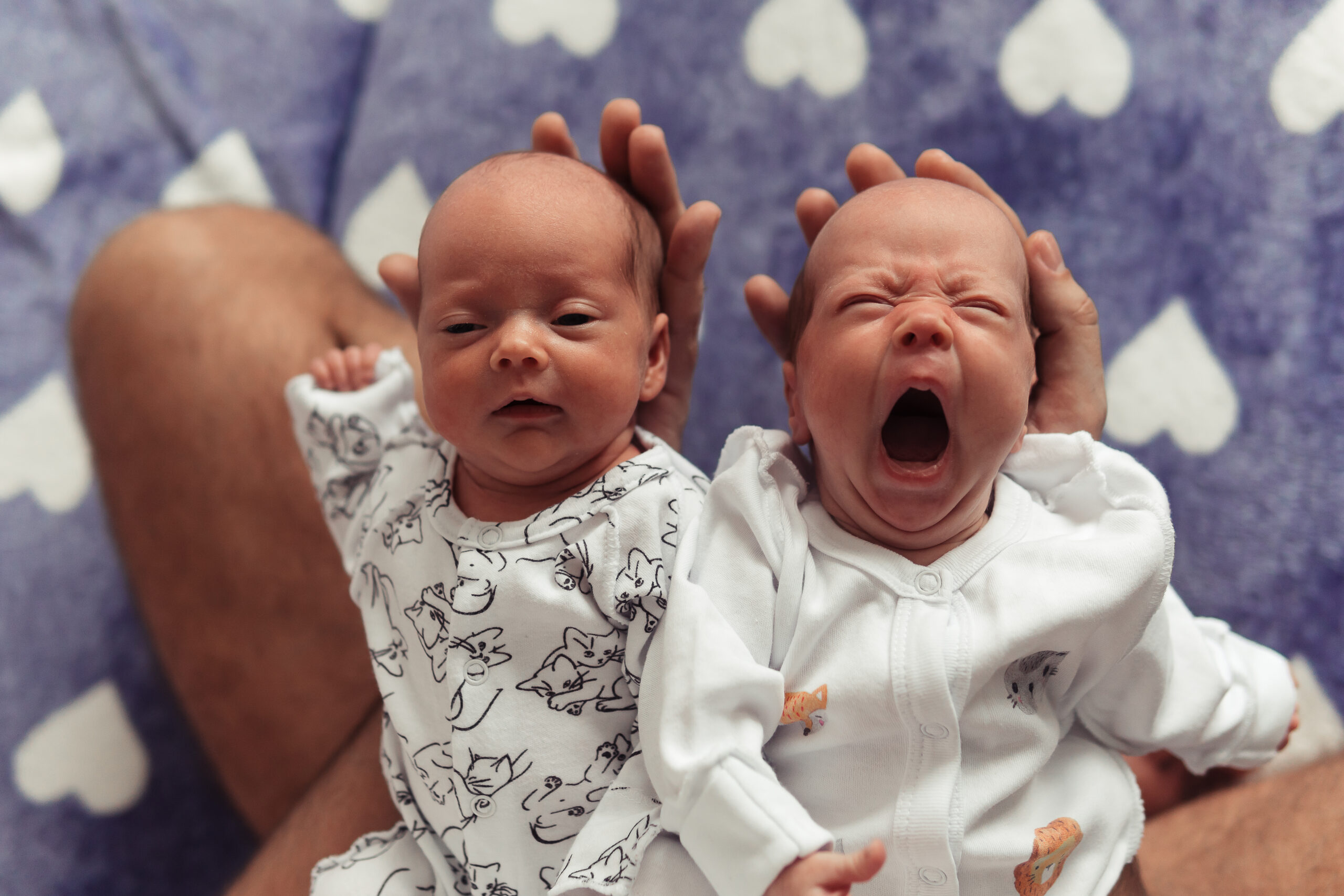

When my husband and I started thinking about having our second child, I had plenty of ideas about how to do a better job the second time around.
We already had a crib, stroller, car seat, and piles of onesies. I had the muscle memory for breastfeeding, swaddling, and diapering. I planned to stress less, enjoy newborn cuddles more, and let unsolicited advice roll off my shoulders. I had all these illusions about how much easier it would be to have a second child, equipped with previous experience and a baby carrier strapped to my chest. We were ready for a walk in the park.
Then we found out we were expecting twins.
It was like the rug was pulled from under our feet and we were tossed into a game of “the floor is lava.” Twin pregnancy is more challenging (it was truly twice as hard), delivering two is naturally more complicated, and rates of postpartum depression are higher with multiples than with singletons.
Something about having twins can make you feel uniquely powerless. You can’t “sleep when the baby sleeps” if they take turns being awake all night. You can’t necessarily carry, soothe, or feed two at the same time, and you definitely can’t change two explosive diapers simultaneously. The number of tiny but important needs can quickly overwhelm you well into toddlerhood.
In conversations with other Catholic twin moms, I’ve found a common theme. Having two children crash into our lives at once has knocked us off our feet, but also strengthened our faith. Before they could walk, our multiples were already making us better people.
Kristina had identical twin girls two months early. She experienced a traumatic caesarean section, then wasn’t able to hold them because both preemies were taken immediately to neonatal intensive care. For the next month, twins who had shared a placenta and a womb were in separate incubators in hospital. Kristina could only visit one at a time, and every visit took her away from her toddler at home.
“The separation is the hardest thing,” she told me. “There is a lot of guilt that comes from it, feeling like I am not there for them in the way I should be… It was really hard thinking that my baby could be crying in the incubator and I’m not there.”
Utterly powerless to be present for her children all the time, she turned to prayer. She imagined Our Lady watching over them every minute she couldn’t.
“I think everyone experiences it at some point as a parent: we want to protect them from danger and evil, and sometimes we are powerless to do it. But to do it from day one was especially difficult,” she said. “There is a time where you feel totally powerless and you rely on God.”
Mindy also had identical girls born early, at 29 weeks. She was 42 years old, and they were kids nine and 10 for her. “The fact that they even survived is a miracle,” she said.
Her monochorionic monoamniotic twins (which means they shared a placenta and amniotic sac) “have terrible statistics and survival rates and we knew that from eight weeks and six days of pregnancy. So I had to practise, every day, relying on God and letting go of control, something that was really hard for me.”
Learning early on that the delivery would be by c-section, she spent most of her pregnancy surrendering her fears of the surgery. “I had to let go and give that to God and trust that he would take care of me, and he did.”
Having twins “has absolutely enriched my faith, as well,” said Caitlin, mother of identical boys.
“Most of all, it has reaffirmed and showed me God’s intentional design of each person.” The boys “look exactly the same, but are total opposite personalities.”
None of us planned to have twins. Yet God has been using our unique kiddos to teach us something about how much greater his plans are than ours.
In my case, I needed to lose control. When I had one baby, I knuckled through survival mode trying to keep some semblance of my old self: my old habits, my old desires, and my old pride. I could do this.
With twins, I felt a total loss of the ability to handle everybody’s needs. My careful plans were tossed aside and my desire to prove to the world and to myself that I’m a great mom because I have done this once before turned into a realization that I can’t raise my babies alone, and that I’m not meant to anyway. I couldn’t help but ask for help.
Jesus was ready when I called out to him. Father Nick Meisl recently called this experience “the grace of being brought low.”
“Jesus tells us that in order to receive God’s help, we must first recognize that we need it. God can’t give us something we don’t believe we need,” he said in a homily last month.
“The Pharisee, who thought he had it all together, prayed as if he didn’t need God. And because of that, he went home unchanged,” he said. But the tax collector in that parable was humble, knew his faults, and asked God for mercy.
“When we find ourselves brought low – when we feel powerless or uncertain – perhaps those moments are not just burdens, but opportunities… to recognize our need for God, to remember that we are not self-sufficient. And it’s precisely then that God can draw near to us.”
Now, when the overwhelm kicks in – when my preschooler is refusing to put on her clothing while one of my babies is getting his fingers caught in a dresser drawer and the other baby is reaching into her own diaper and smearing what she finds on their face – I can turn to the God who placed these kids in my life and say, with the tax collector, “Lord, have mercy!”
Your voice matters! Join the conversation by submitting a Letter to the Editor here.







