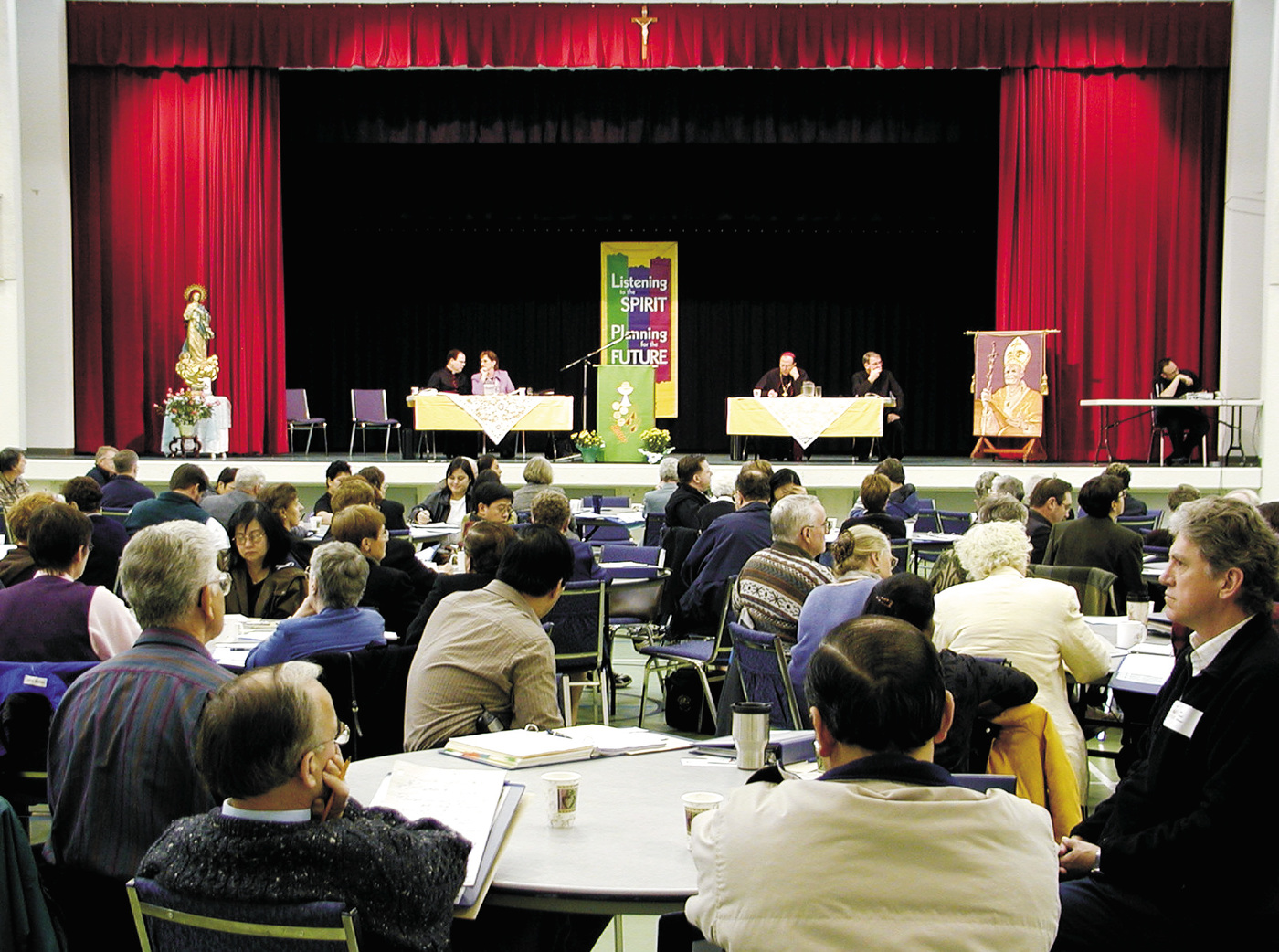

Many people in the Archdiocese of Vancouver are familiar with the word and the work of a “synod.” From 1997 to 2004 the faithful here were involved in an archdiocesan synod that included participation on all levels with hundreds of people.
It was a huge undertaking that was formally opened and closed following all the rules, regulations, and statutes required by the Holy See. There were focus groups, surveys, discussion sessions, and educational presentations around the theme of “the early Church.” Delegates met on 10 successive Saturdays for deliberation and voting, where the final 50 recommendations were proposed and accepted. It was a moving experience that many people still remember.
While we remember our archdiocesan synod, most of us are much less familiar with terms like “the synodal Church” “or synodality.”
As we take part in the current Synod of Bishops on Synodality, we should keep in mind that Pope Francis’ definition of “synodal” implies and demands an understanding that it is more than just a meeting but rather a specific way of living and operating within the Church.
Throughout the documents prepared for the current synodal consultation, we see our Holy Father emphasizing the need to focus on members walking together, gathering, meeting, and eating, preferably in small groups or circles, to listen to how the Spirit is leading us to be more faithful to our baptismal commitment in this place and time.
Archbishop Miller has said one of the most important aspects of this synod is the process itself. He says it is the Pope’s way of introducing us to and familiarizing us with the principle that we are going to learn about “a new way of assuming co-responsibility for the Church’s evangelizing mission.”
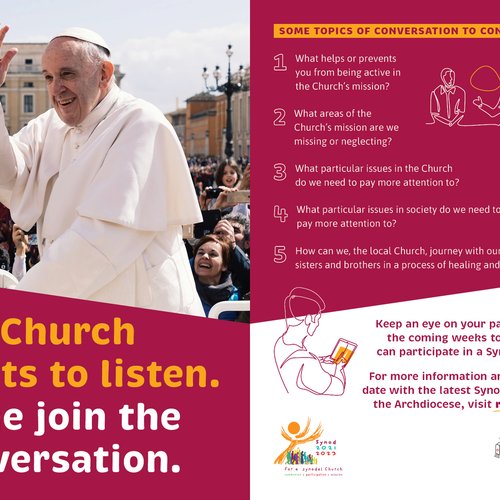
Our journeying together includes listening, dialogue, and conversation by setting up a safe place to meet and allowing all to speak and be heard through prayerful silence and communal discernment.
The Archdiocesan Synod Planning Committee is preparing the framework and building a foundation on which to go forward.
To date:
- We have finalized the series of questions to be discerned in our local process.
- We have hosted a workshop for synod coordinators, pastors, and other interested persons consisting of talks by Archbishop Miller on synodality and by Father Richard Soo, SJ, on communal discernment. Detailed presentations on hosting parish synod sessions were included.
- The archdiocesan website has been updated with guidelines for facilitating the conversation circles process for parishes, groups, and individuals. New and creative ways of thinking are welcome and necessary to bring the process to fruition. There are links to videos, the workshop presentation, and B.C. Catholic articles.
- Conversation starter postcards are available to download and be used as invitations to discuss the synod questions with family and friends.
- Clergy study days with guest speakers have been scheduled.
- Invitations have been sent to our lay associations, groups, and ministries, several of which have already started.
- Conversation circles presentations are scheduled for seminarians at Westminster Abbey and teachers at the Catholic Educators Conference.
- Chaplains and volunteers who work with the incarcerated, homeless, and other marginalized individuals are looking for ways to have these conversations can occur. This is a challenge but one that is clearly on the mind of Pope Francis.
Parishes have been proactive in getting information out to parishioners, appointing synod coordinators and making plans both for now and hopefully after COVID restrictions are lifted. Some have already scheduled their first listening sessions and are offering volunteer training. Others are adding promotional information to their parish bulletin. Another offers a synod prayer for all to pray each Sunday.
Our goal is to invite and include as many people as possible into personal dialogue. In-person sessions will produce the best results; holding multiple sessions will bear even richer fruit.
The more we listen, the better we begin to understand different perspectives. We want to put in place a process that will, as per the Preparatory Document, “foster a broad consultation process in order to gather the wealth of the experiences of lived synodality, in its different articulations and facets, involving the Pastors and the Faithful.”
References to Vatican II documents are many and we are encouraged to study in depth these important writings, particularly Lumen Gentium, Chapter 2, “The People of God.”
While our part may seem small, it is important to remember every piece is integral to the whole. The final synthesis will be made up of conversations with ordinary people like you and me whose differences we need to see and appreciate.
The reporting segment is critical to the success of this initiative. It is important that what is said and experienced is faithfully captured in a complete but concise way so it can be shared broadly with parishes, the Canadian Bishops, and the Vatican.
The feedback we receive in Vancouver will have an impact on our local Church. Parishes will benefit from the discussions, and pastors and parishioners will see trends as they plan for the future. Archbishop Miller will be able to do likewise as he looks ahead for the wellbeing and growth of the archdiocese.
As the Holy Father says, “Let us dream – the path to a better future.”
‘A Synod on Synodality’?
What is a synod on synodality? The word synod comes from the Greek word sinoðos meaning “assembly” or “meeting” and is similar to the Latin word concilium meaning “council.” But it’s important not to think of it as a process of debate, says Barb Dowding.
“In lay terms you might say a synod, and synodality, occurs when people come together for a common purpose to listen to one another with a view to determining a way to proceed forward. It is not, at least in our Roman Catholic tradition, a legislative activity or parliament.
“Pope Francis sees synodality as a way of including more people in a discussion on how to solve problems and discern paths forward by including room for the Holy Spirit. It is the notion of journeying together, walking with, and sharing and being with another in conversation and listening.
“We learn from the lived experiences of others. When we listen as a group in respectful silence we make room for the Spirit to move. At the end of the discussion, the fruit from that listening surfaces and hopefully becomes clearer.
“Synodality as a word does not easily roll off the tongue, but I don’t think there’s another word that replaces it. Suffice to say we should embrace the word and the opportunity it presents to the Church.”
Reflections on the synod
The Church depends on you
By Mark Pan
“‘For every Lent, there is an Easter.”
With those words ringing in my ears, I gathered up my young family and with 13 suitcases made my way across the globe to St. Joseph’s Parish in Port Moody.
The memory of that day in April 2002 came back to me in a flood as I contemplated the synod discussions now underway, and especially the first question: What helps or prevents you from being active in the Church’s mission?
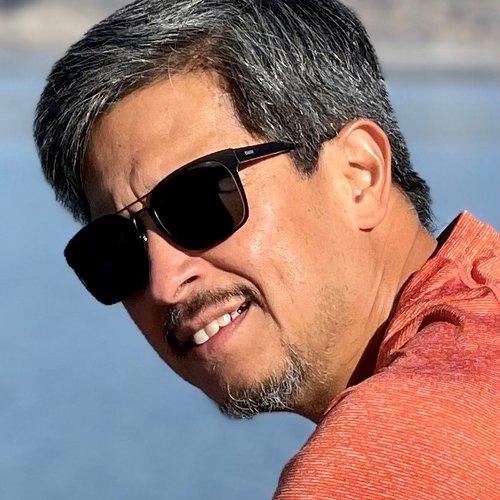
My answer is simple. You. You’re the only one who helps or prevents you from being active in the church’s mission. Let me elaborate.
I had first heard (literally, as you’ll see why) of St. Joseph’s when I was poring over the Archdiocese of Vancouver website as well as The B.C. Catholic online edition back in 2002. My wife and I had decided to immigrate to Canada in search of a better life for our children. The RCAV website had a list of all the churches in its jurisdiction.
Truth be told, back in 2002 not many parishes even had a website. But St. Joseph’s did. More importantly, St. Joseph’s had a section that actually had a sampling of the kind of music they sang in church: Some Latin, some sacred, and, best of all, mostly four-part choral.
“I found it!” That was the mantra of a Christian group back when I was growing up in Malaysia. Except in my case it meant I had found where I was bringing my family. So when my wife asked me, “So, have you thought about where we’re moving to in Canada?,” the answer was quite simple: St. Joseph’s, Port Moody. Why? Well, they had a great choir!
Wait, my friends asked … what about a job? What are the career prospects? Where would you live? All good questions of course. But I was thinking a little differently.
I felt that the single most important job a father has for his family was to provide for them not just financially but spiritually. A church where I could be fully involved in would ground me, not just physically but also mentally and spiritually. More importantly, it would ground my entire family, especially my young children.
To this day, I firmly believe that every father should not only be involved in church activities, they must be seen by their children as involved.
So I attended Mass at St. Joseph’s. I joined the choir. I attended daily Mass. Then one day as I was painting the back steps of the church, a man walked up to me and asked: “Hey, are you new to the church?”
Yes, I said.
“I see you like helping out in church.”
“Well, if I have time, of course.”
“Why don’t you join the Knights of Columbus?”
Before I knew it, I was a Knight. I became part of the degree team that travelled the length and breadth of this great province to introduce other men to the Knights of Columbus. I became Grand Knight, held many other positions, and now make a living as a Field Agent with the Knights of Columbus, helping brother Knights protect their families.
There were tough times. My first real job was working as a labourer in a lumber mill. The pay was brutal, but the exercise was great!
We had very little money, and some days were very difficult. We bought used clothes from Value Village and slept on second-hand mattresses that a company gave away for free. My wife saved on groceries and sundries by using coupons. I’m not ashamed of any of this. It’s what made us stronger.
During some of our darkest days I remembered my former pastor, Father Johnson Fernandez in Singapore, who told me very seriously, “Mark, there will be tough times for you in your new country, but never forget, for every Lent, there is an Easter.”
So nothing stopped me. I made time for choir practices and for attending K of C meetings. I made time to take my kids hiking just about every other day after work. All three of my daughters served as altar servers, and the two youngest are also members of the choir.
And, yes, I still sing at the 10 a.m. Mass at St. Joseph’s, Port Moody. God is great!
As we take part in the synod discussions underway in our parishes, I encourage you to reflect on what helps or prevents you from being active in the Church’s mission. And then share it with others.
Mark Pan is a Knights of Columbus Field Agent and a parishioner at St. Joseph’s, Port Moody.
What the synod offers us
By Venita Kwan
The synodal process we Catholics have embarked upon has led me to recall my own personal faith journey, one that, even after 20 years, still seems miraculous. It is my hope that those reading about my journey will be inspired to embrace the opportunities presented by the synod in the same way that God and I embraced each other two decades ago.
I was born, raised, and married in Hong Kong. My husband, our five-year-old daughter and I immigrated to Canada in 1988. We spent 10 months looking for a house in Vancouver. In the end, though, God gave us a house in Coquitlam, where we have been living since then. And this is where Jesus changed our lives.
I was not a Catholic at the time. Nevertheless in early 2002 I started to hear a voice saying, “St. Joseph, St. Joseph.” I asked some non-Catholic friends what this might mean, and they said they did not know, so I put it out of my mind.
The voice returned a few months later with the same words, “St. Joseph, St. Joseph.” Somehow, I understood that I was being asked to look for a St. Joseph’s church. I asked almost everyone I knew, and someone who was not a Christian pointed me to St. Joseph’s in Port Moody. The church was closed, but seeing a sign on the outside reading, “St. Joseph’s Catholic Parish,” I knew I had found the right church.
Our family started attending Mass the following Sunday. Later, after hearing the pastor at the time, Father Augustine Obiwumma, announce the beginning of a 40-hour prayer vigil, my husband and I signed up for the 8-9 p.m. slot on May 2, which was our 20th wedding anniversary.
When we were walking towards the church on that day, Father Augustine was walking back and forth outside the church with his head down. I asked what he was doing, and he answered that he did not know. Then he looked at me for about 10 seconds and said, “Now I know. I’m here to expect you.”
Right away without thinking, I said, “Father, I studied in Catholic schools in Hong Kong and I believed in God ever since I was in Grade One. But I did not know how to get baptized.” Father Augustine replied, “Come to RCIA in September and I’ll make sure you get baptized next Easter.”
Even though my heavy workload normally did not allow me to leave my downtown office until 8 p.m., Father Augustine’s firm assurance moved me, and I committed to finish the entire course. He was my first shepherd who picked me up wandering on the street.
Nothing happened in the first two years after I was baptized. I was still a low-key Sunday Catholic, never thinking of joining a ministry. That started to change in December 2005 when I was inspired to tell a few good friends over dinner that I had decided to serve God for the rest of my life. I had no idea what I was talking about.
I have prayed every day since then, asking God if that was his will, what he wanted me to do, and whether he wanted me to leave my job, which was a well-paid executive position. The answer to my questions came in October 2006 when, for three consecutive days, I heard the voice saying, “The time is near. In fact, it’s about time.” After much discernment, I decided to resign in January 2007.
I did not know what to do next and had no idea what God’s plan for me was. Looking back now, I realize that it was in fact a calling – a calling to serve and go on “mission,” finding my role in a “field drama,” or new missionary calling, and embarking on a completely new direction that I had never imagined – just like the early disciples of Jesus.
The challenges were great, as I did not fully appreciate what was around me and what was ahead waiting for me. There were many changes, challenges, trials, and sometimes tragedy in my family life – many scary roller-coaster rides, going through the darkest deep valley, and even almost losing all possessions.
Notwithstanding all the unknowns and obstacles, I realized that trust in the Lord was the only way I was able to surrender and that, by fully surrendering myself, I would give full permission to God to prune and lead me.
Though the process was painful, it did guide me to better identify my purpose-driven life and to envision my missionary journey in fulfilling the field drama so that I could embrace God’s will for me, one of his lowly servants, to work to help create a better world worthy of his kingdom.
Venita Kwan is a parishioner at St. Joseph’s, Port Moody.