
28th Sunday of Ordinary Time, Year A
First Reading: Is 25:6-10a
Second Reading: Phil 4:12-14, 19-20
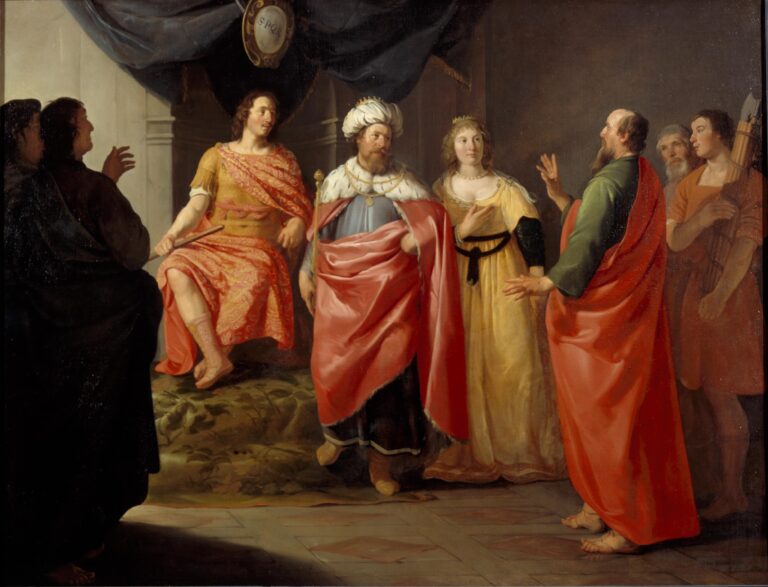
Gospel Reading: Mt 22:1-14
When God created us, he gave us the ability to reason, so that we could tell truth from falsehood and good from bad, says the Catechism of the Catholic Church. He gave us free will, so that we could “initiate and control” our own actions and seek our fulfillment “of our own accord.” Finally, He gave us a “natural desire for happiness,” so that He might draw us to himself.
Our happiness is what God wants, we hear in this Sunday’s Readings, but this is not quite the picture of God that most of us have. We tend to picture Satan as the one who offers happiness and God as the one who forbids it.
Here is how C.S. Lewis explains it. Suppose we take a dog on a leash past a post. The dog tries to go through on the wrong side and loops his leash round the post. We see that he cannot do it and therefore pull him back.
We pull him back because we want him to go forward. He wants to go forward, too, but for that very reason he fights us, or, out of obedience, yields reluctantly, as a matter of duty. He cannot see that yielding is the only way to get where he wants.

If the dog could understand, we would say to him, “What do you mean by your will? If you mean what you really want, namely to go forward, I understand your desire. Moreover, I share it; that is what I want for you, too.
“However, if you mean your desire to pull against the leash, then I can understand it, but I cannot share it, because it will not get you where you really want to be. In fact, the more I sympathize with your real wish, the less I can sympathize with your resistance to the leash.”
God not only understands, but also shares, our desire for fullness of life, complete and ecstatic happiness. We can trust our Master.
To sin is to take God’s pleasures in the wrong ways, or at the wrong times. When we are tempted, we must remember that he wants for us what we really want, and that because he made us, he knows the only way to get it.
That is why he is so ruthless toward sin. The more he loves us, the more he wants to pull us back from our way, which leads nowhere, into his way, which leads us where we want to go.
We must get rid of the idea, which surfaces in every temptation, that there is some delight apart from God which he arbitrarily forbids, but which would really delight us if only He would allow it.
The truth is that apart from God there is literally nothing. All pleasure, all happiness, come from Him. He knows what we want, even in our worst sins, and He longs to give it to us.
In the Gospel Reading, one of the guests accepted the invitation to the banquet, but did not put on a wedding robe. He is like Adam and Eve, who wanted the happiness God planned for them, but “without God, before God, and not in accordance with God,” as the Catechism says. The truth is that happiness cannot be had except as a gift from God.
However, most of the guests refused to go because they had something they thought more important. In the parable, it was a farm or a business, but it can also be a cause, a person, wealth, a possession, sex, alcohol, etc.
It makes no difference what it is: in rejecting God, we reject happiness. “God alone satisfies,” St. Thomas Aquinas said. “If the heavenly life, or the kingdom of God, is not grown up in you, it signifies nothing what you have chosen instead of it, or why you have chosen it,” said William Law.
Father Hawkswell is again teaching The Catholic Faith in Plain English, with new insights. The whole course is available in written form and, one session per week, in YouTube form at beholdvancouver.org/catholic-faith-course. Father is also teaching the course in person: on Sundays at 2:00 pm in the John Paul II Pastoral Centre, 4885 St John Paul II Way, Vancouver (33rd and Willow); and on Mondays at 10:00 am in St. Anthony’s Church hall, 2347 Inglewood Avenue, West Vancouver. The title of next week’s talk is “Prayer.” No pre-registration is necessary.
(Featured image: Unsplash photo)