

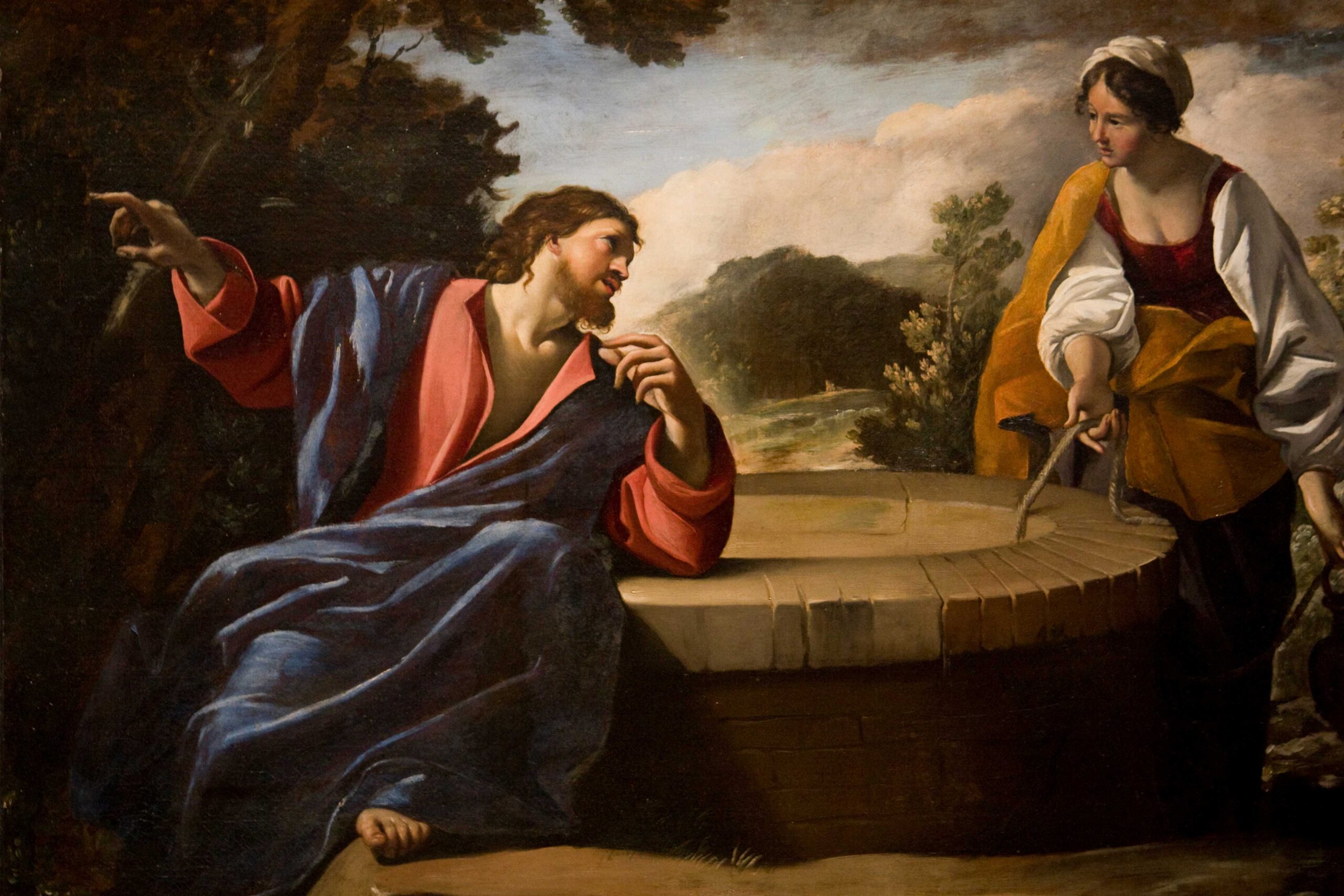

I have always appreciated the spiritual messages in the story of the Woman at the Well. Every time I read it, and every time I hear a homily or reflection on this Gospel, I receive new insights. While I have written about the story before, today I will expand on what I have learned about the sacraments from this woman and her conversion.
Water, representing physical life, has long been associated with the life-giving waters of baptism. In this part of the world, we are spoiled by plumbing systems. Clean water pours out of our taps, causing us to take this gift for granted. In Jesus’ time, and still in some parts of the world today, clean water is not readily available; it is conserved and valued as the essential, life-giving source that it is.
Since we do not always fully appreciate the gift of water, thinking of a woman needing to go to a well and fill water jugs for her household use and personal survival makes me pause. Water is life, and I don’t think of this reality enough. The waters of baptism are life as well. I dip my fingers into holy water and make the Sign of the Cross every time I enter a church, but do I truly think of the fact that, in doing so, I am recalling my baptism and the gift of life this sacrament provides?
Aside from the need to drink water and to use it to grow our produce, water is also used to clean. We need it to clean our food, our utensils, our bodies, and even our wounds, to preserve our physical health. The waters of baptism, likewise, wash away original sin, preserving our souls.
According to John’s Gospel, the woman who met Jesus at the well went at the hottest time of day. The well would have been a meeting place for the women of the community, who would visit early in the day to avoid the heat. This woman presumably went to the well at noon to avoid speaking to others and facing judgment for her sins. Jesus sought to change this; he knew her story and made sure to meet her at the well.
Bishop Robert Barron comments on the fact that noon was not only the hottest time of day but also the brightest, when one could see right to the bottom of the well. This highlights the fact that no matter how much we may try to conceal our guilt and our sins, God will always see right to the bottom of our wells.
Aware of her past, Jesus initiated a conversation with the woman regardless, asking her to give him a drink. Bishop Barron also highlights that even though she was at the well to “get” something, Jesus asked her to “give” something to him. He notes that St. Augustine claimed, “Jesus was thirsty for the woman’s faith.” Even more than we hunger and thirst for happiness, God hungers and thirsts for union with us.
Before the woman could receive the water “welling up with eternal life,” Jesus prompted her to admit her transgressions. This reality speaks to the importance of the sacrament of reconciliation. To receive eternal life, we must choose to honestly examine our consciences and return to God.
The Eucharist satisfies our hunger and thirst for Christ; however, we cannot partake in the Eucharistic feast unless we have confronted and confessed our faults and failings. We need the waters of eternal life to help us remove all barriers within ourselves. Only then can we enjoy the spiritual sustenance Jesus alone provides.
Finally, the woman at the well left her jar behind. No longer needing to carry the physical burden of the jar but holding life within her, the woman’s past became her testimony. She became a vessel, sharing her encounter, her faults, her reconciliation, and her new life in Jesus with everyone, just as we who are baptized and confirmed are called to do. We must bear witness to our faith, allowing the living waters within us to spill into the world.
As Bishop Barron stated, “Evangelization is to … tell the starving people where to find bread” and “tell people dying of thirst where to find water.” Let us all answer the call of baptism to reconcile with God, to be nourished on Word and sacrament, and to share our testimonies by evangelizing the starving and thirsting world around us.
Your voice matters! Join the conversation by submitting a Letter to the Editor here.







