
This story about the history of Canadian Catholic News first appeared in The Sept. 14, 2009, B.C. Catholic.
Before 1984, Catholic papers in Canada relied on mail to share news
By Deborah Gyapong
OTTAWA (CCN)
The Canadian Conference of Catholic Bishops began attempting to get Catholic newspapers, both French and English, to co-operate and share stories back in the 1970s.
The CCCB even sponsored a couple of meetings, recalls Bede Hubbard, associate general secretary of the CCCB, who attended one when he was editor of the Prairie Messenger in Saskatchewan.
The idea for a Canadian Catholic News (CCN) fizzled out until in the early 1980s, when it caught the attention of Father Andrew Britz, a Benedictine priest who edited the Prairie Messenger.
His vision and the practical strategy of Eric Durocher, editor of Montreal’s Catholic Times, led to the conception of Canadian Catholic News 25 years ago. The 1984 visit of Pope John Paul II provided the impetus.
Father Britz wanted to see Catholic papers across the country working together to fill a vacuum in national Canadian coverage.
“We were news-deprived when it came to information about the Church in Canada,” said Durocher. “The only consistent source of national information was the weekly mailings we received from the Canadian Conference of Catholic Bishops.”
“It wasn’t that easy to do,” said Father Britz. “There wasn’t a great deal of enthusiasm in the beginning for the notion. People were afraid they would lose their uniqueness.”
Co-operation was essential for addressing the “information gap,” Durocher said, but it was “easier said than done” in a country that values regional distinctiveness, considering the diverse pastoral approaches of the Church across the country.
One of the big problems was getting the two Toronto papers involved. Initially the Register and the Catholic New Times were cool to the idea of a news co-operative. “I think they thought they were the centre of the Church in Canada, and they didn’t need all this fancy stuff, we in the hinterlands needed it; but they quickly changed their minds,” Father Britz said.
The differences went deeper. The Catholic Register under former CBC national news broadcaster Larry Henderson had become a leading prolife voice, while the now defunct Catholic New Times, founded by Sister Mary Jo Leddy and Father Gregory Baum, had a more left-wing, social justice focus.
The other big problem was technical. Back in the early 1980s there were no fax machines, no accessible Internet and e-mail, no easy electronic means of easily sharing news copy, let alone photographs. The editors then relied on Canada Post’s “snail mail” or couriers.
Glen Argan, editor of the Western Catholic Reporter in Edmonton, said the papers would receive their packages of Catholic news coverage from the United States and Rome “a week after the news came out.”
Then came Pope John Paul II’s first visit to Canada.
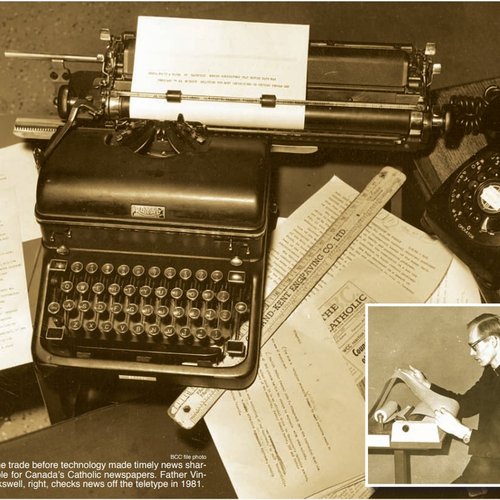
“The papal visit really made it possible to set up Canadian Catholic News,” Father Britz said. “People knew they wanted to cover the story of the Pope’s visit, but they couldn’t have someone in Halifax as well as someone in Vancouver.”
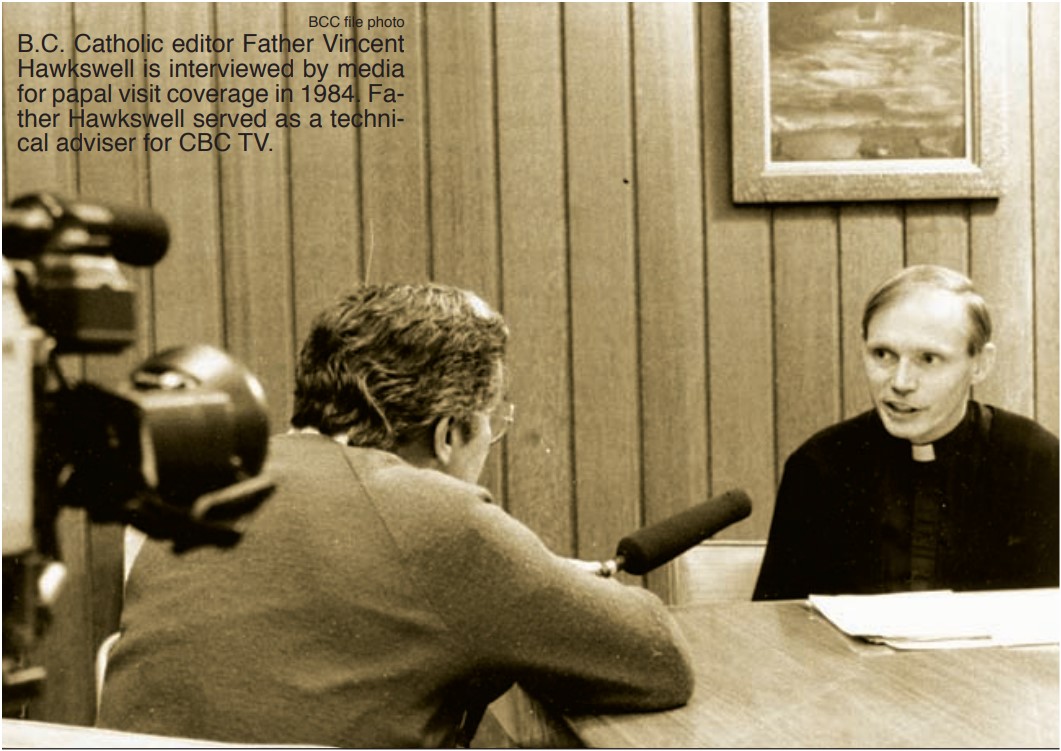
The first formal meeting of Catholic editors or representatives took place in Toronto in May 1984, a few months before the Pope’s September visit. It included the Prairie Messenger’s Father Britz, The B.C. Catholic editor Father Vincent Hawskwell, The Montreal Catholic Times’s Durocher, The Catholic New Times’s Lauretta Santarosa, The Catholic Register’s Henderson, and the Western Catholic Reporter’s Argan. They agreed to share copy and photographs of the visit.
“I can’t say that was a great success, but it did get us talking to each other and got us co-operating,” Argan said.
“To set up the news co-operative we needed a common editorial approach, an affordable service, and the technical means,” Durocher said. “It was definitely an uphill battle trying to get enough editors on board, raising the funds, creating a structure that suited all parties, and getting papers to purchase the necessary technology.”
The next four years were a period of gestation. Catholic editors started holding ad hoc meetings in conjunction with the Canadian Church Press convention, looking for ways to move the process forward.
At the 1987 meeting Father Hawkswell surprised everyone, according to Durocher, when “he spontaneously pulled a crisp $100 bill (more like $500 today) out of his wallet and ceremoniously presented it to Bonnie Brennan, the bishops’ communications officer, as an incentive to computerize her office.”
“Sometimes you need a bit of seed money,” Father Hawkswell said. He spent 16 years at The B.C. Catholic, where, under his leadership, the paper evolved from employees doing their own typesetting and his developing black-and-white film in a darkroom to preparing the first colour edition without outside help.
CCN’s official birth took place at a Toronto meeting on May 26, 1988, when six regional newspapers: The B.C. Catholic; Western Catholic Reporter; Prairie Messenger; Catholic New Times, now edited by Frances Ryan; the Catholic Register, now led by Father Sean O’Sullivan; and Catholic Times Montreal formed a co-operative and made Father Britz and Durocher co-chairmen. New Brunswick’s New Freeman joined soon afterwards. The CCCB’s Brennan was there as an observer, as were some smaller associate member papers.
Durocher said he and Father Britz “both believed passionately in the project, knowing that readers who are more informed would likely contribute more to the life of the Church in Canada and in the world.”
“Father Andrew had the ear of prominent Church leaders and pushed the project forward,” Durocher said. “I waded through the various concerns that had been expressed and developed an affordable, pragmatic co-operative structure.”
Among CCN supporters was Toronto Cardinal Gerald Emmett Carter, who wrote Father Britz a letter telling him to let him know if the Register’s O’Sullivan refused to co-operate.
Father O’Sullivan had become famous in 1972 when at age 20 he became the youngest MP to win a seat in the House of Commons. He served five years as a Progressive Conservative MP in the Diefenbaker government, then left politics in 1977 to became a Catholic priest. He became the vocations director of the Toronto archdiocese, then publisher of the Register. He had already been diagnosed with leukemia in 1983, so his role in the development of CCN was “peripheral,” Father Britz said.
However his winning personality and support did help. “The Register has a prominence among the Catholic papers in the country, and to have him put the Register behind this idea was very important,” Father Britz said.
CCN developed a three-phase plan: create the news-sharing network, establish an Ottawa bureau in the Parliamentary Press Gallery, and offer a paid news service to subscribers.
By 1988 information technology had evolved, making electronic messaging more affordable. That meant a switch from manual typewriters to computers. Three of the initial seven members had to spend between $7,000 and $10,000 investing in computers. “For those operating on shoestring budgets, it required a leap of faith,” Durocher said.
Father Britz said the Prairie Messenger “bit the bullet” and bought a version of a Macintosh computer that he said Apple wrote off six months later as “an Edsel.” A tiny iPod can do more, he joked.
On Nov. 1, 1988, CCN took its first steps in electronic story-sharing, using Telecom Canada’s Envoy messaging system, available through iNET 2000.
The system had bugs and formatting problems. Argan said someone had to retype the stories on both the sending and receiving ends. However the benefits of receiving timely news from across Canada was “an instant hit” with the editors, Durocher said. “Canadian Catholics started meeting each other through the pages of their regional publications.”
CCN set its sights on phase two: an Ottawa correspondent.
Until then, Father Britz had been making the trip from Saskatchewan to cover the annual CCCB conference for the network. He recalled being in Ottawa one year for the yearly gathering of bishops across Canada and Cardinal Carter j-walked across the street in front of the Parliament Buildings to say hello to him, not because he admired the priest but because of Father Britz’s position with CCN, something the cardinal saw “was really something very important.”
Father Britz said the bishops were behind the idea from the beginning.
It took about four years to get the Ottawa bureau in place. Father Britz and Durocher asked Art Babych if he wanted to go to Ottawa to set one up on trial. Babych, who had edited the Prairie Messenger from 1989-1992, had recently quit his job out of restlessness. He leapt at the offer.
“It sounded pretty exciting to me,” Babych said, so he set out in an old car with his TV and got an apartment near Parliament Hill. He became the first religious journalist to get a Parliamentary Press Gallery membership.
Babych said reaction to the Ottawa bureau’s contribution was “pretty enthusiastic.”
The Ottawa bureau was another leap of faith, since the co-operative had raised only $25,000. The Catholic Register, under a new editor, had dropped out rather than contribute.
Argan, who had returned to the Western Catholic Reporter as editor for a second time in 1991, said committing to supporting the Ottawa bureau with a $3-4,000 contribution was “a real stretch.”
“We didn’t have any money for anything,” he said, but the commitment has “paid off in spades.”
“It’s been an enormous boon to providing Canadian coverage for our readers.”
Before Babych began covering Parliament Hill and the CCCB, each editor had had to find his own way to cover national stories. “We did it because we had to do it,” said Argan. “My goodness, it was inefficient.”
Having the national stories covered means the papers are able to provide better local coverage, he said.
Soon Babych also began supplying photographs to the network.
“Having timely reporting from the Hill, the CCCB, and the Ottawa-based national organizations and coalitions certainly raised the profile, expectations, and possibilities for CCN,” said Durocher.
The Ottawa bureau’s success contributed to the negotiation of a news service contract with Catholic News Service (CNS) in Washington, D.C. Durocher co-ordinated this three-year project, which started with a formal meeting in 1994 and concluded negotiations in 1997.
“This launched CCN into its third phase: offering a subscriber service, which is where future funding lies,” Durocher said.
After the creation of the Ottawa Bureau, the Catholic Register rejoined CCN when Bernard Daly became editor and publisher in 1993.
Daly, who worked for the Canadian Conference of Catholic Bishops for 35 years and reported for them on the Second Vatican Council, was succeeded by Joe Sinasac in 1996. “He became a major contributor [to CCN] of news coverage as well as the nuts and bolts of things,” said Argan.
Sinasac, who became CCN co-chairman in 1996, inherited the role of sending the CCCB reports for the grant they had provided to CCN since 1992. The bishops originally provided a $5,000 yearly grant that has since grown to $7,500.
Sinasac also worked to expand the service to include a number of diocesan papers and its first Protestant subscriber, B.C. Christian News. It added Salt and Light Television and the Quebec-based French-language magazine Le Nic.
Babych served 12 years in Ottawa, leaving in 2004, when CCN hired former CBC television producer Deborah Gyapong.
That year CCN also switched from using e-mail to share stories and photos to an internal website with a searchable online database. This was spearheaded by Paul Schratz, editor of The B.C. Catholic.
Schratz, who now serves as Western co-chairman of CCN, joined The B.C. Catholic in 1997 and attended his first CCN meeting in the spring of 1998.
“I was immediately impressed with the scope of what they were trying to achieve,” Schratz said. “Over the years we’ve grown in bits and pieces. I don’t think we’ve ever managed to fully take advantage of the potential that CCN offers.”
Sinasac, who left the network in 2008 to become publishing director of Novalis’s English-language division, said the network has become increasingly aware of the timeliness of its articles and the need for Catholic readers to be part of the public debate. “We are now much more responsive to issues than we were a decade ago.”
“I think the quality of our newspapers is light years away from where it was in the early ‘80s and ‘90s,” said Argan. “We’ve just improved in so many ways, and CCN has been a big part of that.”
What does the future hold for CCN?
“Catholic newspapers, if they’re smart about how they do their jobs, have a good strong niche that could serve them well even in a period when the traditional general daily newspaper seems to be dying,” said Sinasac. He stressed the importance of professional journalistic standards, staying on top of the news, and embracing new technology.
“Catholic newspapers have a very strong identity,” Sinasac said. “If they focus on that identity and the readership that is out there, there is a readership for news of the world from a clear Catholic perspective.”
Schratz agrees. “There is a thirst for that. People want to know about the Church; they want to know about their faith in a world that is not addressing that, and they want to know about their community.”
Schratz sees a symbiotic relationship between print and the Internet or World Wide Web.
“We have to be making use of print to take people to the web and offer them things there that are not available in the newspaper,” he said. “Conversely, we have to be using the web to remind people about the publications.”
Schratz said improving the CCN website is the next focus. He would like to see it modelled after the CNS site www.catholicnews.com, available to the public as well as to member papers. A spiffier site might also link the separate websites many of the Canadian papers now offer.
“We really are a diverse group of publications, national to regional to local, with different mandates,” he said.
Schratz now shares co-chairing duties with Jim O’Leary, the new Catholic Register publisher and editor, who helped pioneer Sun Media’s Canoe electronic news portal. He brings a wealth of print and electronic journalism experience to the position.
CCN has helped the papers develop not only their professionalism but their independence, Father Britz said.
“Vatican II stressed very much that the newspapers were not to be Sunday bulletins, that they were to be bona fide newspapers that were ready to throw stones at glass houses,” he said. “CCN gives the papers the added strength to resist this notion of making the papers in praise of the institution.”
He raised concerns that some in Church leadership might want to see a “cooling it with stories that are a little critical of the institution.”
Argan, who has worked under three different Archbishops, said the Canadian bishops who have newspapers “respect the journalistic integrity of those newspapers.”
Father Britz admits that Canadian Catholic journalists are better off than those in other countries. He said he has friends in the United States who say it’s getting really tough.
Your voice matters! Join the conversation by submitting a Letter to the Editor here.