
As a series of controversial federal bills moves forward — from online regulation to hate speech law — so too are efforts to push back against them. But it is one measure in particular, the planned expansion of medical assistance in dying (MAiD) to include mental illness, where opposition has become increasingly organized.
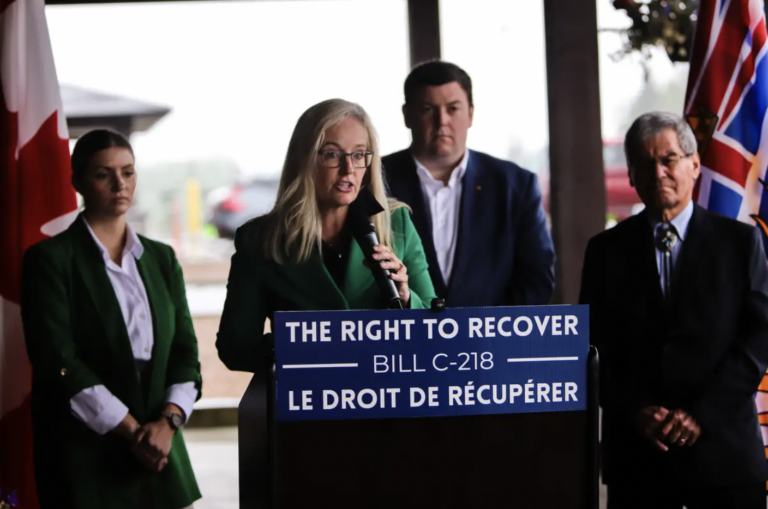
Cloverdale—Langley City MP Tamara Jansen is leading the effort with Bill C-218, the Right to Recover Act, which would prohibit MAiD where mental illness is the sole underlying condition.
With the federal expansion scheduled for March 17, 2027, Jansen warns that Canada is approaching “a line that should never be crossed” and is urging Parliament to act before the change takes effect.
Academics are set to begin testifying Tuesday before the Special Joint Committee on Medical Assistance in Dying, the parliamentary body reviewing Canada’s planned expansion of MAiD to individuals with mental illness.
Across the country, church leaders, advocacy groups, and medical professionals are reinforcing that push. The Archdiocese of Toronto’s Help Not Harm campaign is encouraging Catholics to contact their MPs in support of Bill C-218. Neil MacCarthy, the Archdiocese’s director of public relations and communications, appreciates how Canadian dioceses are amplifying this endeavour by prominently displaying the campaign on their websites.
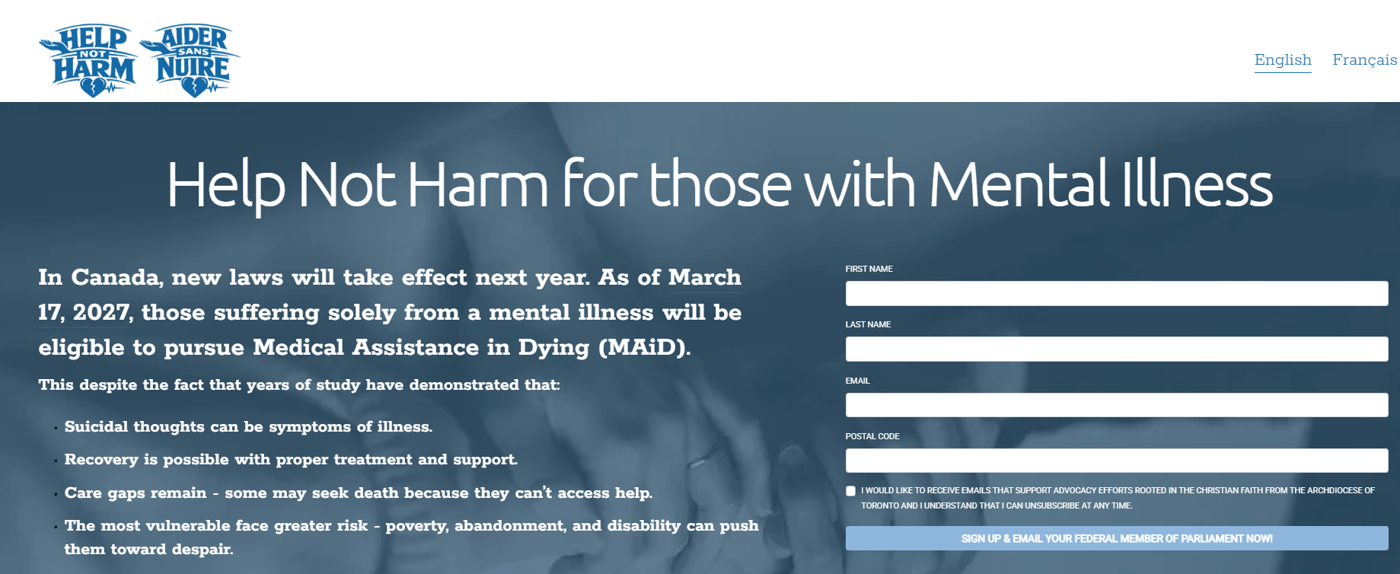
“We welcome the visible solidarity shown by dioceses across Canada in support of the Help Not Harm campaign,” wrote MacCarthy. “This shared witness reflects a common concern for the dignity of every person, especially those who are most vulnerable.”
Nicole Scheidl, executive director of Canadian Physicians for Life, said the proposed expansion raises fundamental concerns about assessing mental illness.
“Most psychiatrists across the country are very much against this because someone who has a mental illness and has suicidality in their mental illness, how do you tease apart what’s part of the illness and what is a rational decision? It’s impossible,” she said.
Alex Schadenberg, executive director of the Euthanasia Prevention Coalition, said the timing is critical as the scheduled expansion draws near, noting that Bill C-218 will be coming to a vote fairly soon and that “there are many members of the government in the Toronto region.”
Meanwhile, Alberta recently introduced legislation that would bar such cases provincially and strengthen protections for health-care providers who refuse to participate. Bill 18, the Safeguards for Last Resort Termination of Life Act, introduced March 18, would prohibit assisted suicide for individuals with a mental illness as their sole underlying condition, bar minors and those without decision-making capacity, and prevent advance requests. Significantly, the Alberta bill also seeks to ban provincial implementation of Track 2 MAiD — offering euthanasia to individuals whose natural death is not reasonably foreseeable.
“This legislation strengthens safeguards and restores clear limits on eligibility to protect vulnerable Albertans facing mental illness or living with disabilities,” said Premier Danielle Smith. “Those struggling with severe mental health challenges need treatment, compassion and support, not a path to end their life at what may be their lowest moment.”
While the response to MAiD expansion has taken on a coordinated character, other federal legislation has also drawn significant concern.
Bill C-9, the Combatting Hate Act, has advanced to the Senate after the House of Commons adopted it with a 186-137 vote at third reading on March 25.
The legislation would criminalize intimidation and obstruction outside of establishments used by faith-based groups and ban the intentional display of certain hate or terrorist symbols in public.
However, these principal components have been overshadowed since early December when it became public knowledge that Liberal MPs on the justice committee intended to approve an amendment to repeal paragraphs 3(b) and 3.1(b) from Section 319 of the Criminal Code, safeguards that have stood since 1970.
The clauses declare that no one should be convicted of an offence if, in good faith, the person expressed an opinion on a religious subject or an opinion based on a belief in a religious text.
An attempt to pacify concerns came in the form of a “for greater certainty” clause, but Conservative MP Andrew Lawton critiqued this for containing “circular reasoning.” Catholic Civil Rights League president Phil Horgan concurred that protections are still not communicated unambiguously. Horgan suggested the door remains open to “the possibility of a charge if the Crown is of the view that a discussion of certain religious texts is not in the public interest, and in the absence of the good faith religious defence, a pastor or faith leader would be at the peril of a charge.”
Bishop Pierre Goudreault, president of the Canadian Conference of Catholic Bishops, warned the removal of the defence “raises significant concerns” and could have a “chilling effect on religious expression,” even if prosecutions remain unlikely in practice.
Cardinal Frank Leo of Toronto cautioned that the change “risks creating uncertainty for clergy, educators, and all people of faith who seek to pass on the teachings of the Church.”
These concerns come as similar legislation is being proposed in British Columbia, where Premier David Eby announced Bill 12 and Bill 13 to establish perimeters limiting certain activities near schools and places of worship.
Concerns about the balance between liberty and state authority extend beyond speech to a series of digital policy bills introduced in the 11 months since the 2025 federal election.
Bill C-2, the Strong Borders Act, drew significant backlash over provisions that would have granted police and intelligence agencies warrantless access to basic subscriber information and allowed secret surveillance orders. While public response stalled the bill, elements have resurfaced in subsequent legislation.
Bill C-8, “An Act respecting cyber security,” initially raised concerns for allowing government to direct telecommunications providers to suspend service to individuals deemed a risk, without judicial oversight. Amendments have since restored judge authorization and narrowed definitions to focus on technical interference.
Peter Menzies, a former vice chairman of the Canadian Radio-television and Telecommunications Commission, said the broader trend reflects a shift in how government approaches regulation.
“Societies depend on a good balance between liberty and order,” said Menzies. “But I think they tend to infringe on liberty more than is perhaps necessary.”
He added that any weakening of civil liberties can have consequences for religious expression, a topic that historically makes regulators “institutionally nervous.”
The trend culminated on March 12 with the tabling of Bill C-22, the “Act respecting lawful access,” which would require providers to retain user metadata for up to one year.
Michael Geist, Canada Research Chair in Internet and E-Commerce Law at the University of Ottawa, described the proposal as “one of the most privacy-invasive tools a government can deploy.”
Geist warned that such mandatory retention requires providers to store information about the communications of all users, regardless of whether those users are suspected of anything.
Four bills expanding power — and one pushing back
Bill C-9 – Combatting Hate Act
Passed by the House of Commons and now before the Senate, this bill would expand hate speech provisions, including criminalizing certain public expressions and conduct. A key controversy is the removal of the long-standing “good faith” defence protecting religious expression grounded in sincerely held beliefs.
Bill C-2 – Strong Borders Act
Introduced in 2025 but stalled after public backlash, the bill proposed granting police and intelligence agencies warrantless access to basic subscriber information and enabling secret surveillance orders, with restrictions on companies disclosing such access to users.
Bill C-8 – Cyber Security Act
Would allow the federal government to order telecommunications providers to suspend or restrict services to individuals deemed a threat to the system. Amendments restored judicial oversight and narrowed definitions, but concerns remain about scope and future regulatory powers.
Bill C-22 – Lawful Access Act
Proposes mandatory retention of user metadata by telecommunications and digital service providers for up to one year, raising concerns about broad, suspicionless data collection and privacy risks.
Bill C-218 – Right to Recover Act
MP Tamara Jansen’s private member’s bill that would prohibit medical assistance in dying (MAiD) where mental illness is the sole underlying condition. It is being actively promoted by pro-life advocates and church-led campaigns such as Toronto’s “Help Not Harm.”
Based on Catholic Register reporting by Quinton Amundson with B.C. Catholic files.