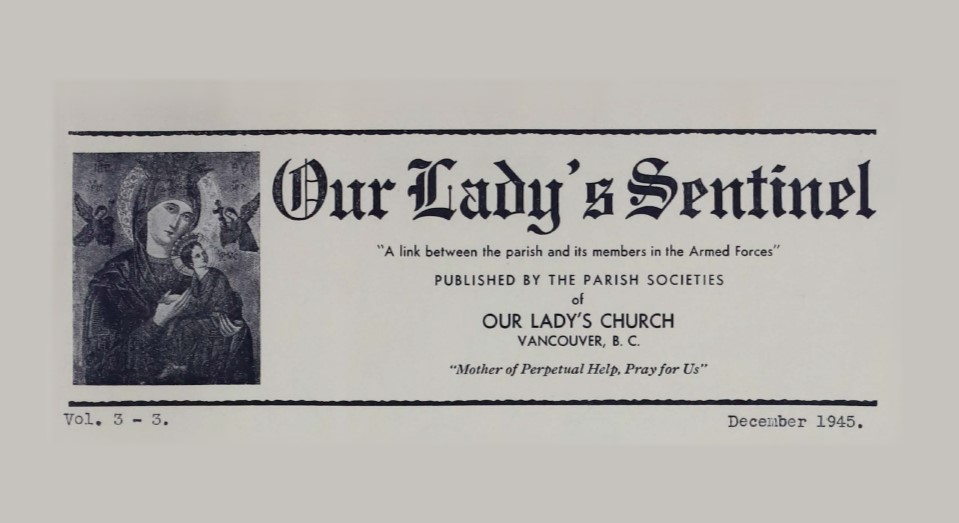

The first edition of Our Lady’s Sentinel reached its readers in September 1943 just as the Allied invasion of Italy was commencing, and the Soviets were pushing ever deeper into Ukraine. On the first page, there is an editor’s note which reads:
“This little effort is to let you know that you are in our thoughts and prayers daily. We hope that you will find it interesting as it brings you each month a glimpse of [Our Lady of Perpetual Hope].”
That “little effort” lasted twenty-seven months, and the publication only stopped when the war had been won and the men were on their way home. All twenty-seven issues can now be found in the digitized print collection of archives of the Archdiocese of Vancouver.
Our Lady’s Sentinel was the brainchild of Jim O’Loane and his pastor, Redemptorist Father James Farrell, C.Ss.R., who, in August 1943, decided the enlisted men from Our Lady of Perpetual Hope in Vancouver needed something to keep their spirits up. Additionally, their mothers were worried, and everyone was anxious for news about their whereabouts and safety.
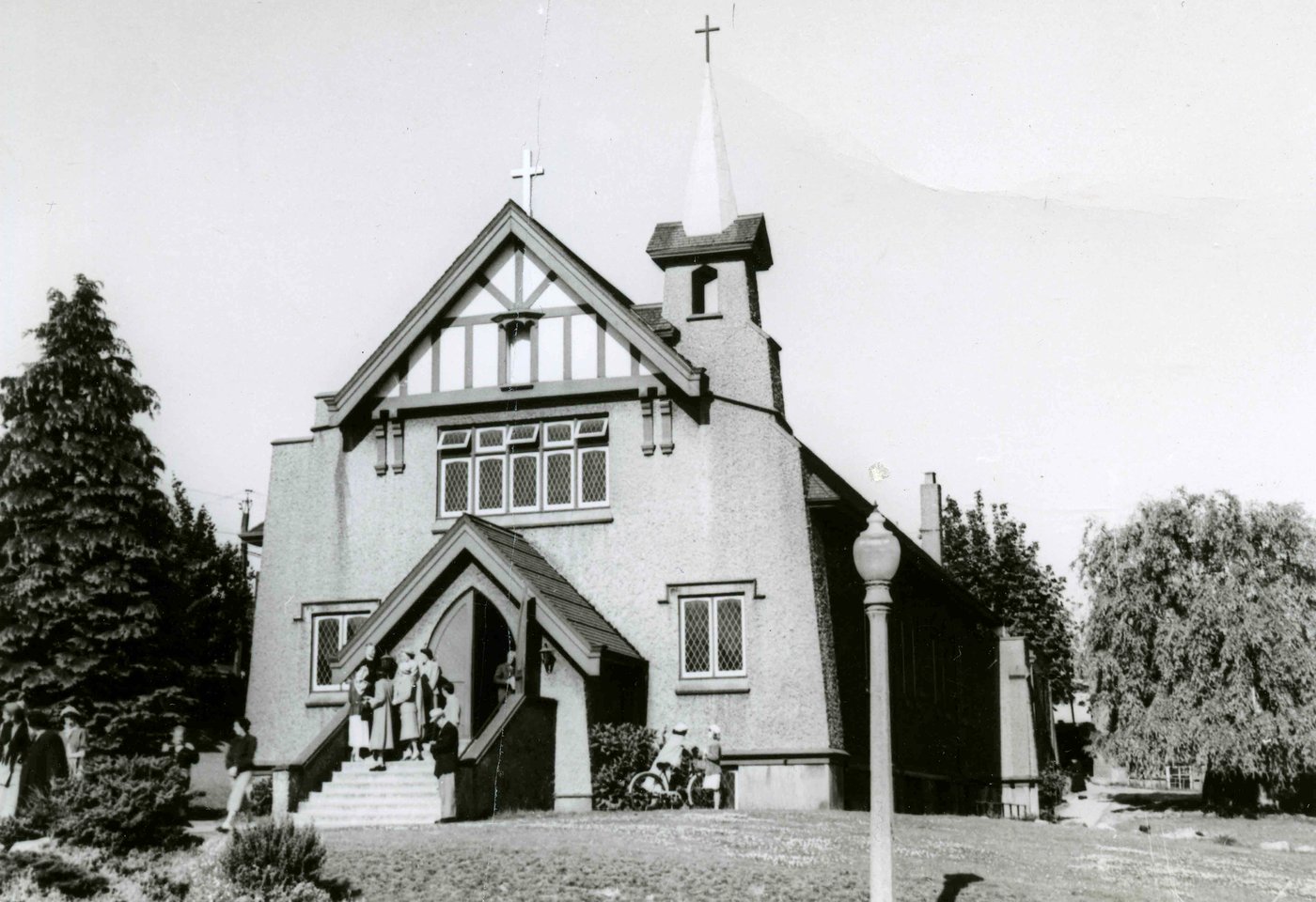
“Every mother was comparing with every other mother about what was going on, and where their sons were,” O’Loane’s daughter, Patricia Lambin, told The B.C. Catholic. Rather than having them confer amongst themselves, “he thought they should just contact him,” she said. “My dad took that on as a real project for the parish.”
With that, their family house became a news office, with the network of parish women serving in place of dedicated reporters. Phone calls and ringing doorbells would announce the arrival of more news: “so-and-so was stationed here; so-and-so is being deployed over there.” Mothers talking to mothers fed the paper a steady stream of intel which would be the envy of any wartime intelligence agency.
Lambin, nearly ninety-nine, remembers working on the paper—at fourteen years old, she and the other girls from the parish would crowd into their basement ping-pong room to help cut the latest issue.
Father Farrell was the driving force behind the paper. “I remember from the time I was about 13, he was gathering news,” Lambin said. “He almost camped at our house!”
Lambin remembers how he used to care for the young women of the parish. “With the young women left behind, he was either comforting them or taking them roller-skating to get them some entertainment,” she said.
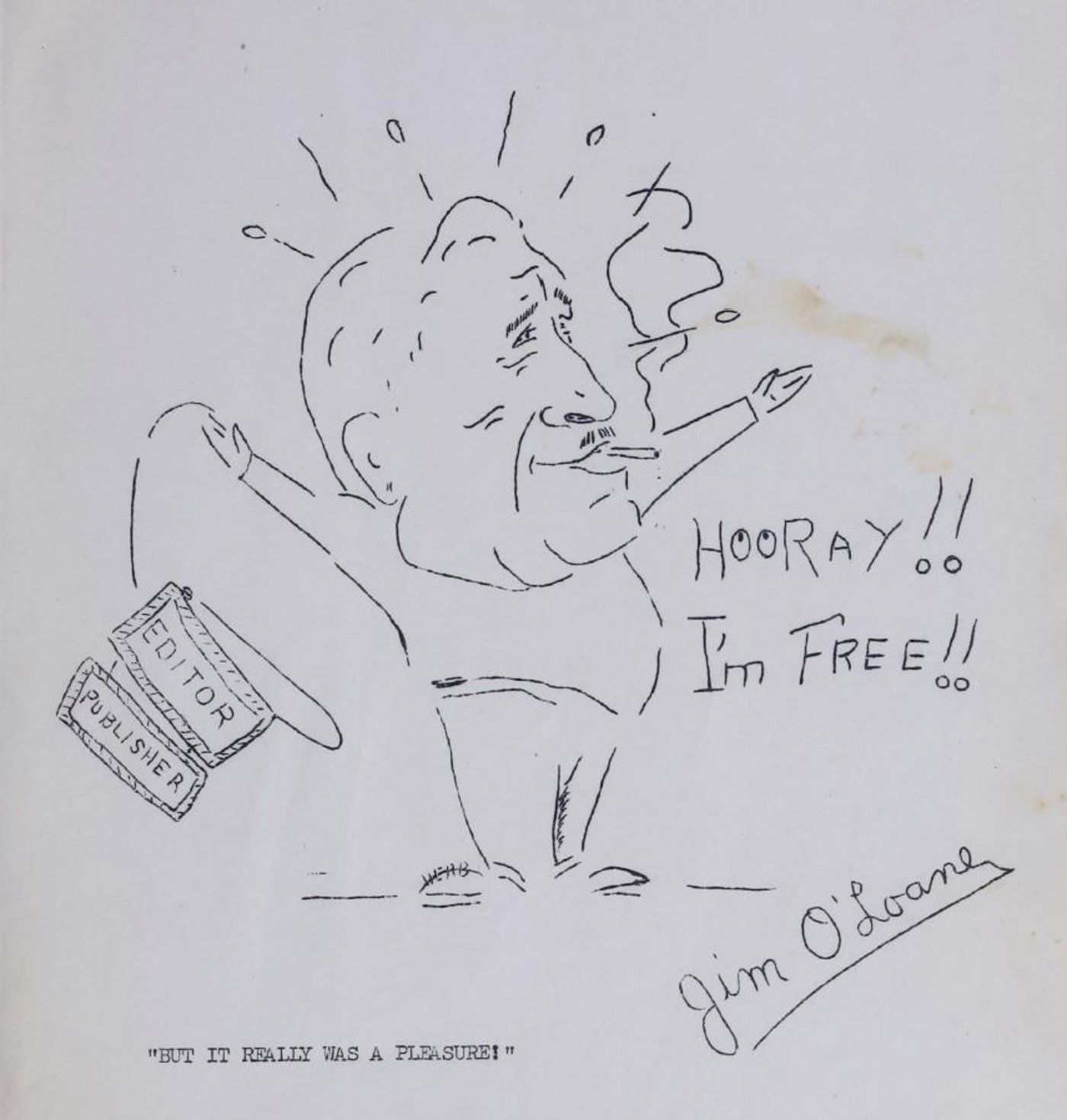
In his final editor’s letter, published December 1945, O’Loane pays homage to the energetic priest: “To Father Farrell,” he writes, “that tower of strength, without whose willing and able assistance at all times, the Sentinel would never have flourished as it did.”
“Father has worked in all departments,” he notes, “from writing those words of cheer… to running off stencils, assembling the pages, stapling, folding, filling envelopes, stamping and finally lugging the mailbag to the P.O. He has done them all.”
The Sentinel was a resounding success. “They loved it,” said Lambin. “Not only did the parents love it, but all the people overseas—they would get together when they were on leave, and they could connect with each other.”
The paper was published by the Holy Name Society of Our Lady’s Parish and was largely financed through donations. For enlisted men, it was free, with a copy being sent to their regiment or camp, as well as to their home address.
After the war, the veterans got together and had two large hard-bound volumes made for O’Loane in thanks for his dedication and hard work.
Lambin, still a parishioner of Our Lady of Perpetual Help, had kept the bound anthologies for decades, but despite her best efforts to find them a home, no one wanted them.
“I had them for many years and I didn’t know what to do with them,” she said. “That was the war, it was almost like we just wanted to forget about it.”
In the end, Lambin contacted the archives at the Archdiocese of Vancouver, where the volumes found a home. The entire twenty-seven-month run of the Sentinel has been digitized and is now available for public access.
The paper launched in September 1943, and the first edition included the locations of some of the enlisted men, a paragraph of surprisingly raunchy jokes, and a message from their pastor, Redemptorist Father James Farrell, C.Ss.R.

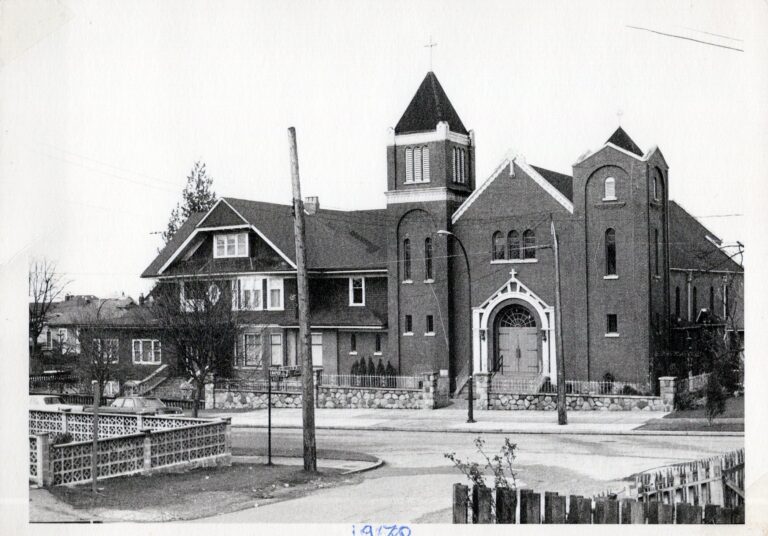
“Don’t forget your true Alma Mater,” Father Farrell wrote to his scattered flock, “that dear little church up at Crown and Tenth where vigil lights are burning and faithful hearts are praying for Our Lady’s boys and girls wearing the glory of the Maple Leaf.”
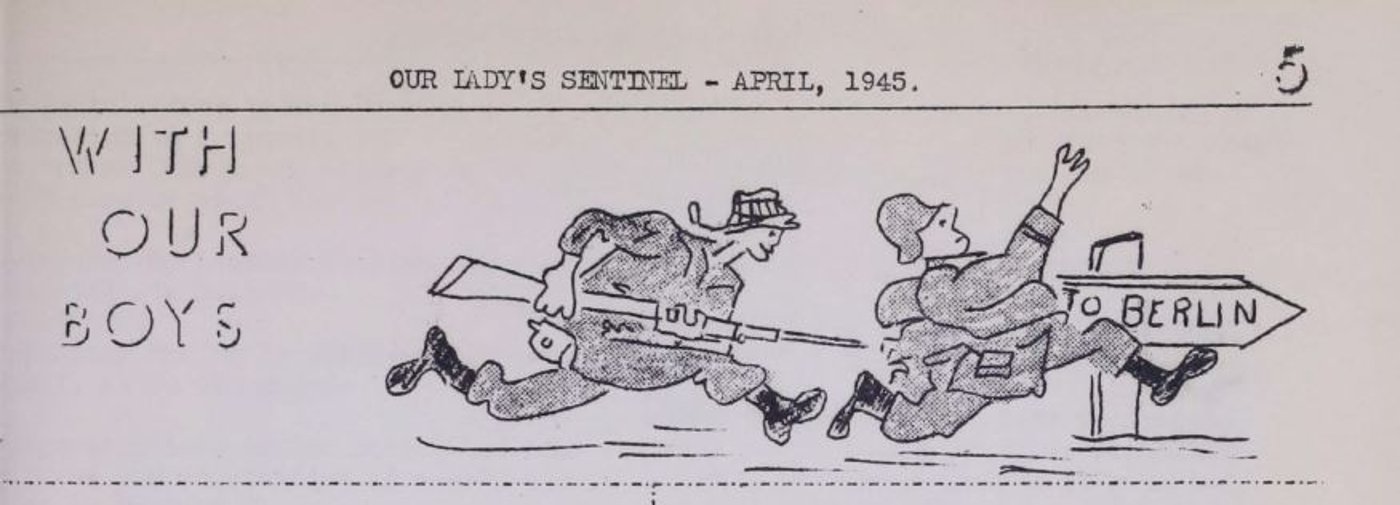
Within a few months, a steady stream of comic sketches, poetry and articles swelled the paper to the 20 pages of its final issue. All the way through to the end of the war, the Sentinel offered its readers, both at home and abroad, a way to stay connected. It published letters and articles written from the field, and let the boys know how things were going back home.
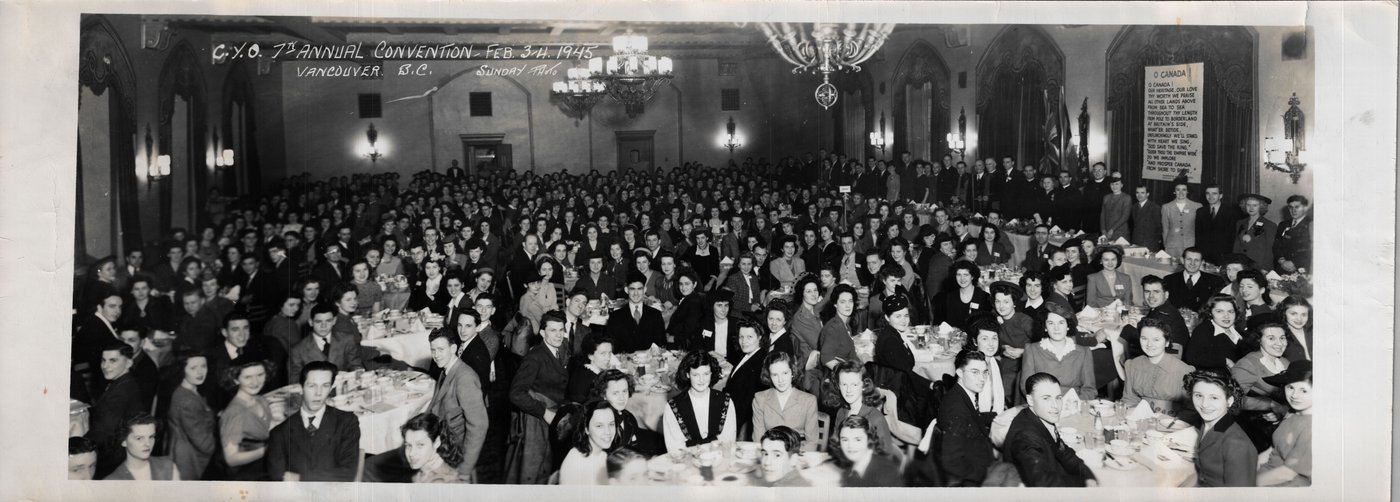
The Catholic Youth Organization was responsible for much of the content and helped with circulation. Within months, their local sports recap and event round-ups were a staple of the Sentinel’s character. Margaret O’Loane and Margaret (Woods) McLaughlin are credited with most of this work.
The paper eventually grew to include regular columns like Once Over Lightly, a sports column by B.C. Sports Hall of Famer Bill Cunningham, and a regular jokes section called Just For Fun.
Crucially, the paper helped connect the men overseas. Every month would contain one or two pages of the latest information about where parishioners were stationed, easing concerns at home, and providing the men the information they needed to find each other while on leave. Letters from the enlisted men consistently report how this helped them meet up with other members of the parish, even in England, France and Italy.
Marriages were always noted with enthusiasm. Every month, upwards of half a dozen couples, depending on the season, were highlighted, with details on their wedding parties and the honeymoon plans.
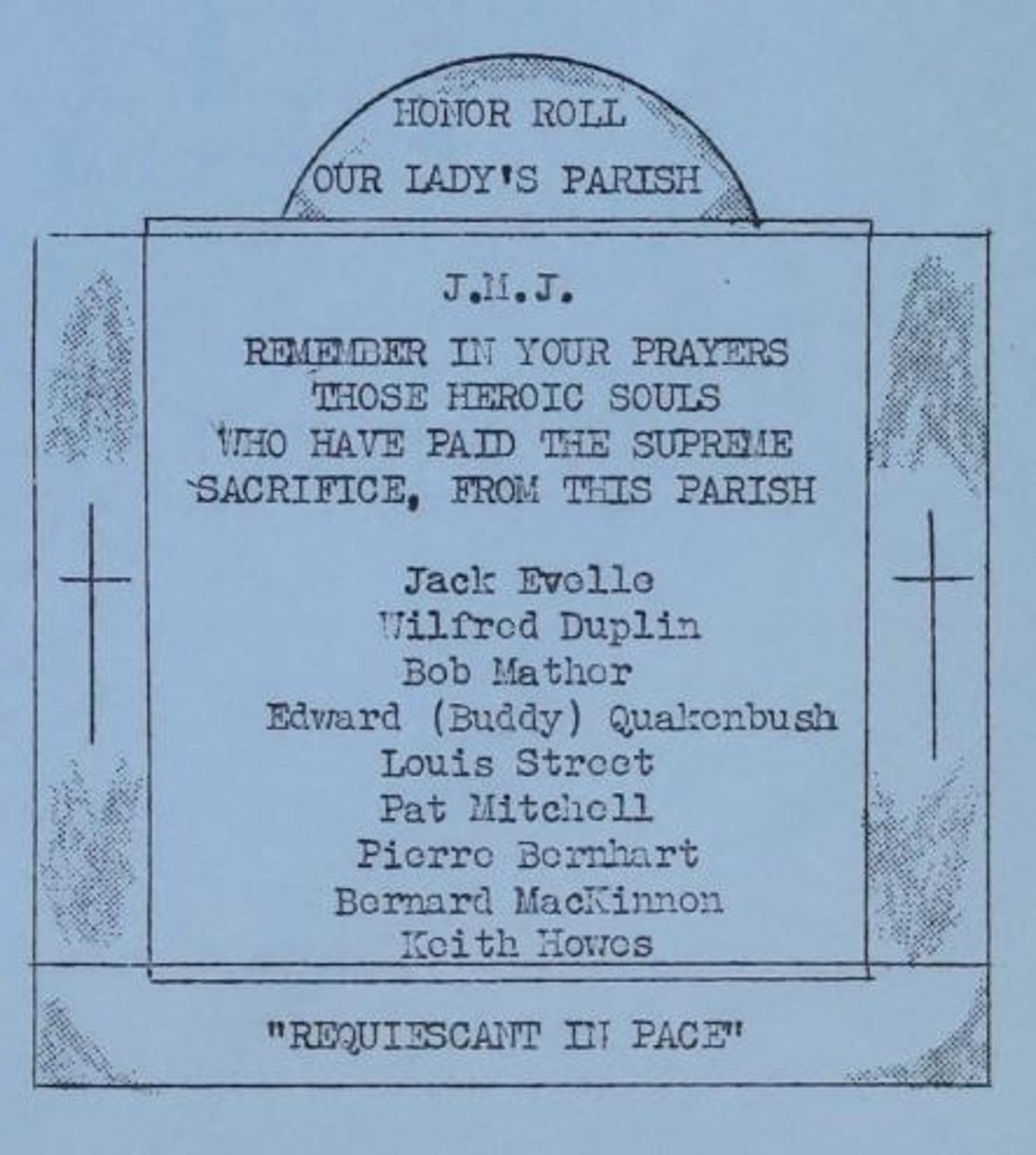
As the old adage goes, war is hell, and despite the paper’s upbeat, often joking tone, it’s running “Honor Roll” listing the parish fallen is a reminder, all these years later, of the horrors of war.
One month, Louis Street (a regular contributor of international news) is heading off to Rome, or buying a $10 pig off an Italian farmer to roast over hot coals, the next, a notice reads: “Our friend Louis Street has died of wounds received in the fighting in Italy… The parish joins in extending condolences to his family.”
Louis was the parish’s fifth casualty. It would lose nine young men by the time peace broke out—six of those during the Sentinel’s publication run.
In the final edition, nearly one hundred men are listed in the acknowledgment of service, which included notes about where they would settle and what their plans were for civilian life.
“From the Rectory,” was Father Farrell’s monthly letter to the community, in which he offered spiritual wisdom and practical appeals.
One touching moment sees him asking enlisted men to send their mothers’ sacrament cards. “Several of your mothers have been quite tickled to receive those little cards signed by your Chaplain, saying you had received the sacraments on such and such a date,” he wrote to the troops in November 1943. “I hope more of you will be sending them along and often.”
“I know that a fellow would just as soon keep his spiritual efforts to himself but this is too great a source of comfort and consolation to your mother to let go by,” he writes. “Why not send her a few in her Christmas letter???”
The scope of historical moments documented by the paper is remarkable. For example, in the February 1944 issue of the paper, it’s noted that Sgt. Ted Earkins, “brother of Pat and Jimmy,” was in Teheran as a member of the Guard of Honour that escorted the Stalingrad Sword presented by Prime Minister Churchill to then Marshal Stalin. Sgt. Earkins apparently spoke with Churchill and advised him on camp food; it improved the next day.
Heroics never went unreported. “Phil LaBelle was piloting a Halifax bomber over the Ruhr Valley recently,” remarks the paper, “when they were attacked by Germain fighter.” They fought him off, the story notes, but not without sustaining significant damage. Then they “ran into a thunderstorm at 13, 000 feet which turned the plane upside down but he managed to level off at 1,000 feet. The storm had damaged the plane—no radio reception, etc… and the crew were ordered to bail out. Phil stuck with the plane and somehow managed to land it at a strange airport in England. He has been promoted to Flight Officer… CONGRATULATIONS PHIL.”
The paper is full of such moments in which Our Lady of Perpetual Help parishioners were part of momentous occasions.
The Sentinel even reached the desk of The B.C. Catholic, which offered best wishes to the troops, and [our advertising man will be proud to know] an advertisement to parents to subscribe their deployed sons and daughters to The B.C. Catholic for $2 a year.
While these old issues of the Sentinel will undoubtedly contain meaning for the parishioners of Our Lady of Perpetual Help, and even the surrounding parishes (St. Augustine’s parishioners featured heavily), who will recognize names and events from their past, for the rest of us, it stands as a reminder of what parish community can accomplish when everyone pulls together; how the efforts of a small, dedicated team can bring solace in the darkest of times.
Letters of Life and Death
One of the things the Sentinel, and indeed most community papers, do well is give a broad view of the people and the culture of their time. These two letters, received by the Sentinel, are about very different, yet complementary topics: life and death. One is from a newly minted father, humorously speaking about his baby, and the other is from a priest serving in Europe, who meditates on the death of a young man. Here they are published in their entirety.
From the HMCS Kelowna. May 18th, 1944.
Dear Editor and Expectant Fathers:
I feel that it is only fair and just that I enlighten those fathers that follow me in the raising of a family, so, I decided that I would write the SENTINEL first in order that my friends could reap the benefit of my valuable knowledge and possibly profit from my mistakes. Afterwards, I am planning to contact the “Woman’s Home Journal.”
In my ignorant days, (not so long ago), I thought that babies were wonderful, but our little “Grackle” (pet name) has shattered my fondest dreams. I still love babies, mind, but I have just had a little practical experience, that’s all. Let me relate my first trying hours in the maintenance of that growing concern, the baby.
There he was lying in his cart, (crib), gooing at me—a bundle of innocence. He looked so harmless that I volunteered to take over the duties of a mother for the day. (NOTE: That was my first foolish move. I would like to suggest at this time, fathers, to be more cautious and less heroic). However, on with my hazardous undertaking. With light step and a merry tune, I started my day—the first job being—changing those things he uses so many of. (I marvelled later, at the efficiency of his eliminating system).
After straining my virtue of patience to the utmost, I finally maneuvered that deadly triangle into position. (It really is quite a chore, men). I plunged on with my next duty, namely, his bottle. “Grackle’s” formula was prepared, that heavens, so feeding him was simple but a trifle slow and tiring. I was all for sticking the milk in a cup and pouring it down, but that suggestion was not very popular with my “husband” [this is a joke referring to his wife] who, incidentally, was lurking in the background.
After he had gorged himself, I settled down for a smoke. My relaxation was short-lived, however, for all of a sudden, the little guy’s face turned purple. I rushed over and loosened his clothing, at the same time fanning him vigorously with the latest edition of the “Victorian Times,” but to no avail. I stood back panting and surveyed the situation. Could it be…? No! It couldn’t be! But, after a brief examination, my suspicions were proven correct. (I rinsed them out). So help me, men, I changed him about a thousand times that day. Oh, if some brilliant character could think up some better idea! The most annoying part was, the little monster wore me to a frazzle without as much as lifting a hand, as it were. I was a complete physical wreck when I threw him in bed at six o’clock.
I could go on with a more complete account, but I think I have put my point across. Be a bystander or a spectator, if you will, before you plunge into the hectic business of caring for an infant.
If any expectant Fathers would care to have any further advice, I would be only too glad to furnish him with it.
In closing, I would like to give every mother a hearty cheer, God Bless ‘Em!
Yours truly, Jas K. (a little wiser)
From S/LDR (Father) Coyne, written from somewhere in Holland. [This is most likely Father Thomas Coyne, a Redemptorist priest who served in British Columbia during the late 1930’s.]
There is little to write about. You know more about the war than I, for the further you are away from a large thing, the better you can see it. All I know is that the air above my head is filled with the beat of mighty engines. Next door to where I am sitting, I can hear the boys talking in the air [pilots using radios]. Some are coming in; others are leaving. The weather has given us a real break, the first good one since the Invasion. The days before the Rhine Crossing were glorious; our boys were scouring the skies from first light until the sun had packed up and gone home.
I have written much about Dick Audet, the lad who on the 29th of December became a legend. Dick had not shot down any enemy planes. He was just another Pilot. But on that day he suddenly became a one-man tidal wave of destruction and in seconds under five minutes shot down five enemy fighters, a new record. From there, he went on to the very top of the hill. Everybody wrote about him and talked about him, but the boys here called him Weak Eyes Willie Audet, and he did not become a hero. He remained the same genial fellow he had been, but I noticed that young pilots coming into the squadron were beginning to imitate the ways of Dick. But my interest in him was far beyond his abilities as a Pilot. Naturally, I was happy that the number one hero always occupied a place very close to the front on Sundays. Naturally, I was very happy that the tall and lanky Audet always received Holy Communion. The weaker members found themselves influenced by him. My great joy was that Dick Audet was trying very hard to live a good life, a very good life.
I did not have tears to part with when one evening I came into the mess for supper and a mutual friend, Flt Lt Jack Boyle, told me that Dick was gone, killed most likely. I had become very used to such things, but I realized that one of Canada’s greatest sons had gone to an early grave. Dick was twenty-two. I had lost one of my best boys. Others are good but he was a man everyone looked at. A “D.F.C.” [Distinguished Flying Cross] shone more brightly on his broad chest.
Once I heard a high-ranking officer say that pilots who think about death are not good pilots. He is, I have no doubt, an honest man, but he was dealing roughly with the truth. Dick Audet did think about death. He roamed the skies day after day looking for it. He was not a killer by nature or by habit. That he did kill many men was a tragedy in his eyes. His record was unique in that none of his victims ever bailed out. They all died. He prayed for their souls. Weaklings would become poor pilots if they thought about death but men of such character recognize the fact and the possibility and then proceed to turn in a much better job than the little men who have not had the courage to face the obvious fact.
The winter has been good. I lived comfortably through it but I am getting an itchy foot again and would like to sweat over a tent on the other side of the Rhine. Life will be different there—much more restricted but every step we take towards Berlin is two towards home.
Have you seen Father [Leo] Hobson since his return to Canada? I have not seen him since one cold day in Calgary, the Fall of ’41. He ought to have some good stories to tell after his lengthy tour of duty in the Middle East. Maybe we will all have a few tales worth recounting when the time of storytelling comes.
Sitting here, with the ruins of an old Dutch windmill not far from my back, I remember that a long time has passed since my departure from Vancouver. In all that time, I have met very few fellows from the Hill. We have a couple of Pilots here from Point Grey but none of them are Catholics but all of them are fine fellows especially one Chunky Gordon. We have Bill Barker from St. Augustine’s and a few days ago I ran into Father [William] Loftus. He is with a night fighter outfit a couple of countries away.
It will be good to get back home and get started again really living.. this life is one of too many raggedy ends….
Your voice matters! Join the conversation by submitting a Letter to the Editor here.