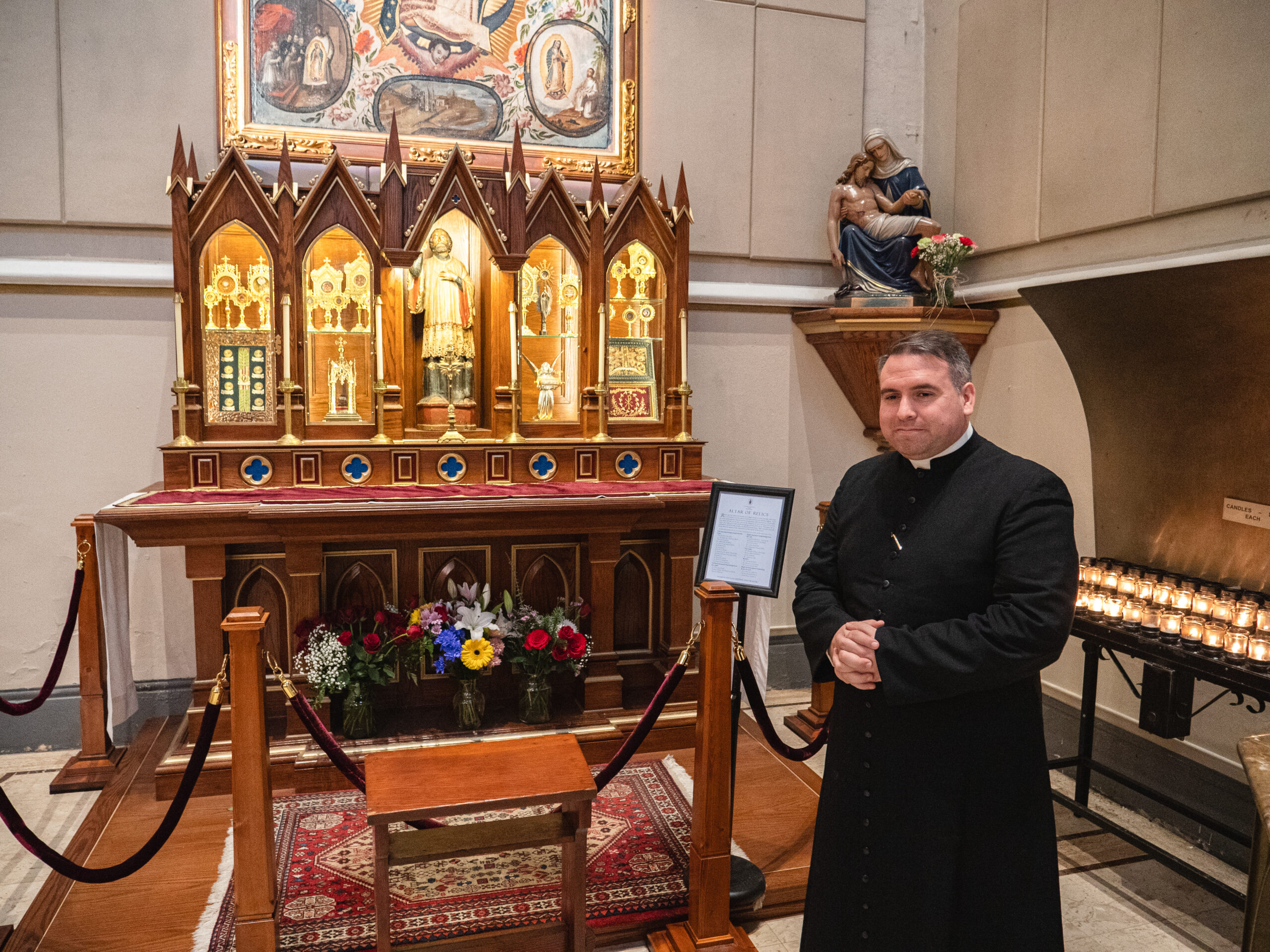

Many are the things a man leaves behind when he departs this world. Most are insignificant, like loose change or a favourite pair of shoes, but some require special attention, like a large collection of relics. Such is the material legacy of Father John Horgan, the beloved local priest who died in 2022.
The relics were perhaps the best-planned part of his estate. The collection is significant in size, and it was well understood that the relics would need a home before he passed away.
Father Horgan acquired the relics over the decades of his life. Some were given to him at the request of monasteries and churches where each saint was interred, but some were, in the words of Holy Rosary Cathedral’s vice-rector Father Pablo Santa Maria, “rescued.”
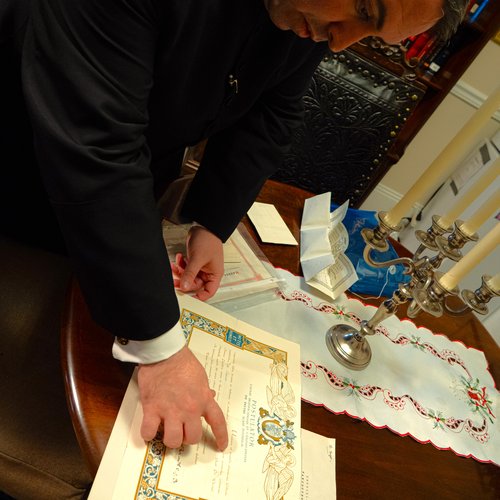
Father Santa Maria and St. Francis of Assisi Parish in Vancouver, as well as pastor Father Juan Lucca, have been managing the collection of relics, serving as their custodians. The priests are also the primary persons in charge of distributing any relics for which Father Horgan left express instructions regarding who should inherit them.
“Father John loved the saints,” Father Santa Maria told The B.C. Catholic. “He saw the saints not just as examples [for us], but also as powerful intercessors.
“They connect us with our physicality,” he said, “because we are not just spirit.”
He knew how to search for them online because there were many convents in Europe that were closing. After years of doing scouring the web, he had a good sense of which relics were genuine.
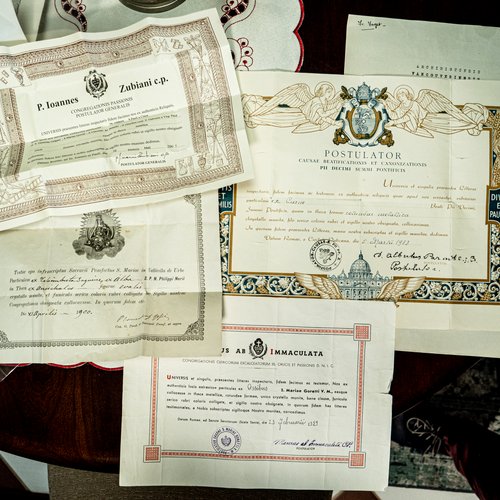
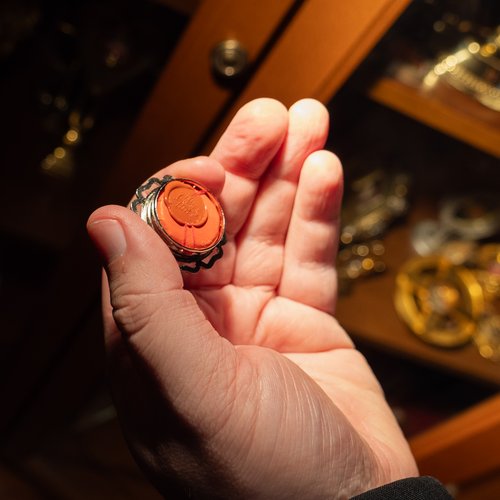
A formal system exists for determining a relic’s provenance. A relic comes with a document signed by the head of its originating convent, church, or abbey, with the signatory’s seal affixed to both the relic and the certificate of authentication. Though these can be forged, Father Horgan excelled at identifying fakes.
The Catholic Church does not allow relics to be bought or sold – a practice that falls within the moral category of simony, named after Simon the Magician, who in the Acts of the Apostles tried to buy spiritual favour from St. Peter. Simony is defined as “the buying or selling of spiritual things, which have God alone as their owner and master.”
The Catechism (2121) says, “It is impossible to appropriate to oneself spiritual goods and behave towards them as their owner or master, for they have their source in God. One can receive them only from him, without payment.”
“[Father Horgan] didn’t want them to remain for commercial purposes,” recalled Father Santa Maria. “But he had some benefactors who helped him get these relics.”
That wasn’t the only way Father Horgan procured relics. Father Santa Maria had the privilege of travelling with Father Horgan. He remembers one trip to the Passionist Basilica of Nostra Signora delle Grazie e Santa Maria Goretti in Nettuno, south of Rome, where St. Maria Goretti is interred.
While seeing the sights of the cathedral, Father Horgan made a point to ask a lay worker if it was possible to get a relic of the young saint. The answer was “yes.”
Most of the relics now are in storage, but several dozen have found a new home at Holy Rosary Cathedral. Some are for the private veneration of the priests in residence at the cathedral – these are sometimes brought out for feast days – but many can be seen in a recently constructed side altar, specifically made to house the relics.
Among the relics available for public veneration at the cathedral now are the Twelve Apostles, St. Thomas More, St. Thomas Aquinas, St. John Paul II, the Canadian Martyrs — Sts. Jean de Brebeuf, Gabriel Lalemant, Charles Garnier — St. Therese of Lisieux, and St. Teresa of Calcutta.
A furry heirloom finds a new family
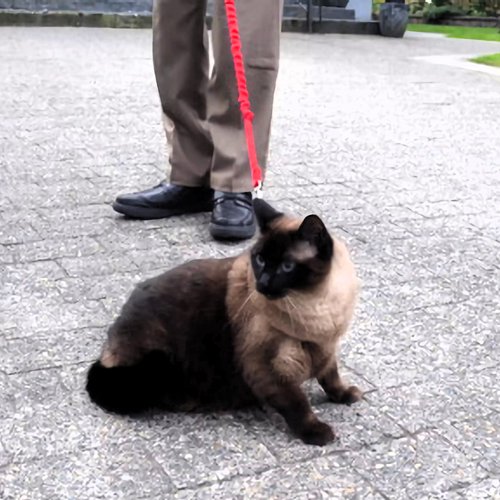
A cat is a tricky heirloom – it won’t sit and wait for the reading of a will to find a new home. Such was the case for Ms. Horgan, the cat formerly known as Maggie Smith, who belonged to Father John Horgan, who died in 2022. Thankfully for her, it would seem she had the grace of God, and the prayers of her owner, to help find her a home, even before he went on to his final reward.
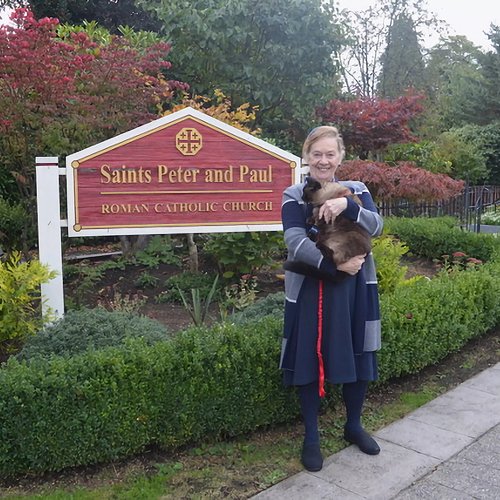
Brigid Gillis remembers when Ms. Horgan came to visit for the first time. She had been staying at Immaculate Conception Church after Father Horgan went into palliative care, but it was clear that was only going to be a temporary solution for the unhoused cat.
As fate, or perhaps providence, would have it, Gillis and her husband Adrian French offered their home in the hope that then-Maggie Smith would be able to help with their mouse problem.
“Cookie,” as they sometimes call her, “came to inspect the house,” Gillis told The B.C. Catholic. “She seemed quite happy and made herself at home very quickly.” She moved in just two days before Father Horgan died.
Gillis and Father Horgan had been friends for years, their relationship beginning when he celebrated a Mass for her first husband, a non-Catholic, after his passing. She also attended his weekday Masses at Immaculate Conception Parish, which was near the care home he stayed at after retirement, and their friendship deepened further when she married a member of Father Horgan’s men’s group, Adrian French.
Naming the cat presented its own challenge. The couple decided she needed a name befitting her patronage. They christened her Ms. Horgan, both as a tribute to her late owner and to lend her an air of dignity. Brigid admits the decision may have also been inspired by their binge-watching of Downton Abbey at the time, as the name lends her an aristocratic air.
“Ms. Horgan has a lovely superior nature and has taken over our life,” said Gillis.
Your voice matters! Join the conversation by submitting a Letter to the Editor here.