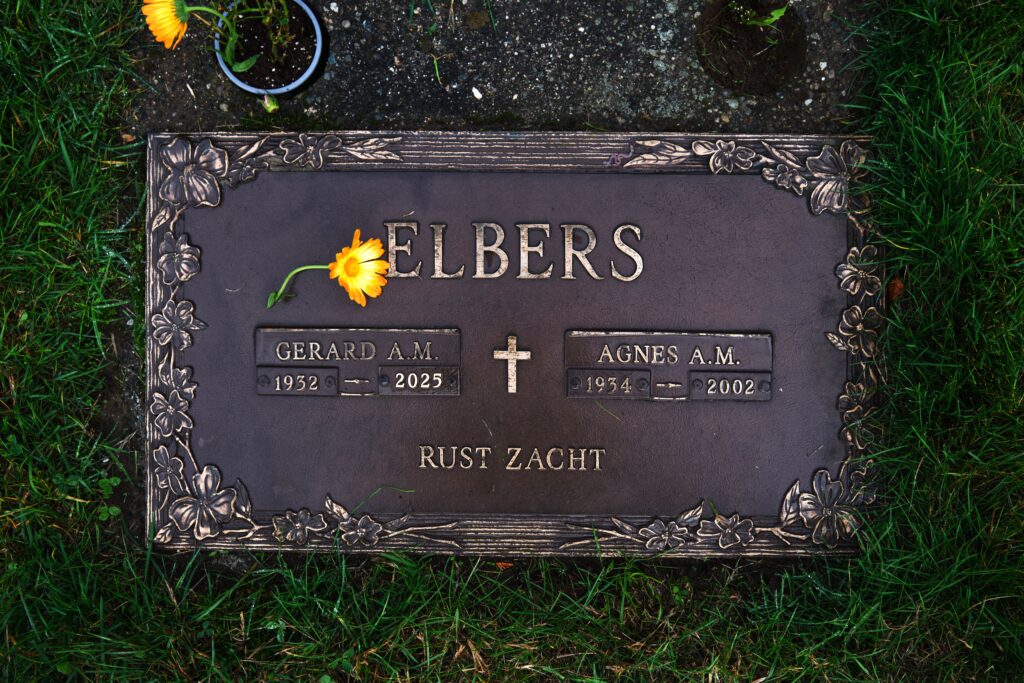
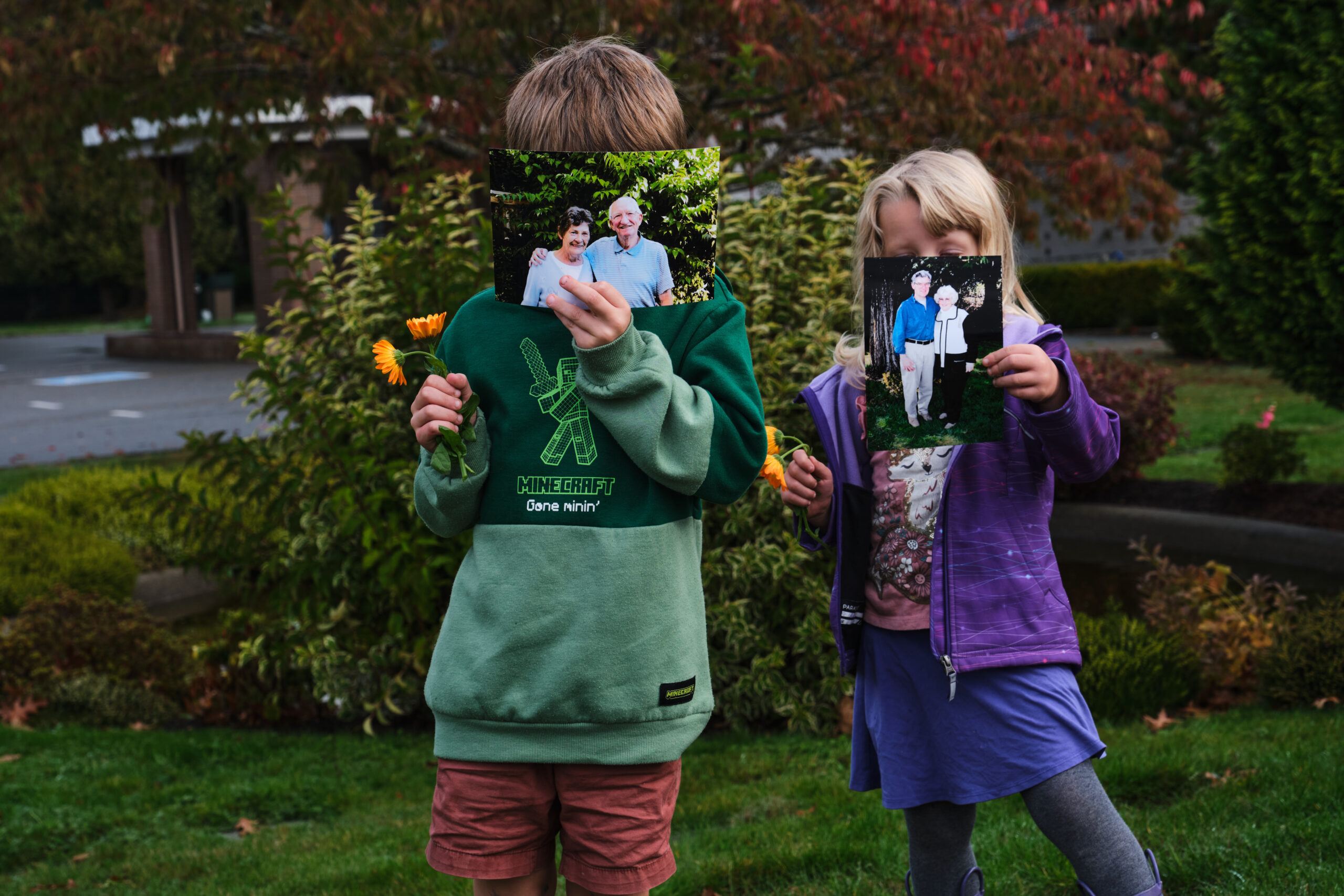

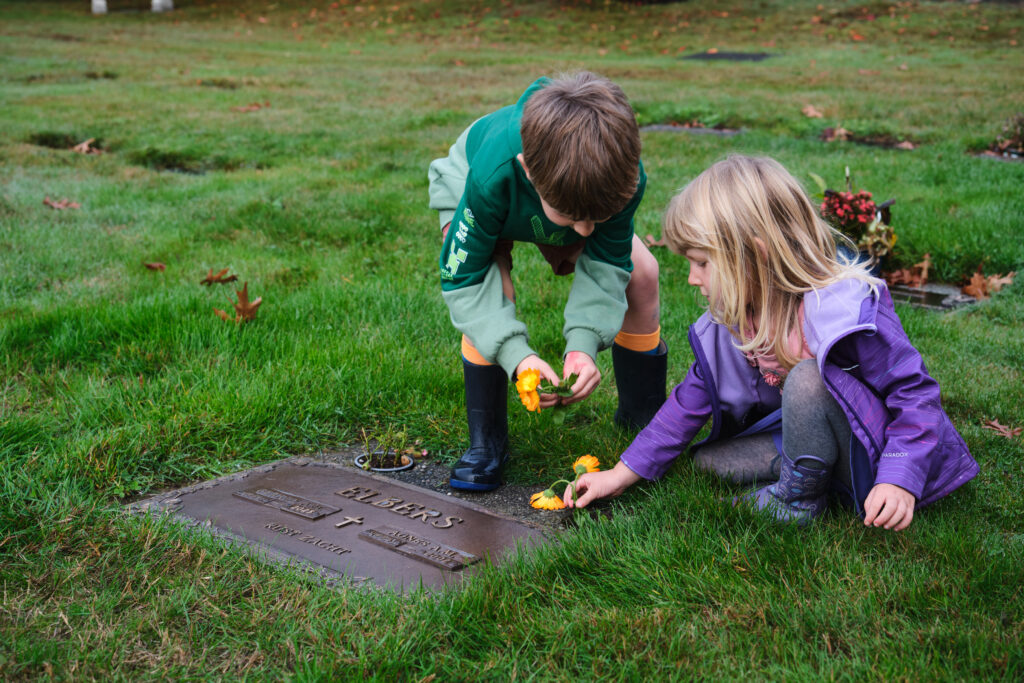
“This is where my Oma [Dutch for grandmother] is buried,” I tell my children when we visit my family’s graves.
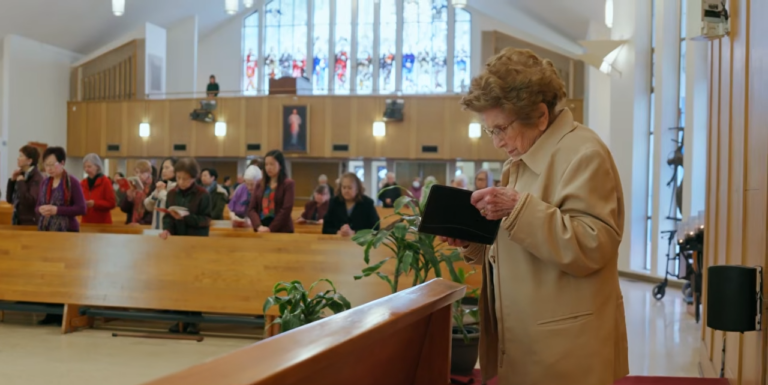
“We just saw Oma at church!” my small daughter replies.
“No… this is my Oma, not your Oma.”
“Why did you bury Oma?!”
“… Never mind. Let’s say a prayer.”
All four of my grandparents are buried within the same five square meters of cemetery ground at Gardens of Gethsemani in Surrey; half of them only got there in the last two or three years. This has given my children a relationship with the dead, and a perspective on reality and faith that I didn’t have at their age.
Like most people who live in the Lower Mainland, we haven’t been here very long. All my grandparents left Holland in the decades following World War II, and after many wanderings across oceans, seas and prairies, they had all settled in British Columbia by the end of the 70s. This meant that growing up, not only were we detached from family, strewn across three continents, but we were also detached from our ancestral homeland. As such, there were no graves at which to visit for our dead; no places to remind us of the incredible human inheritance we’ve received from our family history. My understanding of myself, and my faith, was diminished.
This matters. It isn’t until you can visit graves, heavy with memories and shared experiences, that the weight of your belonging to a place becomes apparent. It’s one thing to say you were born somewhere, but it’s something far more profound to say you know the people who died there.
At the risk of sounding morbid, this is why it’s been strangely edifying to see the number of dead family members I have buried locally increase. To be clear, I would rather they were still alive, but it’s hard to ignore the continued gift of their presence.
Whenever I think about what it would mean to move away from the Lower Mainland, I am always surprised by how high our trips to the cemetery rank on my list of priorities and concerns. It feels strange, but I can imagine leaving living people behind – after all, they could always travel – but it’s leaving the dead that makes me dig in my heels and want to stay.
Humans have always struggled against the embodied reality of human life. Our thoughts are our own, we think, but our bodies grow old and betray us. “Just look at this dead guy in the ground. Look how his body couldn’t sustain who he was. His soul is free or gone… Man, my back hurts when I wake up.” We want separation – especially in the digital age – because it gives us the illusion of control over ourselves. It allows us to choose against the accidents of who we are, things like personality, sexuality, or even species. We revel in the illusion that our identity and our experience of the soul is all that matters, but it’s worth noting that Adam without his body would have been a mere ghost, adrift in a garden he could never steward or care for. Eve would have been a mere abstraction if she were created at all. It is the body that allows us to live fully in God’s very earthy creation.
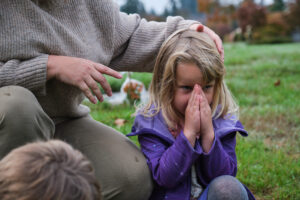
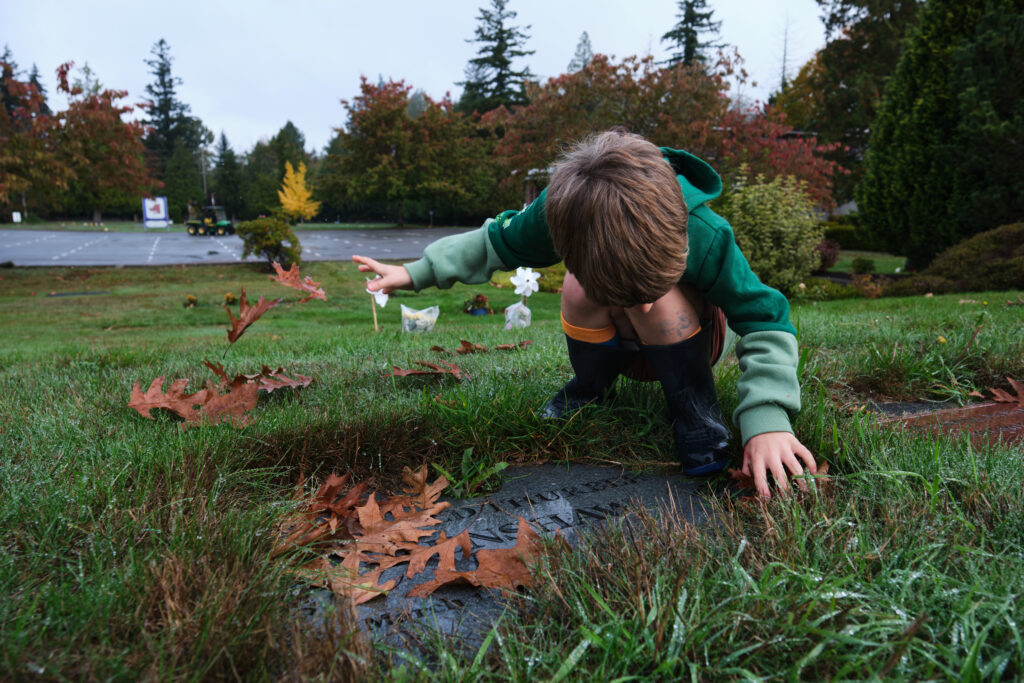
When I take my kids to the cemetery, we stand and look at names, some of which we share. For my children, there is the strange enchantment of knowing that a part of a person is still there. This is made all the more remarkable when they learn that these people were to me what their grandparents are to them (initial confusion notwithstanding).
The implications of this for our faith are vast. When you attend a funeral and watch the casket descend into the ground, you aren’t really saying goodbye; in a Catholic sense, you are simply passing into another type of relationship with the deceased. The Church emphasizes prayers for the dead precisely because the soul persists while the body decays – because the person isn’t gone. When you visit their graves and pray, you are showing them love.
Before his conversion to Catholicism, the English writer G.K. Chesterton had a great secular image for this relationship which he called “the democracy of the dead.” For him, the great collection of human vitality sitting just beyond the pale should remind us of our obligations to others, to our past, and, subsequently, to our future. Within that ghostly polis, the dead call us to a standard of conduct, belief and faith.
The Church has its own more complete ways of talking about this reality. It often refers to the Communion of Saints, that great community of the dead who make up the bulk of membership in Christ’s Church.
Neither of these descriptions can erase the very real pain of grief, mourning and temporal separation, but they should expand our perception of what the Church actually is. The emphasis on our relationships and community with the dead is important because it shows we have the same obligations to them that we have to any relationship or community: chiefly, Christian charity. There is hope here, because it doesn’t take much imagination to realize you can’t really be in relationship with, you can’t really love something that is truly dead and gone.
When placed next to the other corporal works of mercy, our obligations to the dead have a wonderfully wild, enchanted character. Giving food to the hungry makes intuitive sense; people need to eat, and we are all hungry sometimes. Shelter keeps us safe and warm – easy to understand. Even the intangibility of human presence when visiting the sick and lonely has a certain obvious charity to it. But caring for the dead? It pushes the boundaries of the obvious and shows us truths we might otherwise miss. It demands faith.
This is good moral theology because it challenges us with questions if we are willing to dig a little deeper. If the dead can be cared for, what is a dead person? What persists if they haven’t just dissolved into the cosmos? What does it mean for a soul to be separated from the body? If caring for the dead body is caring for the person, what does this say about what it means to be human? What is death? What about the Resurrection?
This is what makes our little trips to the graveyard worth it. They have allowed me to show my children their place in history and in our family, but more importantly, they are learning where they fit in the wider, communal cosmos of the Communion of Saints.
Death is wrong, like an equation that fails to balance, but God turns all things to good, and by visiting the bones of our loved ones (and maybe a few strangers), death loses some of its sting. On these graveyard visits, buried bones take on the role of a crucifix, or a work of sacred art, tragically pointing towards the transcendent glory swirling all around us. Through caring for the dead, my children are pulled towards a deeper understanding of who they are and what it means to be human beings, bodies and souls, created in the image and likeness of God.