

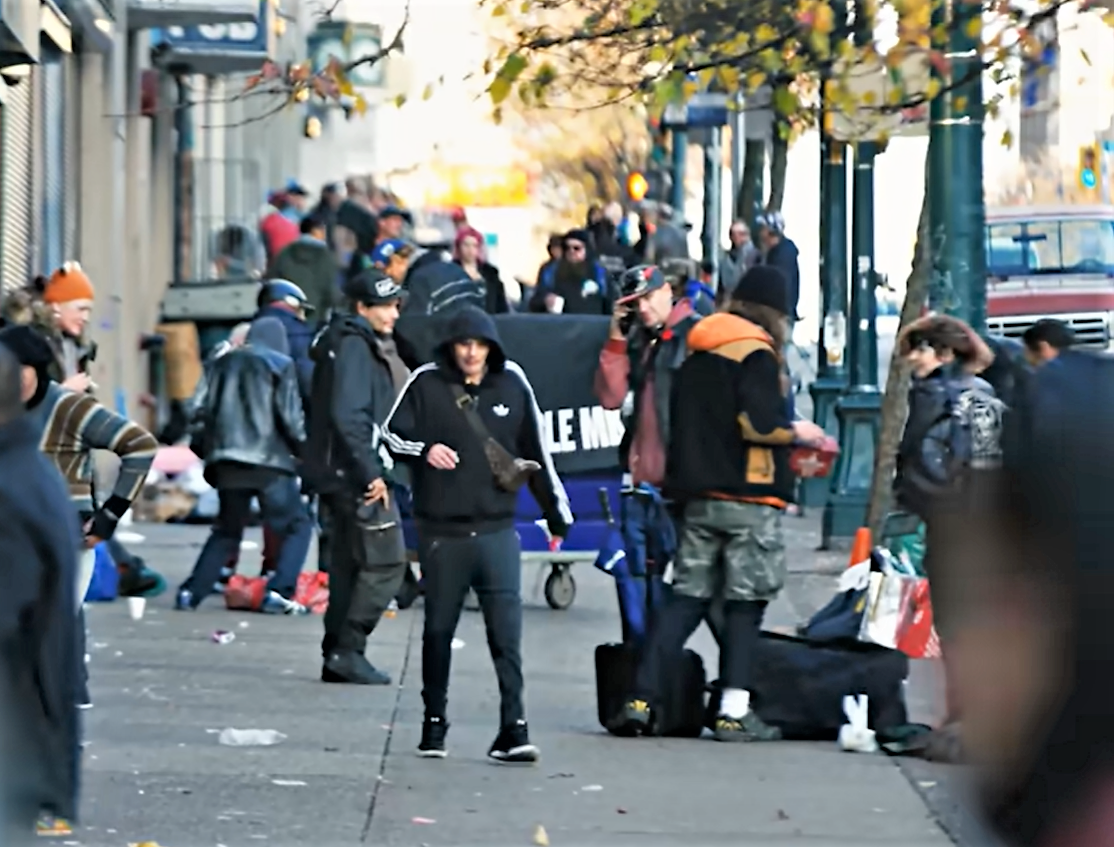

The Advent season of penance is a time to be especially mindful of our Christian commitments, and so as we retreat indoors, huddle around the fireplace, and complain about the weather we need to do more than simply look for entertainment on our televisions and phones. I was made particularly aware of this when watching two documentaries about Vancouver’s growing drug and homeless crisis.
The first, The Tragic Fentanyl Problem, is produced by Real Stories and is available on YouTube. The second is Vancouver is Dying, by independent journalist and B.C. political advocate Aaron Gunn, host of the YouTube series Politics Explained.
All of us have been made aware to a greater or lesser extent of the plague of drugs that has overtaken so many countries, not least among them Canada. We have all been made aware of the problem of the homeless and have been appalled at the growing encampments in cities across British Columbia and elsewhere and the grotesque number of deaths arising from drug usage.
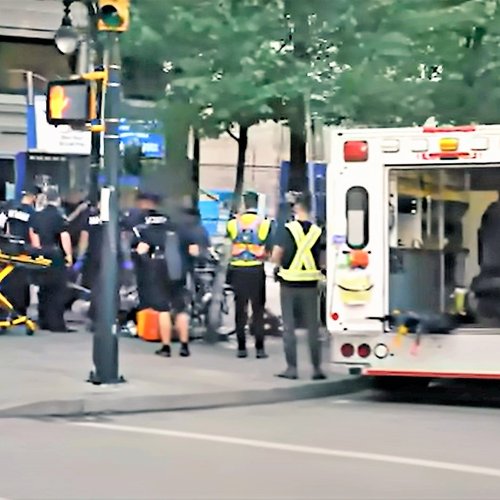
In many discussions around dinner tables I have frequently heard of people’s dismay at this growing social disaster. While they clearly want to see the problem solved, often the refrain is “They need to do something about it.”
Presumably that nebulous “they” is understandably aimed at governments at all levels – though practical solutions are usually in short supply. And before one demands action, one needs to understand the problem.
The significance of The Tragic Fentanyl Problem is that it presents the problem in human and powerful terms. It literally puts a face on some addicts, helping us to see them above all as people – people who once started out life much like us.
Remarkably, the makers of the film, which should be essential viewing in all homes, persuaded several of the homeless inhabitants of Vancouver’s Downtown East Side Vancouver to tell their stories, often articulately and vividly. The result is a heart wrenching saga of people caught in an almost hopeless journey towards what many of them recognize as probably inevitable death. With honesty, with clarity, and with unflinching strength to recognize the horrors of their situations, they help us to realize that “There, but for the grace of God …”
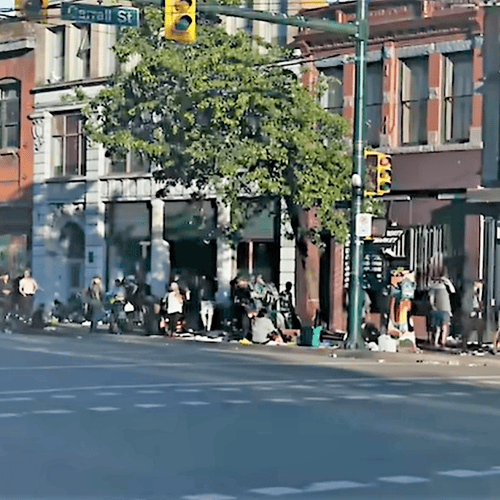
Besides revealing the tragedy of the situation in all its sad humanity, the film also helps viewers to recognize how difficult it is to arrive at a solution. Yes, the film makes clear that there are praiseworthy small efforts by noble volunteers to ameliorate the situation; there are tiny successes in helping addicts break their habits, but in the end one must recognize that it is not enough merely to demand that “they do something about it.” Indeed, if any fault is to be found with the documentary, it is that the real and praiseworthy efforts of the police are given scant treatment. But the fact is clear: neither the police nor the politicians can be expected easily to end the ravages of drugs in our society.
Just how to do this clearly demands a huge effort by all levels of society. We all need to participate in a positive way to provide constructive input. It will be a lengthy process, but in the name of decent humanity it is necessary. If all levels of government invited the many who express concerns to participate in an ongoing dialogue, perhaps we could actually solve this accursed plague.
A second equally fascinating documentary, Vancouver is Dying, does attempt to spotlight the problem and at the same time to address possible solutions.
Unlike the previous documentary, this one tackles the role of the police head on, placing the ineffectiveness of law enforcement in handling the problem of street camps squarely at the foot of the recently ousted Mayor of Vancouver.
Whether one agrees with this position one must decide for oneself, though it is abundantly clear that present practice is ineffective.
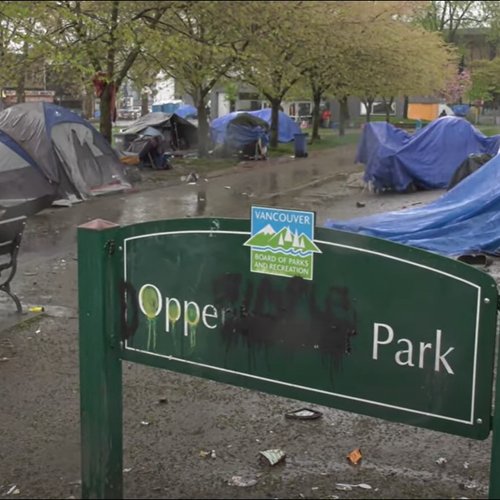
Just what the new mayor and council will do remains to be seen – not to mention other parts of the province and their elected officials. It is also apparent that the problem cannot be solved by the police, vital though they are to the matter.
Equally interesting and challenging is the issue of safe injection sites, a main pillar of a long-term (and clearly unsuccessful) approach to the problem of drug addiction. Supported by the ex-mayor and B.C. Chief Medical Officer Dr. Bonnie Henry, this approach is subjected to a full-scale attack in Vancouver is Dying, in contrast to the first documentary which presented it in decidedly positive terms, particularly as in some cases it has led to addicts breaking their habit.
Ending addiction, of course, is the most desirable goal, and as the film argues the ideal is to provide therapy and support for addicts. Is undoubtedly true that some addicts (evidenced in the film) have benefitted enormously from treatment. The example of Portugal, which adopts a full-scale treatment approach, is persuasively presented as a model.
There are inevitably drawbacks to such an approach. On a personal level, I am aware of one young addict who has been through more than one course of therapy, only to relapse shortly after each.
In addition, the problem is often not merely of physical addiction but of mental illness. In this regard, mention has recently been made of the possibility of reopening the Riverview mental health hospital in Coquitlam. While the idea of institutionalizing sick people is distasteful, one wonders if such an approach might be more humanitarian than giving them unfettered freedom with no real support and the end result being living in tents on sidewalks.
Although some might argue for mass incarceration – a proposed solution not mentioned in either documentary – the availability of drugs in jails would seem to make it a non-starter. One must also ask whether the best approach to illness is imprisonment – the same objection made to institutionalizing patients.
All approaches would require large expenditures of money, but since a recently released Vancouver Police report shows that several million dollars a day are already being spent on the problem with little benefit, cost would not seem to be a strong argument. The money could clearly be spent more wisely.
What both documentaries do is to highlight a growing problem to which there is no easy solution. Ideally, of course, the most efficient method would be closing down the drug trade itself, but this seems to be something none of the world’s governments seem able to do.
It is noteworthy that neither documentary does much to address the role that education might play in limiting drug usage. To a large extent, education seems to have had the desired effect with regard to limiting tobacco use among teenagers – although one has only to note the problem of vaping to recognize that this too has its limitations. However, prevention would clearly be a better option than cure.
What one can take from both documentaries is that the problem is complex and the solution elusive. To every apparent solution, there is a real objection.
All of this can be remarkably depressing, but drug addiction and its many negative social consequences clearly is a problem which all of us must own. As already indicated, it is vital that we the citizenry be as informed as possible as to the nature and extent of the problem as well as possible ways of dealing with it. It is not enough to complain; it is not enough to leave it to others.
As a first step toward being part of the solution, one could do far worse than spend a couple of hours watching the two documentaries mentioned here. They may not provide the answers for which we are all looking, but at least they may provide for a better-informed debate leading to possible solutions. And it is a debate in which all of us need to participate, since the problem touches us all.







