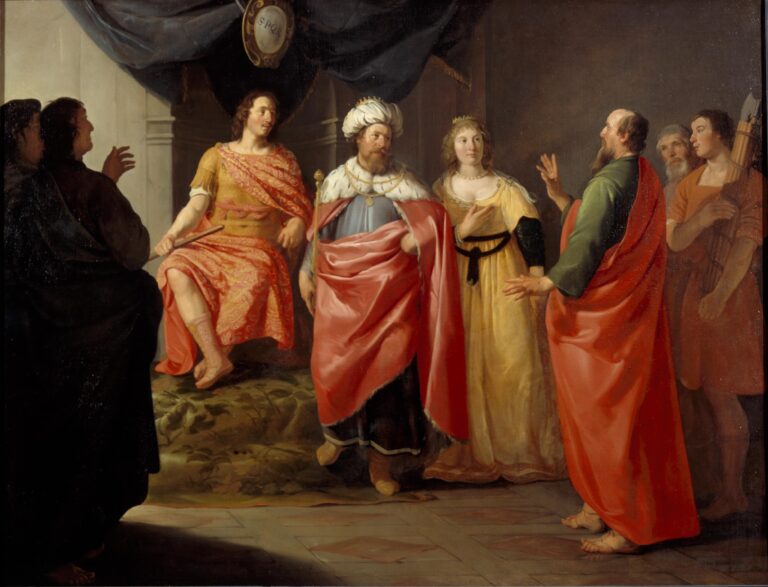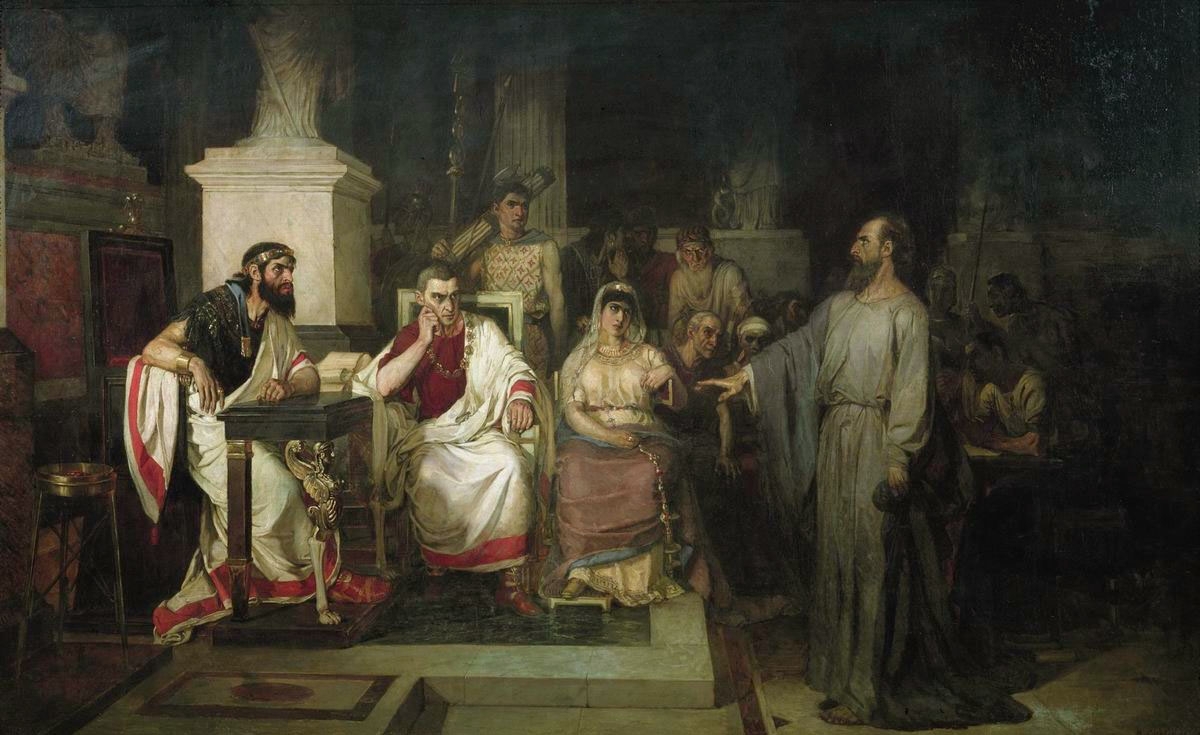

In Acts 26, Paul stands before the governor Festus and King Agrippa. What begins as a legal defence becomes a testimony of faith and, once again, a proclamation of the Gospel. Paul’s conscience is clear, and he is glad the king knows Jewish customs and religious questions. Before an informed judge, he has nothing to hide. A man with an upright conscience has no reason to be afraid.
This is the third time Acts recounts Paul’s conversion, which shows how important it is. Again we hear Jesus’ words: “Saul, Saul, why are you persecuting me?” Jesus identifies himself with his followers. He also speaks of “kicking against the goads”: Paul was like a stubborn animal that refused to submit. Yet he was overpowered by Jesus, and that encounter with the risen Lord decided the rest of his life. Jesus came not to punish Paul but to make him an apostle, and so Paul can say with a clear conscience, “I was not disobedient to the heavenly vision.”
A Bible commentator observes that Paul’s experience is repeated, usually less dramatically, in the life of every man and woman. At particular moments the Lord calls us to a new conversion, drawing us out of sin or lukewarmness. We must listen carefully and obey. St. Josemaría Escrivá notes that we always want to be in charge, even if only of our own wretchedness, and this blocks us from hearing God. Paul was very much in charge: he wanted to persecute the Church. But when he met Jesus, he let go and let God.

Paul did not receive cheap grace. The Gospel requires action as well as faith, so he preaches that people should perform deeds worthy of their repentance. St. Gregory of Nyssa likewise teaches that grace received should be followed by a real change in our ways. When we receive grace in the Sacraments, in Confession and the Holy Eucharist, we must correspond to it.
God gave Paul a special actual grace, and actual grace is given to us too, to do good and avoid evil. Paul obeyed. God keeps calling us to repentance through his inspirations, and we should answer with the same obedience.
Paul tells his hearers that he proclaims not what he heard from others but what he himself saw and heard from heaven. He is a reflector of the light he has seen, sent to open eyes that people may turn from darkness to light, and that light is meant to be shared. His faith is also public and open to investigation; Christianity did not spread in a corner.
Then Paul presses the king: “King Agrippa, do you believe the prophets? I know that you believe.” He is no longer merely defending himself; as a good evangelist, he calls for a response. Two responses follow. Festus says, “You are mad, Paul!” A Bible commentator remarks that divine wisdom can seem to make no sense humanly speaking, and Festus, using only human logic, could not see it. Agrippa deflects with humour: “In a short time you think to make me a Christian!” Paul replies that he wishes them to become as he is, “except for these chains.” He meets them at their level. Paul loved his chains and loved to suffer for Christ, but they were not yet believers, and not ready for suffering.
Two lessons emerge. The first is partnership. A Bible commentator points out that God has given us natural talents, life experience, and training that we are meant to use to promote the Gospel and persuade people of the truth. Yet in the end only God can convert hearts. Our skills are good and we should use them, but only God changes hearts.
The second is responsibility. The apostolate is a duty Christ lays on every Christian at all times. St. John Chrysostom says nothing is more useless than a Christian who is not dedicated to saving his brethren, and nothing is colder than a Christian unconcerned about the salvation of others.
Paul’s speech had two goals. As a defense, it succeeded: when the governor and the king conferred, they concluded that he had done nothing deserving death. As an attempt to convert the king, it was less successful: the governor called him mad, and the king answered with humor rather than conversion.
Paul speaks about his own conversion. Can we identify the moments of greatest conversion in our lives? Have we ever told that story to others? St. John Paul II said that the door of hope is always open to every sinner. We do not share such stories to make ourselves famous, but we keep them in mind, because someone may one day benefit from hearing them. When the right moment comes, and with the proper intention, we can tell the story.