

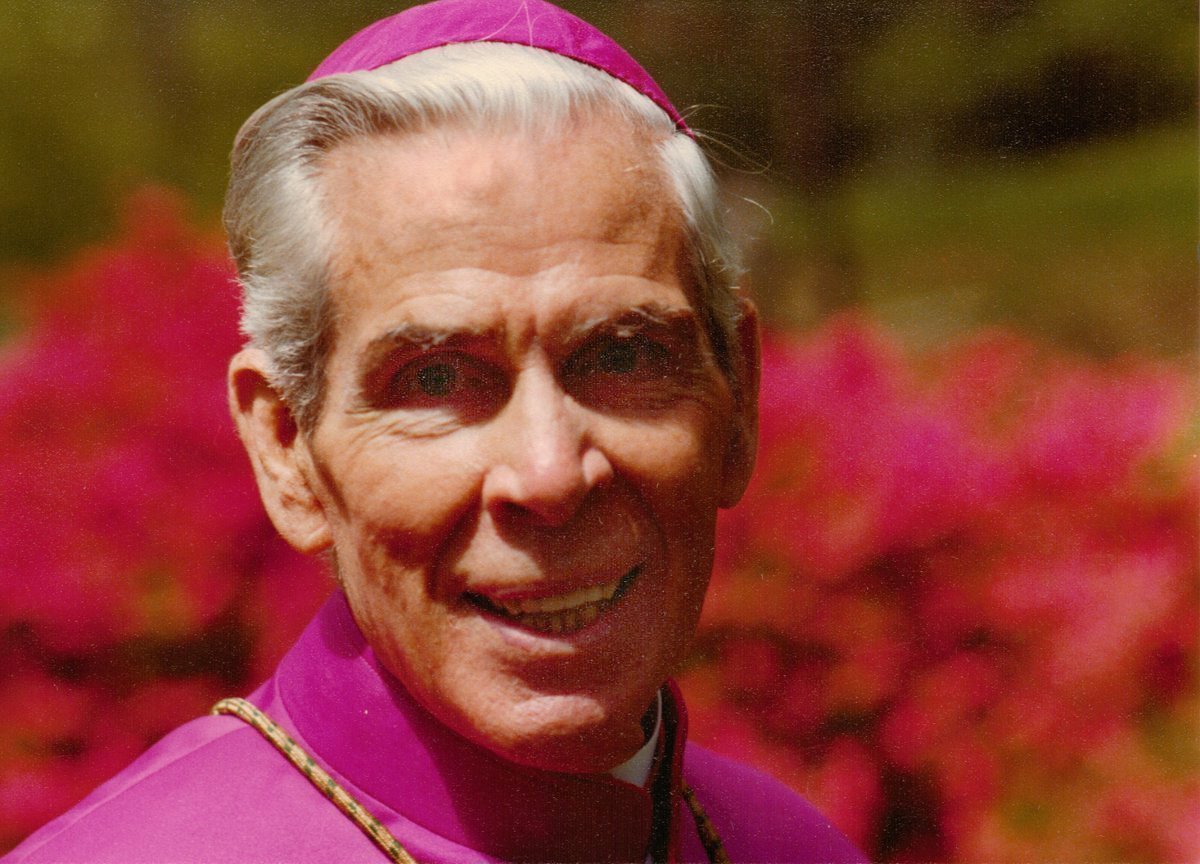

On September 24, Venerable Archbishop Fulton J. Sheen will be beatified. This means that he has reached the final stage before canonization as a recognized saint in the Catholic Church.
I have heard about Archbishop Sheen for several years, primarily because he hosted radio and television shows, paving the way for our current norm of recorded homilies, interviews and podcasts. Both Bishop Robert Barron and Father Mike Schmitz – contemporary media evangelists – regularly speak of ways in which Archbishop Sheen inspired them in their ministries and their personal prayer lives.
With Sheen’s beatification approaching, I was intrigued to know more about him. Therefore, I read the book, Meet Fulton Sheen, Beloved Preacher and Teacher of the World by Janel Rodriguez. In this short biography, I learned of Sheen’s past, his relationship with Mary, and the popularity of his show which shared the Gospel message.
Sheen grew up on a farm where work and prayer life were integral in his upbringing. Rodriguez states, “… a strong work ethic was a value his parents pressed upon him from an early age and one he took to heart. He learned it well through his chores and responsibilities on the farm, and it was a virtue that would prove enormously beneficial throughout his life (pp. 3-4). His faith permeated his attitude as he grew up, and he notably stated in his autobiography (as cited by Rodriguez), “’No true vocation starts with “what I want” … if Christ calls, I am a servant forever’” (p. 22).
One faith-based habit ingrained in Sheen’s mind was introduced to him by a nun when he was in Kindergarten. She taught Sheen to write “J.M.J.” (for Jesus, Mary and Joseph) at the top of his work page each day to bless his efforts with the intercession of the Holy Family. Later, on his television show, “Life is Worth Living,” he would begin each episode by writing “J.M.J.” on the chalkboard he used for teaching.
I have spoken to several people whose Catholic teachers encouraged this habit, as well. Inspired by the practice, I now display a “J.M.J.” sign in my classroom. This sign, in Archbishop Sheen’s cursive, motivates my students to offer their schoolwork to God, and ask for the intercession of Jesus’ earthly family as they go about their earthly tasks. Sheen learned the custom from his teacher and “in turn promote[d] it to two million viewers” on his show (pp. 48-49).
Sheen had a particular devotion to Mary, as highlighted by this “J.M.J.” habit. Sheen taught that “The vocation of everyone, man or woman, married or single, priest or layperson, was to be like Mary: that is, through God’s grace, to lovingly and humbly conceive and bear Christ within and then usher him in service to one another”, Rodriguez states (p. 34).
Additionally, Rodriguez mentions that Sheen was an “apologist for misunderstood Catholic doctrine about [Mary]” (p. 35). Sheen is quoted as saying, “The Church has never adored Mary, because only God can be adored … But she, of all creatures, was closest to God” (p. 35). Sheen clarified, “Comparing Mary to Jesus would be like calling the moon the sun,” he said. “The moon can never take away from the brilliance of the sun. In fact, the moon has no light of its own. Its perceived beauty and light are only reflections of the sun’s light and just the merest fraction of its brilliance. Mary reflects her Divine Son, without whom she is nothing” (pp. 35-36). I find this explanation a wonderful way to explain our reverence to Mary while maintaining that Catholics do not put anyone or anything before God.
“Life is Worth Living” was a unique television show which followed Sheen’s earlier radio broadcasts. Since he was on television, people of all faiths were exposed to Catholic teachings and the Gospel message. He was popular enough to win the 1952 Emmy award for “Most Outstanding Television Personality.” Rodriguez writes that two of his fellow nominees were Lucille Ball and Jimmy Durante (p. 52).
Further evidence of his influence and popularity is shown in this story about actor Ramon Estevez. Inspired by Sheen, the actor “wrote and asked permission to take [Sheen’s] last name as part of his stage name.” Sheen agreed and Estevez subsequently changed his name to “Martin Sheen” (p. 53).
There are many more stories about Sheen’s personality, his influence, his devotion to a daily Holy Hour, and his willingness to follow God’s plan in his life. As his beatification approaches, I hope that many more people will read about his life and watch YouTube videos of his show. I have to say that literally listening to the voice of a future saint certainly gives the phrase “Live is Worth Living” extra meaning for me.
Blessed Fulton Sheen, pray for us.







