


In my last column, I reflected on some general insights from Pope Leo XIV’s first encyclical, Magnifica Humanitas (Magnificent Humanity). I now wish to explore the five main takeaways from the “Conclusion” to this document: truth, education, relationships, justice and peace, and rebuilding.
The topic of Artificial Intelligence is admittedly overwhelming. While I appreciate many conveniences of technology, immediate and often incorrect AI responses to simple Internet searches and inaccurate transcripts for online videos, fill me with fear for the future. Therefore, I appreciate our Pope’s hope-filled offerings in this rapidly changing world. Four paragraphs in his encyclical’s “Conclusion” begin with the imperative “Let us…”, as he shares ways to follow our Christian call and “assume an active role” in building the Kingdom of God (MH, 236).
Paragraph 237 exclaims, “Let us remain faithful to the truth!” Even though algorithms and digital content can offer information, Pope Leo reminds us that we must “prefer what is right despite the most appealing content” and “immediate results” (MH, 237). The Holy Spirit’s Gift of Wisdom allows us to seek and love the truth. While computers can hold data and can be programmed to generate answers, AI does not have the ability to discern due to the absence of conscience.
In the First Book of Kings, we hear that the voice of God was not heard in the noise of wind, earthquakes or fire, but was recognized in a “tiny whispering sound” (1 Kings 19:12). Bishop Barron reflected on this small voice, namely our conscience. He reminded us that our “objective moral values” allow us to recognize right from wrong, making us proud of our good choices and resulting in shame when we choose poorly. Pope Leo acknowledges that technology is a current reality, but likewise states, “fidelity to the truth requires integrating the possibilities offered by technology within a framework marked by wisdom” (MH, 237). To remain faithful to the truth, we must follow God’s voice and our consciences – our objective moral values – to consider multiple points of view, to choose fact over opinion, and to discover the nuances in documents, conversations and situations, as only human beings created in the image and likeness of God can do.
Paragraph 238 begins with the imperative, “Let us invest in education, beginning with ourselves!” As a schoolteacher, this command resonates with me. Not only must I challenge my students to evaluate information, using their consciences, I must constantly do so myself. I must challenge myself to stay current with new platforms and research methods. Pope Leo states, “We all need to learn how to engage with the digital world in a human way … we must consider the digital world as a new continent to be evangelized” (MH, 238).
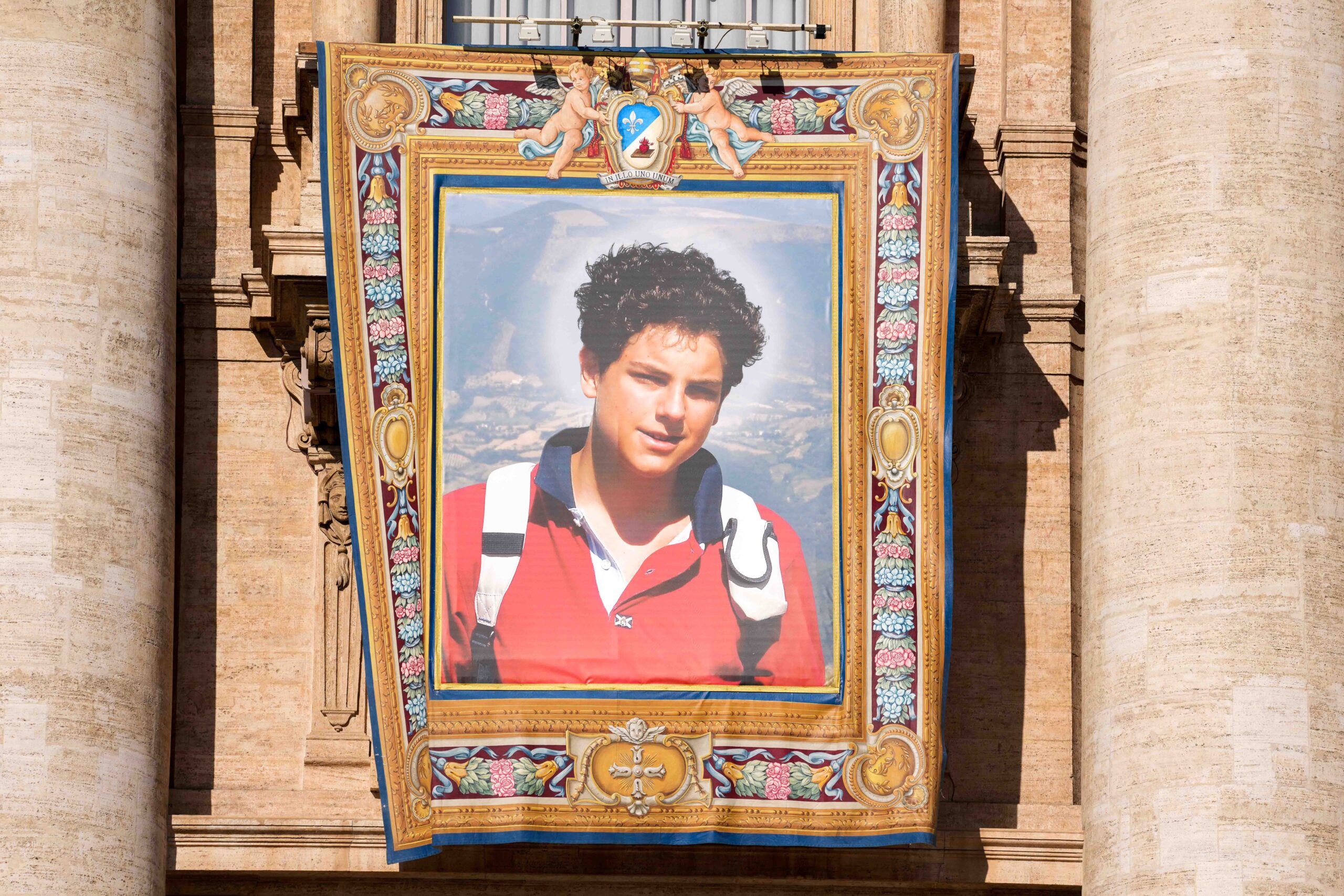
A wonderful example for everyone of using technology wisely is St. Carlo Acutis, canonized on September 7, 2025. St. Carlo, who was only fifteen when he died of leukemia in 2006, created a website to share Eucharistic miracles throughout the world. He most certainly treated the digital world as a “new continent.” We can learn not only from the information he shared, but from his example of using technology to evangelize. Spreading “good news” should always be our goal and, as Pope Leo states, “accompanying children and young people in using technology for developing responsible relationships, helping them to recognize the risks and choose what fosters inner freedom, is a concrete form of charity and will safeguard their dignity” (MH, 238).
Paragraphs 239 and 240 begin with the phrases, “Let us cultivate relationships!” and “Let us love justice and peace!” Pope Leo reminds us that even though we may have multiple, worldwide connections through technology, “the human person still yearns to receive care and recognition from attentive minds, kind words and hands capable of tenderness” (MH, 239). God entered our world in human form to accentuate the importance of relationships. When we cherish human interactions and experience love, we develop empathy and can work effectively to protect the vulnerable and overcome war, with “spiritual discernment” (MH, 240).
Overall, Pope Leo’s first encyclical provides a spiritual lens for living in a world influenced dramatically by technology. As stated at the beginning of Paragraph 229, “Let each builder choose with care how to build.” Created uniquely by God’s design, we all must actively assume a role in rebuilding Jerusalem (MH, 241 and 242). With progressive mindsets, rooted in conscience, relationships, justice and peace, we must strive to “overcome our divisions and to work together” in the way of Jesus (MH, 242).







