
As we explored in part one of this two-part series, yes, digital cameras are very much still a thing, and perhaps even a growing technology sector after several years of stagnation.
Although the Metro Vancouver camera market has experienced attrition in terms of stores selling the devices (local names now gone, or no longer selling cameras, include Leo’s Cameras, Lens and Shutter, The Source, and Costco), others such as Best Buy and Walmart increasingly make use of online sales through third-party resellers.
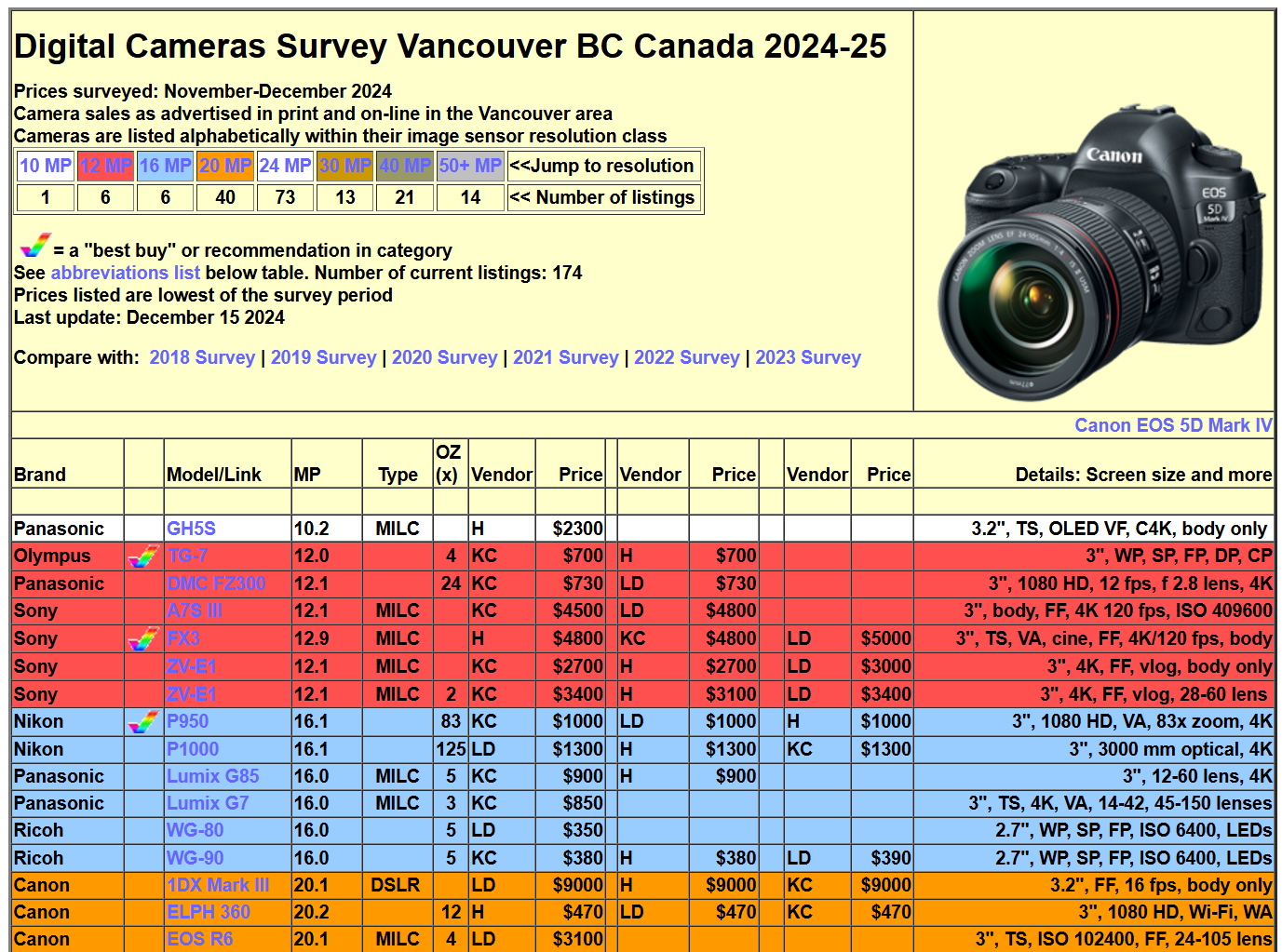
As of this writing, our Vandigicams.ca website contains more than 170 listings for camera models and packages, ranging from a few hundred dollars into the multiple tens of thousands of dollars. Nearly all of these listings come from four chains: Vancouver-based Kerrisdale Cameras and Broadway Cameras, national chain Henry’s, and western Canada mainstay London Drugs.
Prices on the site, rounded to the nearest $5 increment, are the lowest found in the November–December survey period, which often occurs around Black Friday week. If you decide to buy a unit on the list, you may be able to convince the salesperson to roll the price back to the earlier low point if it has risen in the interim.
Nearly all the cameras on the list come from the big five: Canon, Nikon, Sony, Fuji, and Panasonic. Representing the remainder are the likes of Olympus, Pentax-Ricoh, Leica, and Hasselblad. The latter appears on the survey list, as it did last year, with the H6D-400C priced at a whopping—are you ready—$66,580! This unit is effectively a 400-megapixel camera. It is only available through online order from an outlet in Montreal.
Individual cameras and camera packages in the survey are allocated a single line on the Vandigicams.ca site. Each listing is hyperlinked to the corresponding manufacturer’s website for that camera’s full specifications. Along with the camera sensor megapixel rating, there is an optical zoom value, an overview of around half a dozen features, and “street” pricing from up to three local retailers.
All the manufacturers have their flagship cameras. Typically, these incorporate the latest chipsets, the fastest shutter speeds, the best-quality video, and numerous other features. Sony, for instance, has several flagship offerings: the Alpha 1 II, A7RV, AC7R, and the FX3, with the Alpha topping out at $8,500 for the body only.
Nikon has its Z range, with the new Z9 leading the way at around $7,000 for a body only, capable of 120 fps shooting and 8K video. Canon has several flagship units, ranging from its years-old 5D Mark IV DSLR to the EOS R5 II. Fuji’s flagship is the GFX 50S II, but its top seller remains the X100 VI.
Again, these are flagship cameras, representing the best the companies have to offer. The Vandigicams.ca site has many other listings at lower price points.
Want a point-and-shoot digital camera, one of the few left in the market? The Canon ELPH 360, with a three-inch screen, is around $470 (up by almost $200 over the past two years). A starter DSLR camera such as Canon’s T7 with a basic kit lens can be picked up for around $650 (up by $100 from last year). At the other extreme, you’ll find a 102-megapixel unit from Fuji, a holdover from last year, for around $13,300, and there’s that 100/400-megapixel Hasselblad for $66,580!
Looking for a rugged camera? The Olympus TG-7 (shockproof, freezeproof, waterproof, dustproof, and crushproof) remains popular. Ricoh and Pentax also offer ruggedized units. Prices range from $380 up to approximately $1,000, the latter for a unit designed for use in harsh environments.
As for a solid general-purpose camera, how about something like the Nikon P950, with an incredible 83x zoom lens. Priced in the $1,000 range, this unit takes fine outdoor shots and perfectly acceptable indoor ones as well, something often lacking in lower-cost units. Its successor, the P1000, is the first unit to pass 100x zoom, offering an amazing 125x, at around $1,300. These two have been available for several years.
Some other manufacturers still offer high-zoom models in their lineups. Examples include Panasonic’s FZ300 (24x, $730), Canon’s SX70 (65x, $900), and Sony’s RX10 IV (25x, $2,200).
Action and nature photography remain popular pastimes and no doubt drive some of the standalone camera market. Then there is the influencer market, which drives demand for specialized vlogger cameras such as Sony’s ZV lineup and Panasonic’s GH5 II model. This segment also drives the demand for ever-better video quality, which is a selling point for many of today’s cameras.
Do check out this year’s survey list at Vandigicams.ca. You’ll find cameras at every price point, from a few hundred dollars all the way up into the tens of thousands of dollars. In between, you’ll find cameras equipped with Wi-Fi, GPS, OLED variable-angle touch screens, and numerous other features and technologies. Yes, standalone digital cameras are indeed still a thing.
Your voice matters! Join the conversation by submitting a Letter to the Editor here.