


When the first widely available large language model artificial intelligence (LLM-AI) platform, ChatGPT, surfaced in November 2023, we immediately wrote several columns in this space on its capabilities.
We also interviewed local artist John Souter, whose work has run in this newspaper, about the features of ChatGPT when it came to generating images from textual commands. He was impressed, and, equally, perplexed that this sort of activity was now possible.
In a test of ChatGPT in those early months, Mr. Souter provided a lengthy and explicit list of instructions for what he wanted in an AI-generated “painting.” He was astounded to see pretty much every one of those instructions followed as the AI engine spat out four variations on his theme.
Not that the images were perfect, mind you. On close inspection there were various artefacts to be found in many of these images – imperfections, or objects that simply shouldn’t be there. The potential, however, was obvious. This was merely a beginning.
At the time, we couldn’t answer questions about who really owns a work of art generated by a computer system. Fast forward just a couple of years and the floodgates have opened. We can generate ever more sophisticated artwork, and yet the question of ownership – even of copyright violation – remains open.
There are no easy answers.
Recently, ChatGPT unleashed added graphics processing options for its service. These options caused a surge in new signups – in the tens of millions – for the LLM AI engine, leading to this statement from OpenAI CEO Sam Altman: “Our GPUs are melting.”
Altman was specifically referring to the advanced graphics processing units which are at the heart of the current surge in AI demand. He announced temporary limits on image generation to manage demand.
What captured the public’s attention initially was Ghibli-style images, evoking the style of a Japanese design studio. These images represented a major step up from first-generation LLM AI artwork. Further, they could be produced with very simple commands.
All that is needed with these new types of images is to upload a photo and then follow with a very simple command, such as “Redo this in Ghibli style.”
Within hours, ChatGPT’s servers were bogged down and users of the free service were either facing long wait times or image generation limits. At the time of this writing there seems to be a limit of about half a dozen images a day, although the service will spit out bizarre statements such as “You’ve reached your image creation limit. Upgrade to ChatGPT Plus or try again tomorrow after 7:33 PM.” It is not at all obvious where the times come from.
Users are now able to work with existing photographs and have these manipulated in various ways. The so-called “prompt” is the key. No longer are prompts limited to a few words – they can be pages long even. Some users have the AI engines do prompt refining to the point where the engines are effectively generating the prompt sequence to produce the final product, be it a piece of artwork or a 50-page summary of a political party’s election platform.
While it may be an enjoyable activity generating images, let’s not kid ourselves that the AI engines aren’t using all these materials – both outputs and our prompt inputs – as part of their ongoing “training.” You bet they are.
This very column, as well as all others in this paper, appears in electronic format on a website. Unless the Archdiocese of Vancouver expressly places a robots block code on its publication, or uses other means to block this published resource mining, we can be pretty certain the newspaper contents will be ingested by the AI search robots within days of appearance.
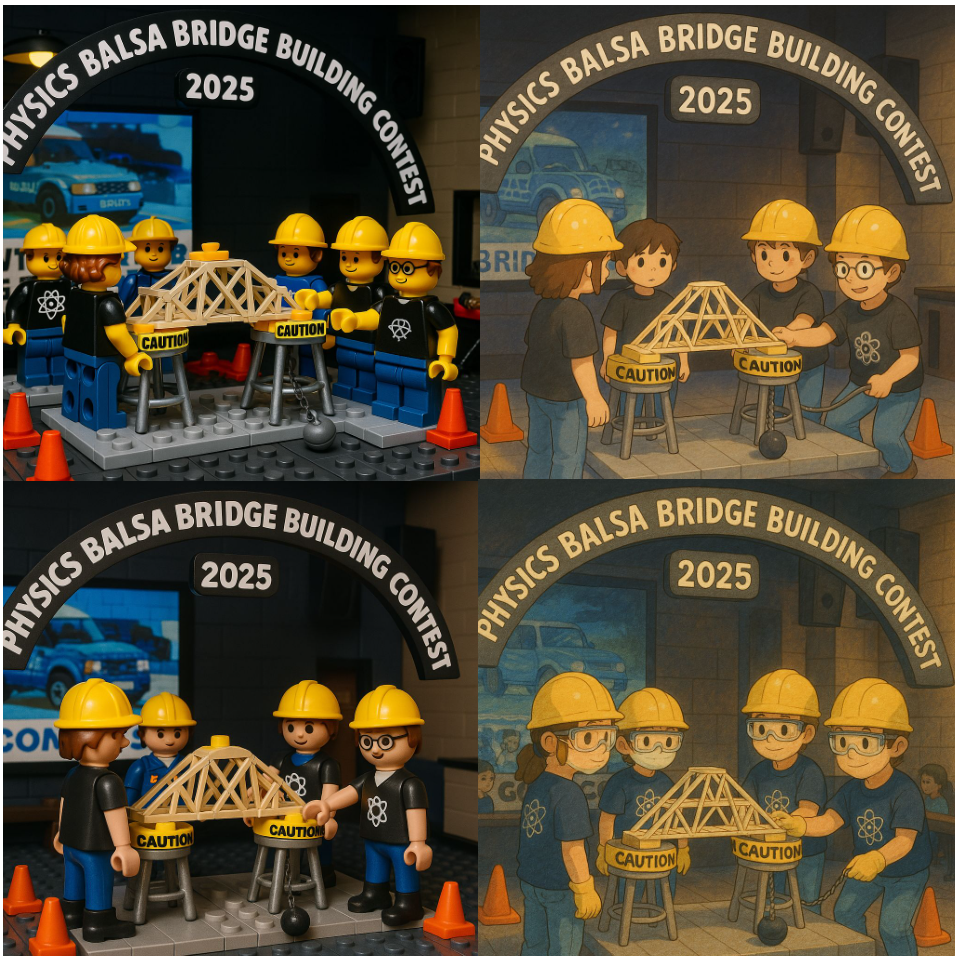
However, leaving those worries aside, I couldn’t help but play with the new graphics options in ChatGPT. I used a photograph, taken last year at my annual Physics Balsa Bridge Building Contest, to produce whimsical variations – most of which I learned about through seeing other creations. “Redo this photo in Lego people style,” for example. You see how that went in the collage accompanying this column.
Here are some others: “Cartoonize this photograph,” “Fisher-Price people style,” “Playmobil people style.” If the engine balks at an instruction, try a slight variation on the wording.
Go ahead, play with these LLM AI engines. Their capabilities have increased dramatically in a short period. They are evolving so fast that we may not be able to properly regulate them. Their usage rates are high. ChatGPT has around 160 million daily average users. Stay tuned.
Follow me on Twitter/X (@PeterVogel) or on Bluesky (petervogel.bsky.social).
pvogel@outlook.com
Your voice matters! Join the conversation by submitting a Letter to the Editor here.







