

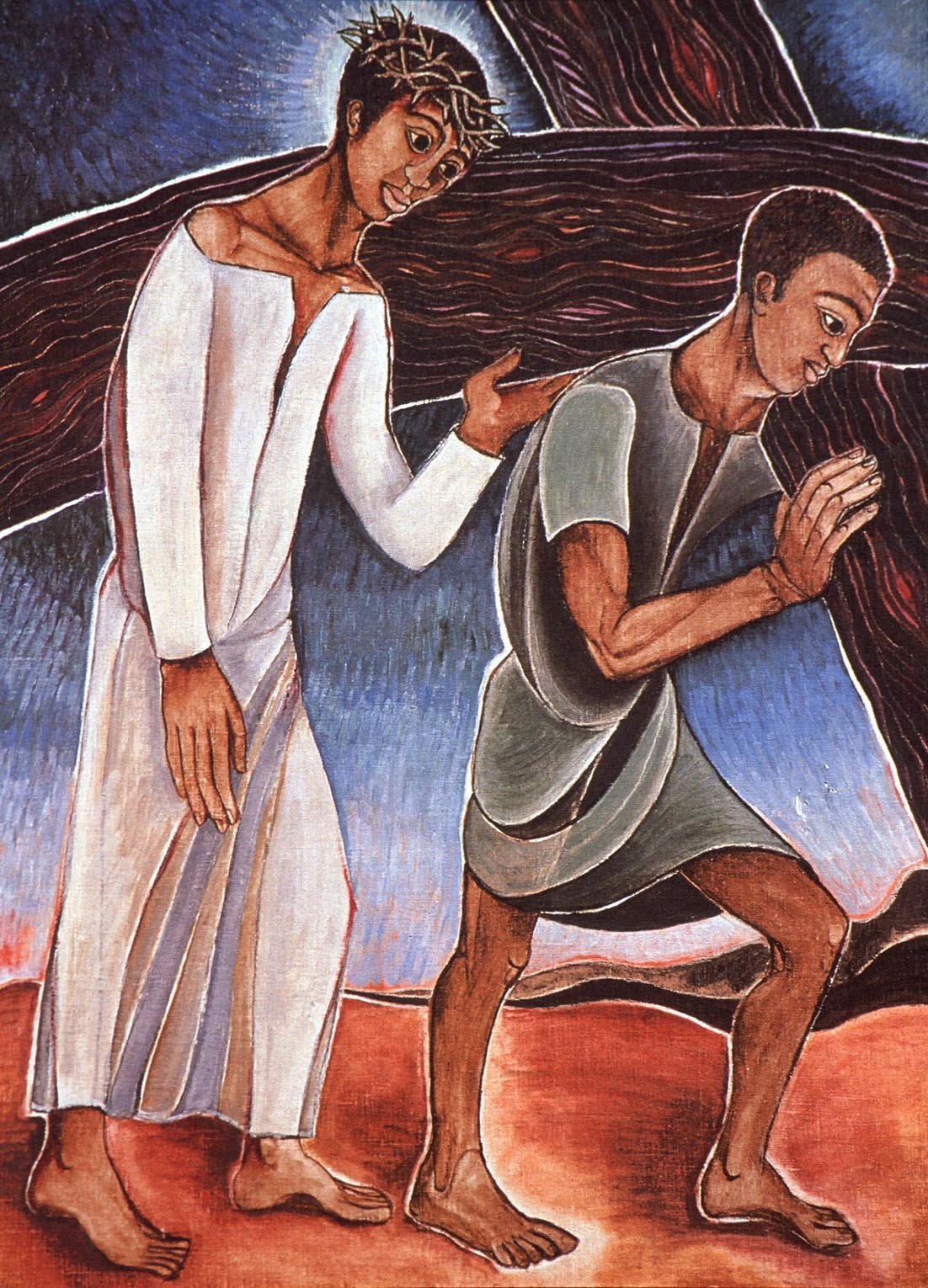

Have you ever thought about the part you would have played if you had been present during Christ’s walk to Golgotha? If you’re like me, you might imagine yourself reaching out to wipe his brow, or running to volunteer as a cross-bearer after he had fallen the first time.
In my love for Christ now (or in my attempt to love him), I see myself wracked with grief as he walks the road, bleeding and tortured. I see myself running out to just touch the hem of his garment and look into his eyes before he died for my sins.
That is easy enough to imagine, but when I am realistic, I ask myself what the reality might have been. Our Lord came to the Jewish people and turned their world upside down. Can you imagine the interior struggle inside the hearts and minds of faithful Israelites, taught since childhood the law and ways of the Lord, the grave sin of idolatry and blasphemy, and then suddenly being confronted by One who challenges everything.
You can see why the Pharisees and other faithful Jews doubt him. He seemingly breaks so many of the ceremonial laws, touching lepers, consorting with women with questionable pasts, claiming to be God. And now you and I stand before him with this one chance to decide if he is who he says he is, or if he is, as the leaders say, a blasphemer deserving death. There would be no going back.
So, while I imagine myself enraptured in love and sorrow, perhaps the reality is that I would have hesitated. It’s hard for me to accept that, but I know I now have the benefit of hindsight.
The obvious question to ask is how does my claim of rapturous love, weeping and grieving, stand up to my day-to-day life now, hindsight and all? Would I really give myself completely for love of him? If fasting for 40 days is so tortuous, how would I stand up against true persecution, or martyrdom?
I prayed the Stations of the Cross this morning, a private prayer at the church. It was very simple and brief: genuflecting, “I adore You, O Christ, and I praise You…” and a short Hail Mary. But even in those brief moments before each image I tried my best to imagine myself present. As I looked at the meeting between Our Lord and his Blessed Mother, I felt a pang of grief for the sorrows of a woman wrapped up in such a mystery. Her entire life had been offered up to God, accepting whatever was to be offered. The glory of her immaculate nature was also the source of her greatest suffering. Her son, the Son of God, was given to her and then ripped away. Any mother knows the struggle of seeing a child suffer. For Mary, to stand by without the chance to offer any comfort, other than her love, must have been hellish.
I was struck by the hand of Christ reaching out to Simon as his bloodied body landed in the dirt again. With his arm stretched out and his face in anguish, Simon couldn’t grasp him in time. He gave what he could, but still Our Lord fell.
I have always appreciated the scenes with Simon in The Passion of the Christ. He goes from total annoyance at being forced into the job, reminding everyone around him that he has nothing to do with the criminal, and knowing that the blood of this same criminal would make him ceremonially unclean, to looking at him, so perplexed. He has come to know that this strange, horrible meeting with a stranger will only ask more of him, and change his own life forever. (The Scriptures refer to Simon as “the father of Rufus and Alexander,” seeming to prove that he and his family became known to the disciples as believers.)
Finally, I found myself struck by the 10th station, Christ is stripped of his garments. Did the soldiers delight in the humiliation they imposed? In the lust for blood did they see his flesh and the gored work of their hands, and have a sickening gratification? Or perhaps did one of them, like Simon, find themselves suddenly perplexed? Did a pulse of eternity rush through his fingers as he touched the hem of Christ’s garments? Could it have ever occurred to him that the man they stripped stood in the place of Adam, also naked, in the garden? But this Man did what Adam could not, and so his scarred nakedness retained its purity and perfection.
Could they have possibly understood that the wood they placed on his back took the place of the wood of a certain tree, standing in a certain garden thousands of years past? The first tree was the source of suffering of death, and in a strange irony the second tree used suffering and death to bring about freedom from both.
We are each called to participate in the works of God. Lent provides us with the chance to reach out and touch Christ’s hem. In our own physical sufferings, small as they may be, we perhaps, still with a sense of perplexity, can carry the cross with him.
But the question to ask ourselves this Lent is if will we look at him, and see him for who he is, and truly offer him ourselves?







