

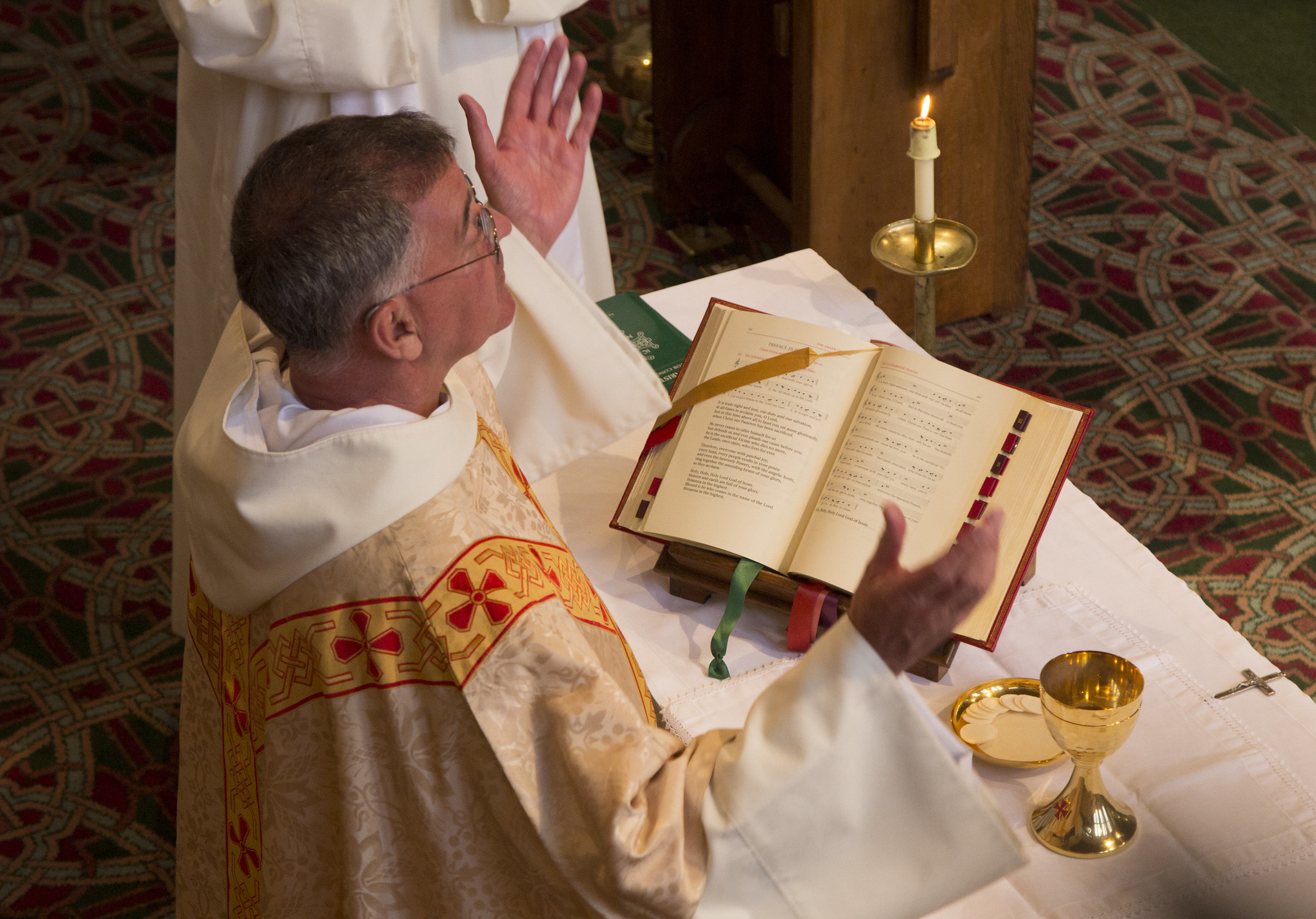

As COVID restrictions are gradually lifting, the faithful are returning to Holy Mass in person. One catechism states: “The Mass is the same sacrifice as the sacrifice of the cross because in the Mass the victim is the same, and the principal priest is the same, Jesus Christ.”
Father Patrick Gearon explained: “On Calvary Christ gave external expression to His inward willingness to die, and He gave it by His real death. During Mass, Christ gives external expression to this same continued inward self-immolation, His inward readiness to die. And He gives expression to it by taking on the appearance of death. This appearance of death is called His Mystical Death.”
This mystical death is brought about by the double consecration of bread and wine into the body and blood of Christ. Father Patrick wrote, “Now, after the words of Consecration have been spoken, what have we? The bread is changed into Our Lord’s Body, and the wine is changed into His Blood. Since it is a living Body, then, in some wonderful way, Our Lord’s Blood is there hidden in the Host. And since the Blood is living Blood, in some wonderful way, Our Lord’s Body is also in the Chalice. But we are dealing with appearances. It appears that the Blood of Christ is really separated from His Body. So we have the appearance of death, and this appearance of death is used by Christ to express outwardly His inward willingness to die. And since the words of Consecration bring about this appearance of death, then those words are said to be a sword slaying Christ mystically.”
On the cross, Christ merited all the graces for our salvation and sanctification, and at the Mass he applies those graces to us. St. Lawrence Justinian pointed out that there is no prayer or good work so great, so pleasing to God, so useful to us as the Mass. The saint wrote, “No human tongue can describe the immense favors and blessings which we receive from the Mass. The sinner obtains pardon, the good man becomes more holy, our faults are corrected and our vices uprooted by hearing Holy Mass.”
St. Josemaría Escrivá wrote, “The humility of Jesus: in Bethlehem, in Nazareth, on Calvary. But still more humiliation and more self-abasement in the most sacred Host – more than in the stable, more than in Nazareth, more than on the cross. That is why I must love the Mass so!”
The altar resembles the manger in Bethlehem and the tabernacle resembles the holy house in Nazareth. Father Patrick wrote, “Whilst Our Lord lay there in the manger, He was praying all the time, although no mortal ears could hear His voice. And whilst He is on the altar, He appears to be lifeless but He is praying all the time, although no human ear can hear His voice.”
“During Mass, after the priest has placed the ciborium in the tabernacle, Our Lord will be leading a hidden life in the tabernacle. So much so, that with truth we could write the word ‘Nazareth’ over every tabernacle in which the Blessed Sacrament is kept.”
The saints taught that angels are present at Holy Mass. St. Gregory said, “The Heavens open and multitudes of Angels come to assist at the Holy Sacrifice.”
According to St. Augustine: “The Angels surround and help the priest when he is celebrating Mass.” St. John Chrysostom said, “When Mass is being celebrated, the Sanctuary is filled with countless Angels, who adore the Divine Victim immolated on the altar.”
St. Josemaría Escrivá observes: “Many Christians take their time and have leisure enough in their social life (no hurry here). They are leisurely, too, in their professional activities, at table and recreation (no hurry here either). But isn’t it strange how those same Christians find themselves in such a rush and want to hurry the priest, in their anxiety to shorten the time devoted to the most holy sacrifice of the altar?”
我們應該熱愛彌撒
新冠疫情的限聚快要撤消了,信眾們可以親身回歸聖堂參與彌撒聖祭。一教理闡明:『彌撒聖祭和十字架同一的祭獻,因為彌撒中的祭品是相同的,主祭的神父也是相同的,耶穌基督。』Patrick Gearon神父在解釋稱:『在加爾瓦略山基督給了外在表達祂內在死亡的意願,祂付出的是祂真正的死亡。在彌撒中,基督給了外在表達這同樣的持續內在的自我祭獻,祂內在準備就緒死亡的意願。祂取用了死亡的外表去作表達。這死亡的外表是稱為祂奧秘的死亡。』
這奧秘的死亡是由兩項祝聖餅,酒成為聖體聖血所致。Parick 神父寫道:『現在在祝聖的字句說完後,我們得到什麼?餅變成我主的身體,酒變成了祂的聖血。因為這是個活的身體,在些奇妙的方法,我主的血也隱藏在聖體內。因為這血是活的血,在些奇妙的方法,我主的身體也在聖爵內。但是我們是在看外表。外表上基督的血真的與祂的身體分離。所以我們有了死亡的外表,這死亡的外表是基督作外在的表達祂內在死亡的意願。因為祝聖的字句達成這死亡的外表,這些字句就成了一把利劍奧秘地刺殺基督。』
在十字架上,基督為我們賺得了所有救贖和聖化的恩寵,在彌撒中祂分施這些聖寵給我們。聖Lawrence Justinian指出沒有任何的祈禱或善行能比彌撒更偉大,更能悅納於天主,更有用於我們。這位聖人寫道:『人類的口舌沒法形容在彌撒中我們可以得獲的那些巨大的恩惠和祝福。參與彌撒聖祭,罪人得獲寬恕,好人更為聖化,我們的過錯得獲改正,我們的悪習得獲根拔。』
聖施禮華寫道:『耶穌:在白冷,在納匝肋,在加爾瓦略山的謙遜。但在這最神聖的祭獻中,尚且有著更多的羞辱更多自我的貶黜—更甚於比馬糟,更甚於匝肋肋,更甚於十字架。這就是為什應我應該熱愛彌撒!』
祭台相似白冷的馬糟,聖體櫃相似納匝肋的居所。Patick神父寫道:『當我主躺於馬糟,祂全時間祈禱,雖然沒有凡人的耳朶可以聽到。當祂在祭台上,祂看似沒有生命,但祂全時間祈禱,雖然沒有凡人的耳朶可以聽到。』
『在彌撒中,當神父把聖體盒放聖體櫃中,我主在聖體櫃內帶領一隱蔽的生命。這樣,真的我們可以在每個存放耶穌聖體的聖體櫃上寫上「納匝肋」。』
聖人教導我們說,天使們出席在彌撒中。聖額我略說:『天堂打開,大量的天使到來協助這神聖的犧牲。』根據聖奧斯定說:『天使們團繞著,幫助神父奉獻彌撒。』聖金口約望說:『當彌撒在奉獻時,聖所充滿著無數的天使,他們朝拜祭台上至聖永恆的犧牲品。』
聖施禮華觀察說:『很多基督信徒利用他們的時間清閑地花在他們的社交活動中「這裡不急不忙」。在他們的專業活動中,他們也一般的清閑在檯上在消遣中「這裡也不急不忙」。這不奇怪嗎,同一批的基督徒發覺自己是這般的忙,他們催促神父,期望祭台上至聖犧牲奉獻的時間能夠縮短?』







