

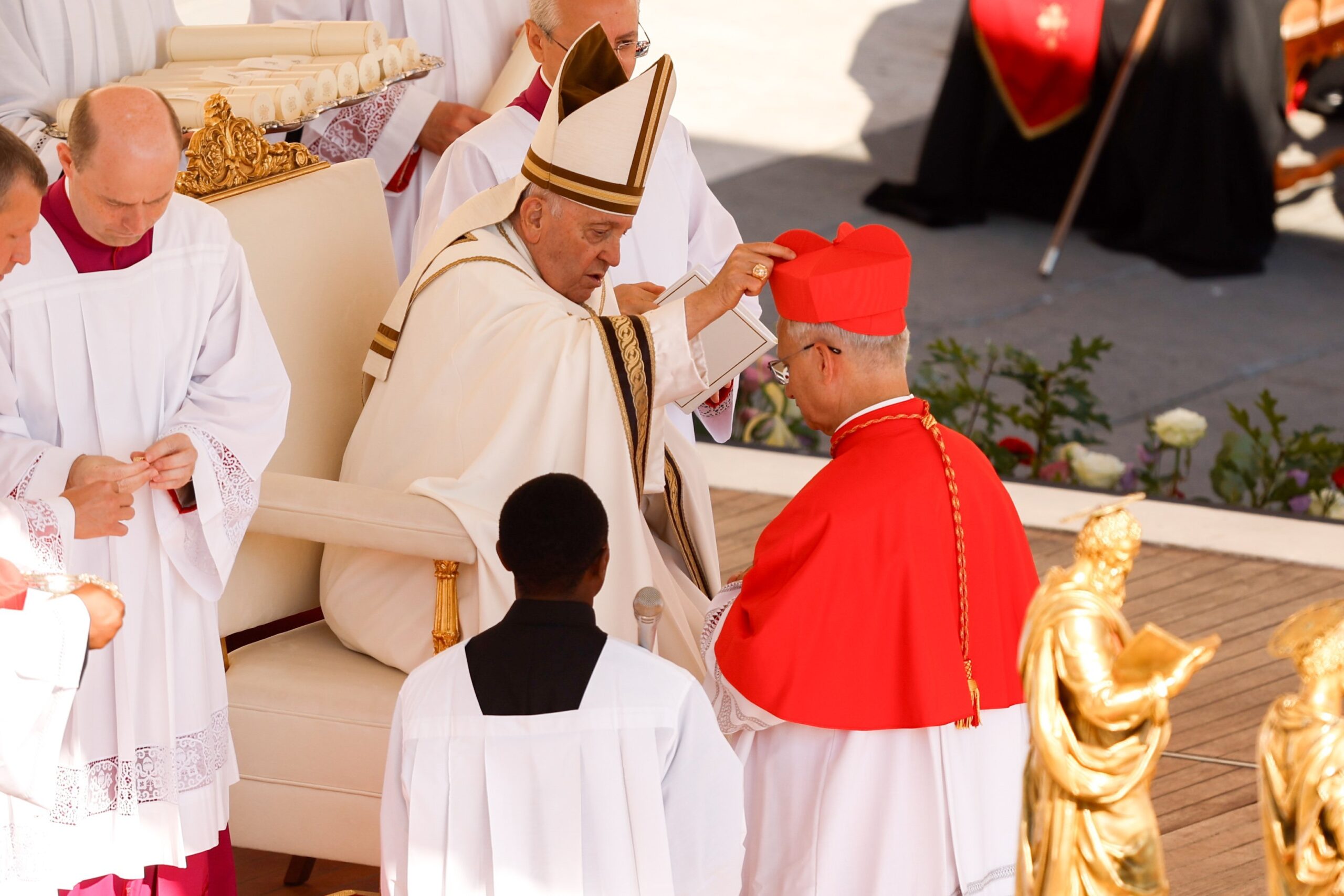

Habemus papam! We have a new Pope. Can there be any phrase more joyful to the Catholic ear?
And now all eyes will be on him, watching and waiting to see the direction that this new successor to Peter will take, because, after all, where he leads, the faithful will be called to follow.
It is probably fair to say that the selection of the first U.S. American Pope was unexpected, although the stage was partially set for him to ascend to the position. As Prefect of the Dicastery for Bishops at the Vatican, Cardinal Robert Francis Prevost, 69, was well known to the Roman Curia. He oversaw the selection of bishops and interacted with numerous cardinals in a way that was not necessarily available to most. There is no doubt that this profile contributed to his selection as the 267th Pontiff.
While Pope Leo XIV is American born, he is also a citizen of, and served for nearly two decades in, Peru. He was Bishop of Chiclayo for eight years before being brought, by Pope Francis, to Rome. Unlike some of his predecessors, he is also fluent in many languages and, on the surface of things, will be a champion of many of the late Pope’s priorities, especially around matters of social justice and interfaith understandings.
In his opening comments to the assembled in St. Peter’s, he specifically invoked Pope Francis’ language: “We must be a synodal Church,” he said, reminding us that we must stay “close to those who suffer.” And we must be champions of peace: “a disarmed peace and a disarming peace.”
But of course, every Pope is different. While much was made of Pope Francis’s refusal to wear the ornate stole and chasuble when he first appeared on the loggia of St. Peter’s Basilica, Pope Leo XIV appeared bedecked in dramatic reds, similar to previous Popes. He is also understood to be more conservative than Pope Francis but somehow strikes a middle balance so that he is supported, it seems, by both conservative and progressive cardinals. He will bring renewed energy to the U.S. context, where only a few days prior President Trump had tweeted a photo of himself as Pope, and where the landscape seems most divided between right-leaning and left-leaning bishops.
It is true to say, as well, that the impact of having another Latin American Pope will be enthusiastically received in the Spanish-speaking world. Peruvian President Dina Boluarte noted that Cardinal Prevost, while in Peru, “walked alongside the most needy, and shared the joys of our people. His choice for Peru was not merely formal, but profoundly spiritual and human. He chose to be one of us, to live among us, and to carry in his heart the faith, culture, and dreams of this nation.”
There is perhaps also a pointed irony to the decision to choose the name Leo XIV, since the previous Leo, who headed the Church from 1878 to 1903, is credited with critiquing what could be called an Americanism movement within the Church that was driven by a somewhat nationalist, inward-turning impulse. Pope Leo XIV, in choosing to speak in Italian and Spanish for his first address, and knowing Pope Leo XIII’s legacy, may well be distancing himself from an insular Americanism and indicating that he wishes to champion a truly global Church.
With Pope Leo XIV we are also transitioning from a Franciscan to an Augustinian philosophy, and many will be studying the differences, no doubt. In point of fact, however, the two spiritualities are remarkably complementary, each focusing on a love of neighbour and environment, on valuing the poor and marginalized, but also resisting closed or compartmentalized interpretations of Catholicism. Pope Leo, like Pope Francis, would also see himself as a marginal figure, something the world may well appreciate. Indeed, Pope Leo XIV/Cardinal Prevost once explained why Pope Francis nominated him to his initial role in Rome by saying, “He wanted a missionary; he wanted someone from outside; he wanted someone who could come in with a different perspective.” That was certainly true of Pope Francis, and many suspect it will be true of Pope Leo.
Our new Pope inherits a dynamic agenda created by Pope Francis, but also arrives at a time when world conflicts and political divisions are at their highest. How a Chicago-born, Augustinian, Latin American enters into these polarized and wounded times is the question everyone will be asking.
The election of a new Pope is always exhilarating, and the roadmap that he develops is critically important to all Catholics — and indeed, to people of all faiths, all peoples, everywhere. We’ve seen the white smoke and now we wait for the sacred fire. The challenges are many, but the cause is great.
Your voice matters! Join the conversation by submitting a Letter to the Editor here.







