


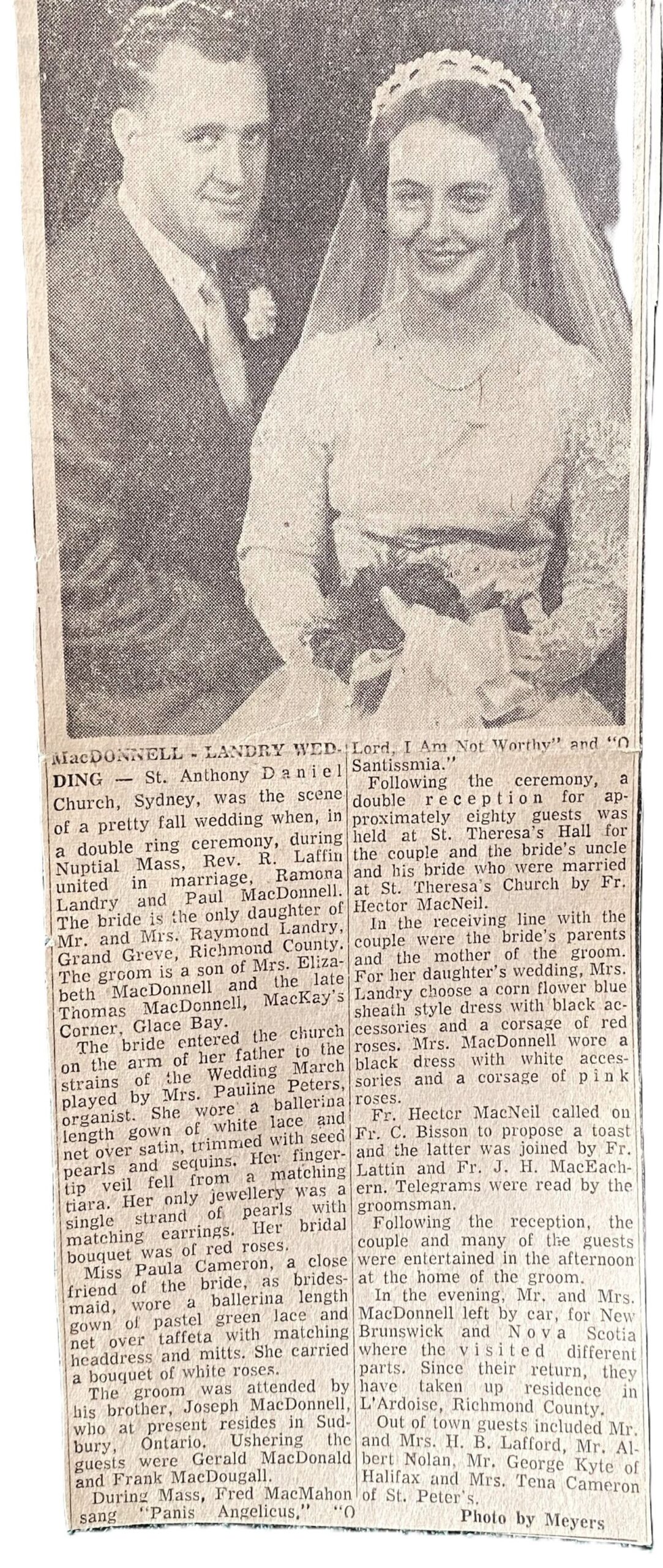
My mom recently showed us a newspaper clipping about my parents’ 1957 wedding — a virtual play-by-play of the event, including identifying the bride and groom, their families, the witnesses, the ceremony, the priest, the hymns, the reception, and even the colour of the accessories my grandmothers wore.
My mother wasn’t royalty or of particularly noble birth, but back in mid-20th-century Sydney, Nova Scotia, and in many rural communities, every wedding made the local paper.
Why? Well, on the surface, I think it was because people were curious about who was getting married to whom and what was going on in their community. But on a deeper level, I think it was because weddings were viewed as special and had a direct impact on the whole community. Marriages used to be the building blocks of communities.
At the time my parents were married, a wedding usually meant a family was soon to follow, thereby ensuring the security of the neighbourhood, village, town, etc. Also, a wedding was a good-news story in small communities where people had hard lives and found true joy in others’ special milestones.
On a spiritual level, making weddings a matter of public news also made sense because weddings are integral to the life of the Church. Although we have seen a slight upswing in Catholic marriages at our small-town parish church in the last couple of years, the number of weddings has spiralled downward in recent decades. This negative trajectory, which has been the experience of Catholics all over the world, has had a huge impact not only on the community in general, but on the parish and, thereby, the universal Church.
What is really happening when couples choose not to get married sacramentally? A sacramental marriage means a wedding officiated by a Catholic priest or deacon, with both bride and groom in a state of grace, in a Catholic church, with at least two witnesses, vowing before God their marriage contract to each other to love, honour, and obey, and to welcome and raise children in the Catholic faith.
When this does not happen, and a couple instead decides either to cohabitate without getting married at all or to get married civilly outside the Church, both the couple and the Church lose.
The couple loses spiritually because they cannot access the graces available to them through a sacramental bond, nor do they access the support of the parish community.
The Church loses because the couple is not present to be part of the congregation, fulfilling their baptismal promises to build up the kingdom of Christ. There is also the sad reality that the faith will likely not be passed on to any children born of the union.
In my own growing-up years, I clearly remember everyone (especially females) looking forward to the mid-February edition of our local weekly newspaper, The Casket, which would have a special wedding section featuring helpful articles on wedding planning and local ads from businesses that could host weddings, provide catering and flowers, and offer dress shops.
The best part of this annual feature was the photos from the majority of the previous year’s weddings that had occurred in churches throughout the community. I don’t know if we were the only community that had this (I’m guessing not), but thinking back to the excitement it generated, it spoke of something else: a time, a place, a community that valued marriage.
While not all those marriages were Catholic, I can’t remember any that didn’t occur in a church of some kind. And yes, there was a big part of it that bordered on nosiness — some comparing of dresses, venues, and hairstyles — but it was a true celebration of marriage. Even the fact that it was a revenue-maker for the local paper, both in advertising and copy sales, speaks to the truth that marriage is good for everyone.
The section of the Catechism of the Catholic Church (Nos. 1601–66) on the Sacrament of Matrimony is a beautiful explanation of the important role of marriage in the Church and the world. In explaining why Catholics are required to have a church wedding, the Catechism says this:
“Sacramental marriage is a liturgical act. It is therefore appropriate that it should be celebrated in the public liturgy of the Church; Marriage introduces one into an ecclesial order, and creates rights and duties in the Church between the spouses and toward their children; Since marriage is a state of life in the Church, certainty about it is necessary (hence the obligation to have witnesses); The public character of the consent protects the ‘I do’ once given, and helps the spouses remain faithful to it” (CCC No. 1631).
We probably all know couples who are engaged, maybe even in the midst of planning a wedding. Pray for them, especially if they are Catholic and not planning to marry within the Church. Pray that each couple and the Church family will not be deprived of their sacramental witness. Pray also for the couples who are planning to get married in the Catholic Church, and be sure to celebrate them.
Lazzuri writes from her home in Nova Scotia, where she lives with her husband, three of her six children, and her mom. She can be reached at clarelazzuri@gmail.com.
Your voice matters! Join the conversation by submitting a Letter to the Editor here.







