

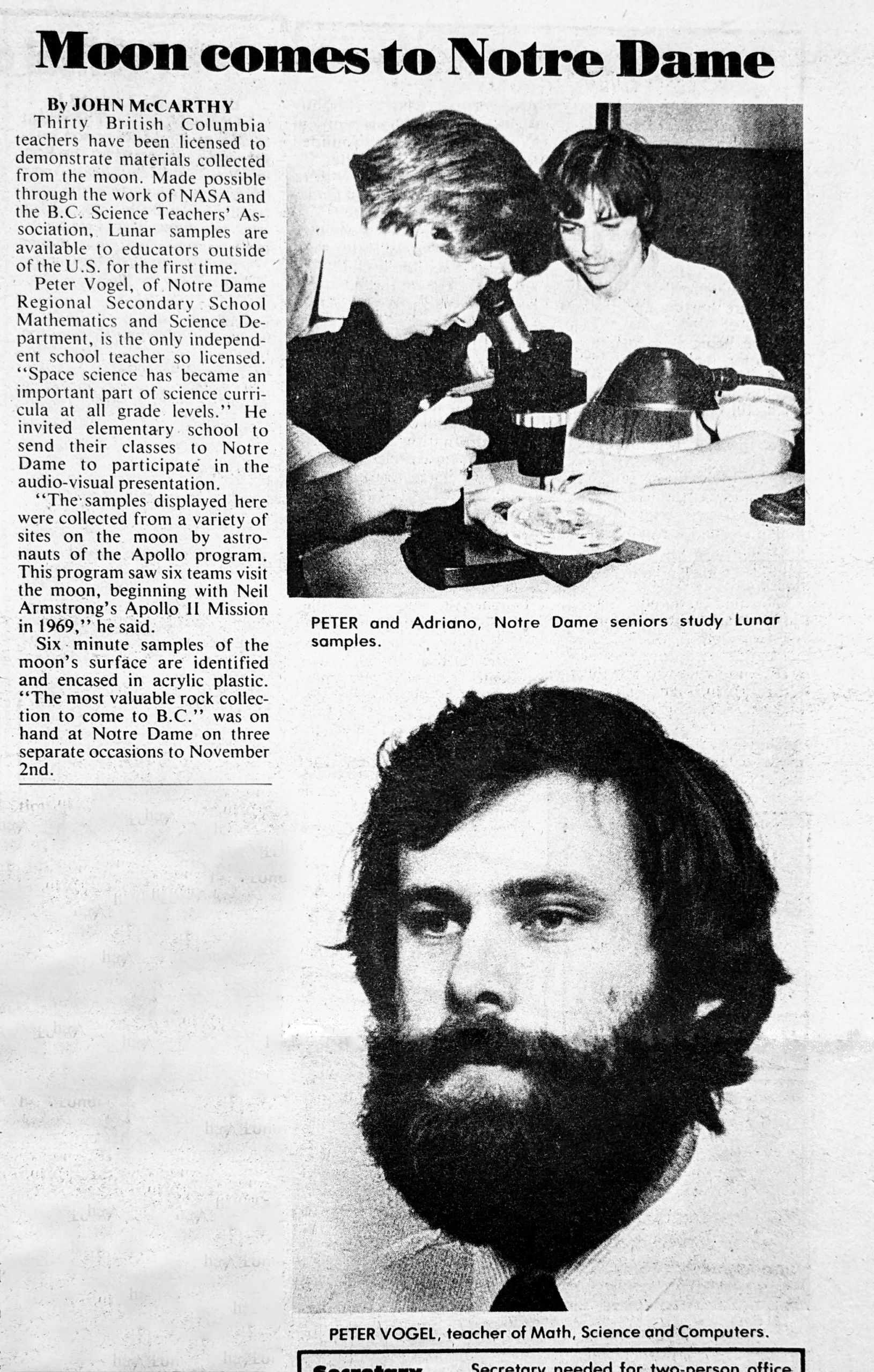

Back in October and November 1981, more than 40 years ago, this archdiocese through one of its high schools briefly became part of the U.S. space program.
OK, there is a bit of hyperbole in that sentence, in that the U.S. space program was at no point dependent upon the Archdiocese of Vancouver. Nonetheless, what did happen back then is worth remembering and celebrating.
When Neil Armstrong stepped on the moon in July 1969, uttering the memorable although slightly misheard words, “That’s one small step for (a) man, one giant leap for mankind,” little did I know that 12 years later a small assortment of lunar material collected by the Apollo astronauts would find its way to Notre Dame Regional Secondary in Vancouver.
Generations have passed since mankind last set foot on the moon, but back in 1981 there was still excitement over the achievements of the manned space program. Canada was on the verge of nominating its first astronauts, one of whom, Marc Garneau, would go into space in 1984 before becoming this country’s Minister of Foreign Affairs until the most recent federal election.
Having just begun teaching physics and computer science in 1980, I had already been part of a group of science educators who put on an annual “space update” conference to highlight new developments in the field that could subsequently be shared with students and teachers across the province.
During one of these update conferences I was fortunate to meet Garth Hull, a NASA public affairs administrator who worked out of NASA’s Ames Research Center in Silicon Valley. Early in 1981 Hull wrote those of us who worked on the update conferences to let us know NASA and the U.S. government were going to make a small sample set of lunar material available to a select group of educators on a short-term loan basis.
So it was that about 10 B.C. science teachers found themselves in a classroom one Saturday morning to receive background materials and, most importantly, be certified to receive and exhibit lunar materials.
Fast forward to October 1981 when I received a letter from Hull, designating a date and time to present myself to a customs official at Vancouver Airport to pick up a sample of the most valuable rock collection on earth.
Needless to say, presenting a certificate to pick up moon rocks at the airport customs office generated some discussion. The rocks themselves were encased in a small plexiglass shell, labelled with the missions from which they originated. This shell was contained in a small metal case with a lot of soft foam packing material.
Accompanying the rocks’ transport case was a set of teaching materials to duplicate for students, along with a 16 mm film that described the Apollo program and the various sites where the landings occurred, beginning of course with the now infamous Mare Tranquillitatis, the Sea of Tranquility, where Neil Armstrong and Edwin “Buzz” Aldrin landed, becoming the first humans to set foot on another world.
Knowing that there would be tremendous interest in the moon rocks, even if only small samples, I had arranged ahead of time for various schools to bring their students to hear my presentation on the program, watch the NASA film, and then see the lunar rock samples directly and under microscopes.
That’s how a little over 40 years ago a small Catholic high school in East Vancouver briefly became an outpost of the American space program, the first I believe outside of the United States.
Sadly, the lunar landing missions ended with Apollo 17 in 1972, and no human has since set foot away from Earth. To be sure there were political overtones to placing humans on the moon, but the technology developed to accomplish the goal set by President Kennedy in May 1961 of “landing a man on the moon (before this decade is out) and returning him safely to the earth” led to much of the electronics we use today.
Follow me on Facebook (facebook.com/PeterVogelCA), on Twitter (@PeterVogel).
pvogel@outlook.com







