

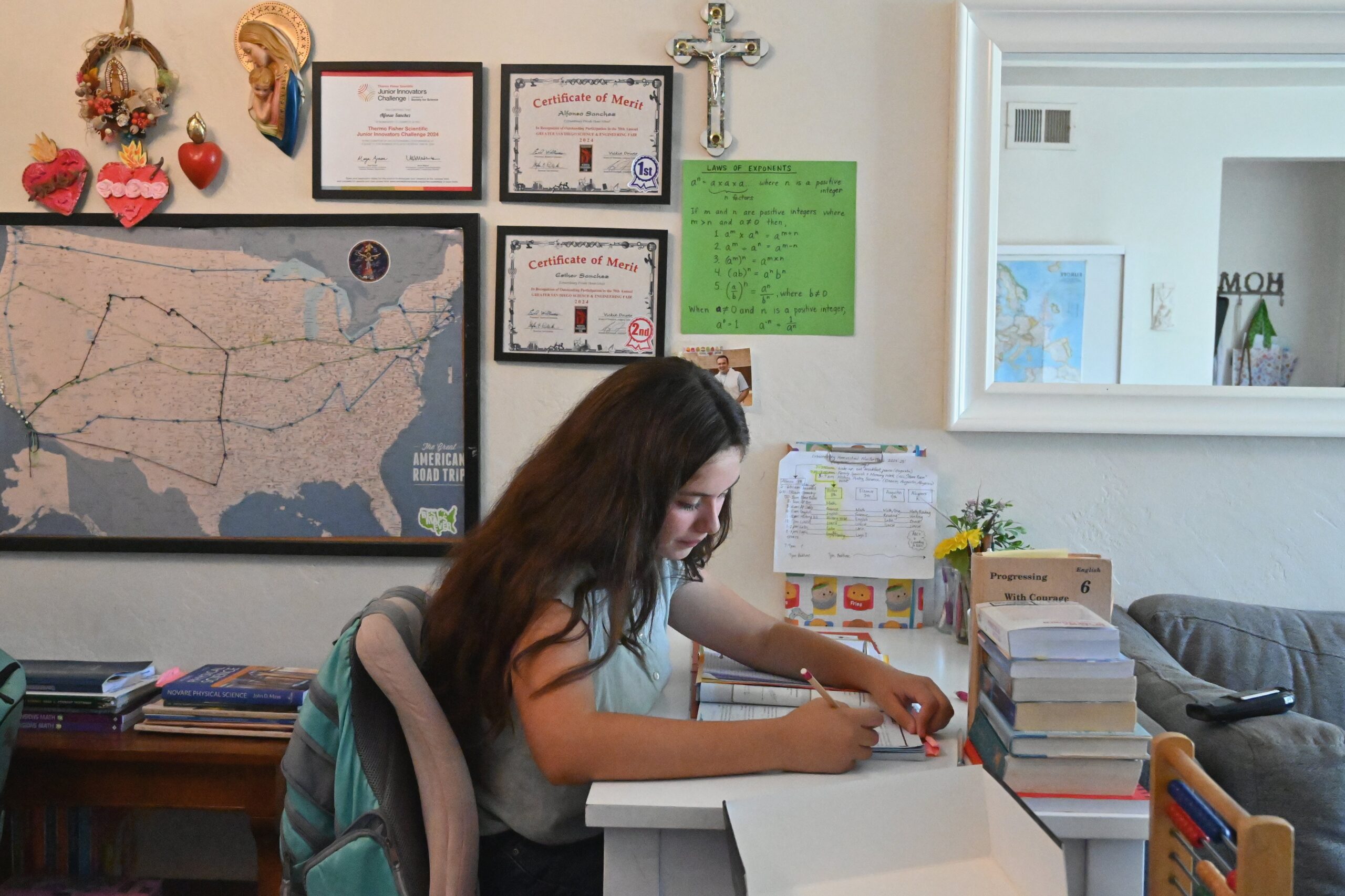

I remember envying a family of seven in my neighbourhood. All five of their children (including a daughter my age) were homeschooled, and all I knew about their educational experience was that they spent very little time on it. Or so it seemed.
While I sat in class all day, they would ski, play musical instruments, or come up with complex challenges that involved bouncing a basketball off the roof and the driveway at just the right angles to get it in the hoop – and catching it all on camera.
It wasn’t fair, I thought. I wished I was out skiing.
To homeschool or not to homeschool?
Many of us parents with kids in the two- to four-year-old age range are trying to decide how to educate our kids. Do we send them to preschool to get a foot in the door in our preferred private school? Do we have to teach them numbers, letters, and shapes before they start kindergarten? Do we take a crack at homeschooling? Now that I’m the parent of a three-year-old, these questions are deeply personal.
Homeschooling in Canada is on the rise. It was slowly climbing about five per cent per year, but the COVID pandemic triggered a huge jump. The number of students enrolled in homeschool in the fall of 2020 was more than double the previous year.
It still is by far the least common way to educate children, far behind public (91.1 per cent of students) and private (7.5 per cent) education, according to Statistics Canada. Only about 1.5 per cent of Canadian children are homeschooled.
Or, maybe, they all are.
A section of the Catechism of the Catholic Church on the duties of families states that “Parents have the first responsibility for the education of their children.”
I’ve heard it many times, especially in the context of parents being unhappy with some curriculum or other that their child’s public or private school is using. We parents have a say! Of course, I agree with this. No teacher has to live with their students for life. Parents must make certain choices about what their kids learn and how because they are ours.
The next part of that Catechism clarifies further: “They bear witness to this responsibility first by creating a home where tenderness, forgiveness, respect, fidelity, and disinterested service are the rule. The home is well suited for education in the virtues.”
Letters, numbers, and shapes are secondary. First come the basics: forgiveness, respect, and serving others no matter what they can do for us in return.
It is the home where kids first learn (or don’t learn) to love their neighbours and stand up for the bullied. The home is where kids who can’t quite reach, can’t quite read, can’t quite manoeuvre their arms or fingers right, can receive encouragement and support. The home can lay the groundwork for respect for different abilities, needs, and preferences. The home is where kids can learn that people who act or learn differently are equally loved by God.
At home, kids start to learn how to become virtuous human beings – or not. It’s a far more encompassing thing than once-a-year Pink Shirt Day.
As for the numbers, shapes, biology, geography – they can be taught in many places and in many ways. Some things we learn in the classroom change over the years. (Remember when Pluto was a planet?)
But the unchanging truths that God loves us all and that we must love each other with respect, forgiveness, and tenderness do not change. That lesson plan is best started at home, no matter where you learn the other stuff.
I think that’s the kind of homeschooling we can all get behind.
Your voice matters! Join the conversation by submitting a Letter to the Editor here.







