
This Sunday’s Readings examine the relationship between God’s power and secular power.
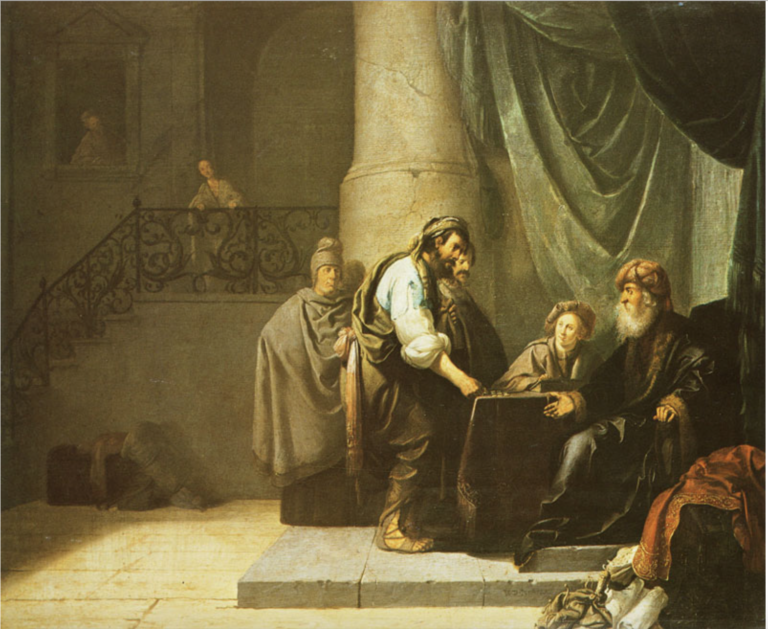
The Cyrus of the First Reading was the founder of the Persian Empire. Starting as leader of the Persians while they were still a small tribe of hardy warriors subject to the King of Media, he became master of the whole of Asia Minor in 546 BC. Seven years later he captured Babylon and allowed the Jews who had been taken there in 586 BC to return to Jerusalem.
Dorothy Sayers said that she first met Cyrus in Tales from Herodotus (the Greek historian). She pigeon-holed him in her mind, she said, with the Greeks and the Romans.
Then, she said, with a “shock as of sacrilege,” she discovered that in his campaign against Babylon, Cyrus “had marched clean out of Herodotus and slap into the Bible.” Here was God, she said, “bursting” into history, “taking an interest in events and people that seemed altogether outside His province.” She found it “disconcerting,” she said.
In this Sunday’s First Reading, God does more than “take an interest” in secular events. He tells Cyrus that it is he who has armed him, and for His own purposes: “to subdue nations” and “strip kings of their robes” so that everyone may know that God is the Lord, “and there is no other.”
God “disposes his works according to his will,” says the Catechism of the Catholic Church. “He is the Lord of the universe, whose order he established and which remains wholly subject to him and at his disposal. He is Master of history, governing hearts and events in keeping with His will.” The sacred books “powerfully affirm God’s absolute sovereignty over the course of events.”
It is with this in mind that St. Paul could say in the Second Reading, “For we know, brothers and sisters, beloved by God, that he has chosen you, because our message of the Gospel came to you not in word only, but also in power and in the Holy Spirit and with full conviction.” The people might think that they had chosen God, but, as Jesus said to His disciples at the Last Supper, “It was not you who chose me, but I Who chose you.”
“God is the sovereign Master of his plan,” the Catechism affirms. “But to carry it out he also makes use of his creatures’ cooperation.” He enables us to collaborate with him freely, intelligently, and purposefully, in order to perfect the harmony of creation for our own good and that of our neighbours.
Because we are free, we can refuse. However, we do not thereby frustrate God’s plan. God “would never allow any evil whatsoever to exist in his works if he were not so all-powerful and good as to cause good to emerge from evil itself,” St. Augustine said. God always brings good out of evil. If we will not collaborate with him like a son or daughter, we will serve him unconsciously, willy-nilly, like a tool. God’s will is always accomplished.
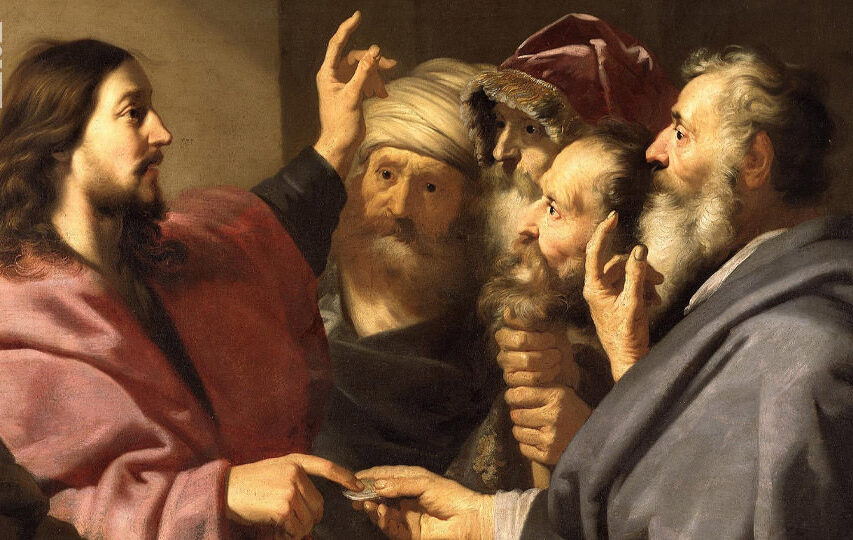
When Jesus’ enemies presented him with the coin used to pay taxes to Caesar, He asked, “Whose head is this, and whose title?” When they replied, “Caesar’s,” Jesus said, “Give therefore to Caesar the things that are Caesar’s and to God the things that are God’s.”
In other words, if we pay to Caesar that which bears his sign, then we should pay to God that which bears his sign, and that means everything.
All of creation bears God’s stamp, because he made it, as the Psalm asserts. Then, as the end and purpose of his creation, he “created man in His own image, in the image of God he created him; male and female he created them.”
More than anything else on earth that God created, humans bear the stamp of His image. We owe Him, therefore, nothing less than ourselves.
Father Hawkswell is again teaching The Catholic Faith in Plain English, with new insights. The whole course is available in written form and, one session per week, in YouTube form at beholdvancouver.org/catholic-faith-course. Father is also teaching the course in person: on Sundays at 2:00 pm in the John Paul II Pastoral Centre, 4885 St John Paul II Way, Vancouver (33rd and Willow); and on Mondays at 10:00 am in St. Anthony’s Church hall, 2347 Inglewood Avenue, West Vancouver. The title of next week’s talk is “Liturgy: Public Worship.” No pre-registration is necessary.