


Second
Sunday of Easter, Year B
First
Reading: Acts
4:32-35
Second
Reading: 1 Jn
5:1-6
Gospel
Reading: Jn
20:19-31
Throughout the world, by Vatican decree, the Second Sunday of Easter is Divine Mercy Sunday. In the Gospel reading, we hear how Jesus, on the evening of the very day he had risen from the dead, came through locked doors and stood among his apostles. He breathed on them and said, “Receive the Holy Spirit. If you forgive the sins of any, they are forgiven them; if you retain the sins of any, they are retained.”
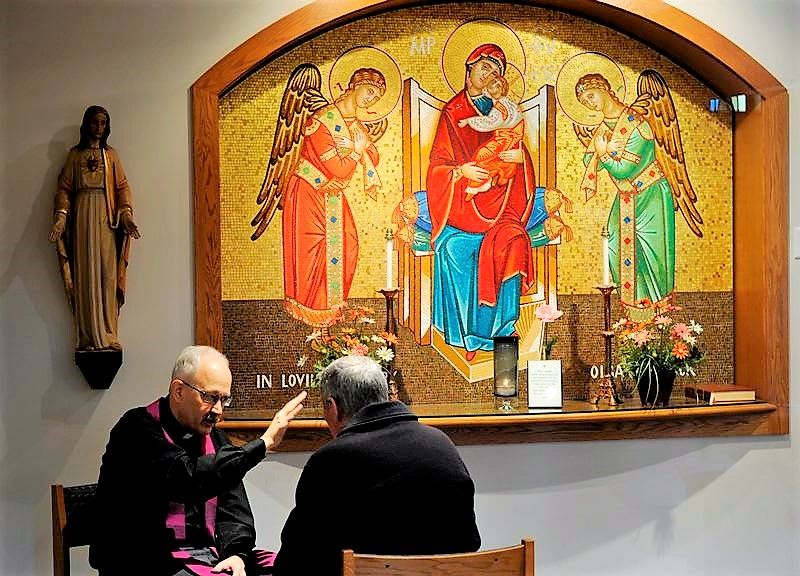
He did not say, “I have redeemed you from Satan!” or “I have won eternal life for you!” even though he had done both, notes Cardinal Timothy Dolan in his book Priests for the Third Millennium. What Jesus “most wanted to give his Church was mercy for sins;” he wanted to “share with his priests the power to absolve them.”
God “has reconciled us to himself through Christ and has given us the ministry of reconciliation,” St. Paul says. “This makes us ambassadors for Christ – God, as it were, appealing through us. We implore you, in Christ’s name: be reconciled to God!”
“The essence of priesthood is configurement to Christ as the Head and Shepherd of the Church, to such an intimate degree that we actually act in his Person,” Cardinal Dolan says. “Never do I feel more in Persona Christi than in the confessional. Our people know that they are confessing not to a priest but to our Lord. We stand in his place. We are his ears, his words, his forgiveness! Christ is the Minister of the Sacrament, and we act in his Person. How awesome and humbling that is!”
The cardinal tells how, as seminarians, he and some of his classmates travelled from Rome to go to confession to St. Pio of Pietrelcina, but found the lineups too long. When, the next day, they met that great confessor, he shrugged his shoulders and said, “Go to confession back in Rome. It’s the same thing!”
“He wasn’t being rude,” the cardinal says; “he was being realistic! Christ is the Confessor; we priests are only his instruments.”
In the sacrament of penance, priests proclaim “not a proposition, not advice, but a Person,” the cardinal says: “we proclaim Christ!
As confessors, priests are not theologians (“although Lord knows a sound knowledge of theology, especially a good grasp of solid moral theology, is called for”). They are not psychologists (“although insights from that helpful discipline are valuable”). They are not social workers, friends, or advice columnists (“although elements from each of those roles would be beneficial”).
As confessors, he says, “we are Christ!” What “we say is, ‘Our Lord loves you very much; Jesus now completely forgives all your sins; your sorrow for sin moves his Sacred Heart; Heaven is rejoicing because you have returned; Jesus is happy because you have accepted his invitation to repent and have made his cross worthwhile; Jesus never loves us more than when we tell him we’re sorry.’“
“People want us to take their sins seriously, because they themselves do, or they would not be there,” the cardinal says. Accordingly, the priest is firm, rebuking, challenging, correcting, and even admonishing. His job is not “to explain sin away but to forgive it.”
Owning up to a sin is the first step toward salvation, he says. If, as the late Billy Graham said, “the preacher’s first job is to convict people, to move people to be so convinced of their sins that they view themselves as convicts waiting for a sentence from the Eternal Judge,” then the priest’s job, the cardinal says, “is to give the sentence,” and the sentence is, “You are forgiven!”
On this Divine Mercy Sunday, we priests remember that, with you, we are sinners, in need of God’s mercy. We also remember that, for you, we are Christ the Confessor, and we say with St. Paul, “We implore you, in Christ’s name: be reconciled to God!”
Note: Pope St. John Paul II, who instituted Divine Mercy Sunday, granted a plenary indulgence to those who, on that day, “in any church or chapel, in a spirit that is completely detached from the affection for a sin, even a venial sin, take part in the prayers and devotions held in honour of Divine Mercy, or who, in the presence of the Blessed Sacrament exposed or reserved in the tabernacle, recite the Our Father and the Creed, adding a devout prayer to the merciful Lord Jesus (e.g. ‘Merciful Jesus, I trust in you!’)” He also granted a partial indulgence to those who, “at least with a contrite heart, pray to the merciful Lord Jesus a legitimately approved invocation.”
For the plenary indulgence, which remits all punishment due to sin, the usual three conditions apply, namely sacramental confession, Eucharistic communion, and prayers for the Pope’s intentions. The confession can be within three weeks of Divine Mercy Sunday, before or after; the Communion and the prayers for the Pope, usually an “Our Father” and a “Hail Mary,” should be on the actual day.







