

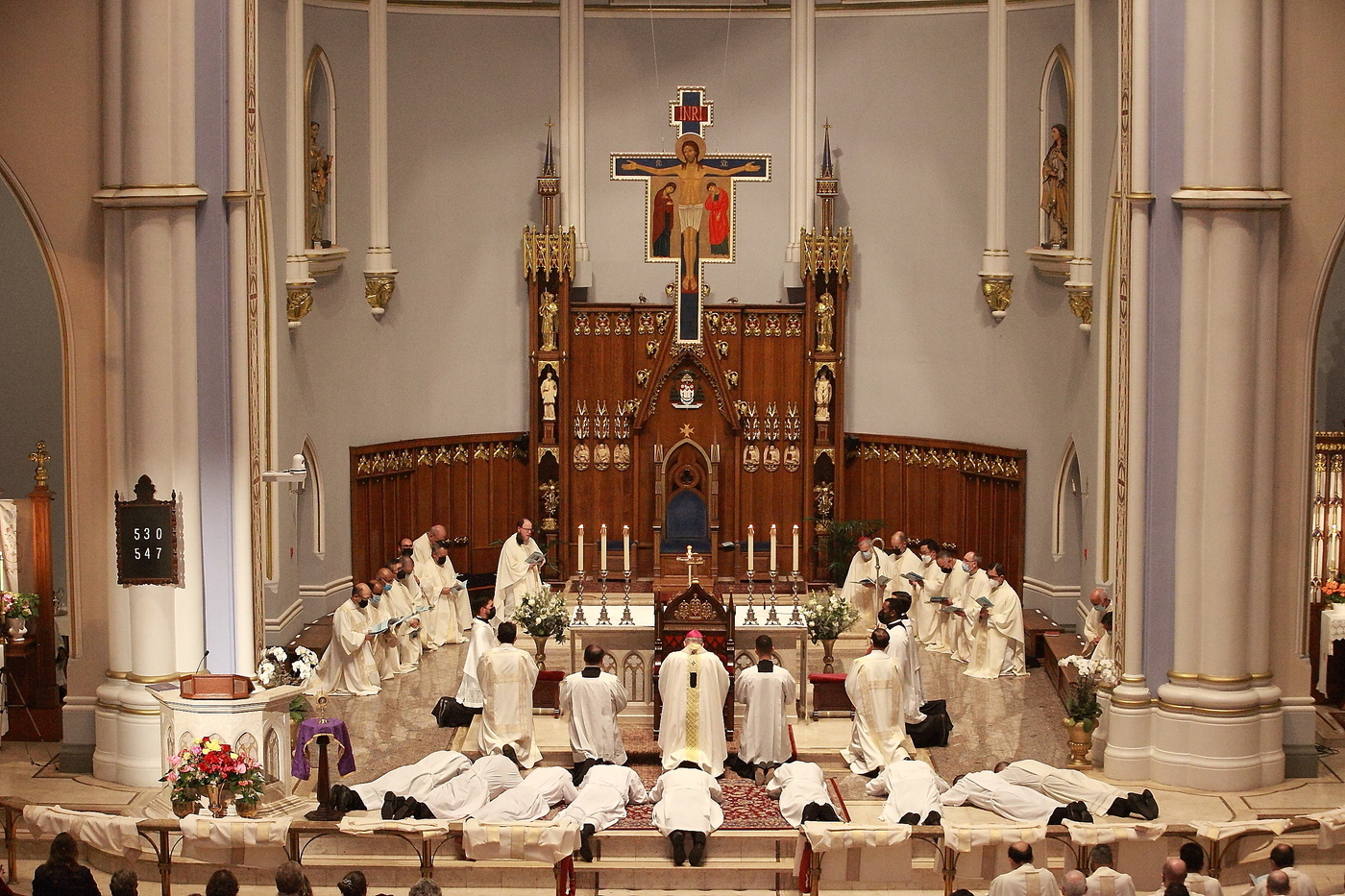

Fifth Sunday of Easter, Year A
First Reading: Acts 6:1-7
Second Reading: 1 Pt 2:4-9
Gospel Reading: Jn 14:1-12
“It is not right that we should neglect the word of God in order to wait on tables,” the apostles said. “Therefore, brothers, select from among yourselves seven men of good standing, full of the Spirit and of wisdom, whom we may appoint to this task, while we, for our part, will devote ourselves to prayer and to serving the word.”
“What they said pleased the whole community,” and they had those whom they selected “stand before the apostles, who prayed and laid their hands on them.”
In this way, the apostles established the diaconate: an ordained ministry (along with those of bishops and priests), transmitted by the imposition of hands.
In the Middle Ages, the office of deacon declined in importance, but in 1964 the Second Vatican Council restored it as “a proper and permanent rank of the hierarchy.” Archbishop Miller inaugurated a four-year program of studies for permanent deacons in the Archdiocese of Vancouver in 2011. The archdiocese now has 34 permanent deacons.
“The Church’s deepest nature is expressed in her three-fold responsibility,” said Pope Benedict XVI: proclaiming the word of God (kerygma-martyria), celebrating the sacraments (leitourgia), and exercising the ministry of charity (diakonia). These duties presuppose each other and are inseparable. For the Church, charity is not a kind of welfare activity that could equally well be left to others, but is a part of her nature, an indispensable expression of her very being.”
At some periods in the Church’s history, the emphasis has been on spirituality to the exclusion of feeding the hungry. Then, in an effort to correct the imbalance, the Church has emphasized the necessity for waiting on tables.
However, like the drunkard who falls off his horse first on one side and afterward on the other, we then tend to forget the spiritual and think that the only true Christians are those who work with the poor. Pope St. John Paul II said that some theologians have diminished Christianity to little more than waiting on tables. Some people are Christians not because they believe the truths of the Creed, but because Christianity preaches love for the poor.
Accordingly, we need the admonition contained in this Sunday’s Second Reading: “Like living stones, let yourselves be built into a spiritual house” – not an economic house or a political house.
Vatican II saw both sides: “What the faithful have received by faith and sacrament in the celebration of the Eucharist should have its effect on their way of life.”
“Everyone who has participated in the Mass should be eager to do good works, to please God and to live honestly, devoted to the Church, putting into practice what he has learnt and growing in piety.”
Before we can minister to others as true Christians, we must be in Christ – members of his Mystical Body – in the sense that Christ meant in the Gospel Reading: “Believe me that I am in the Father and the Father is in me.”
However, it is tempting to think that the Church should enter the field of politics.
I have just been reading about what the Catholic Church did and did not do for the Jews during World War II. Again and again, diplomats and politicians urged Pope Pius XII to condemn Hitler and Germany explicitly. Instead, he condemned the evil of persecuting people on the grounds of their nationality or race.
The bishops have been specially trained to look after the affairs which concern us as creatures who are going to live forever in another world, not as pilgrims spending a few years journeying through this one. Their job is to pray and serve the word, preaching Christ as “the way, the truth and the life.”
Only when we understand and believe that will we find the strength and the energy to feed the hungry, protect families, do justice to the disinherited, and disarm the violent.
Father Hawkswell teaches The Catholic Faith in Plain English, with new insights in both print and YouTube form at beholdvancouver. org/catholic-faith-course. Father is also teaching the course in person on Sundays from 2 to 4 p.m. at the John Paul II Pastoral Centre (4885 Saint John Paul II Way, 33rd Avenue and Willow Street, Vancouver) and on Mondays from 10 a.m. to noon in St. Anthony’s Church Hall, 2347 Inglewood Avenue, West Vancouver. Next week’s topic is “Marriage and the Family.”







