


Fourth Sunday of Easter, Year A
First Reading: Acts 2:14a, 36b-41
Second Reading: 1 Pt 2:20b-25
Gospel Reading: Jn 10:1-10
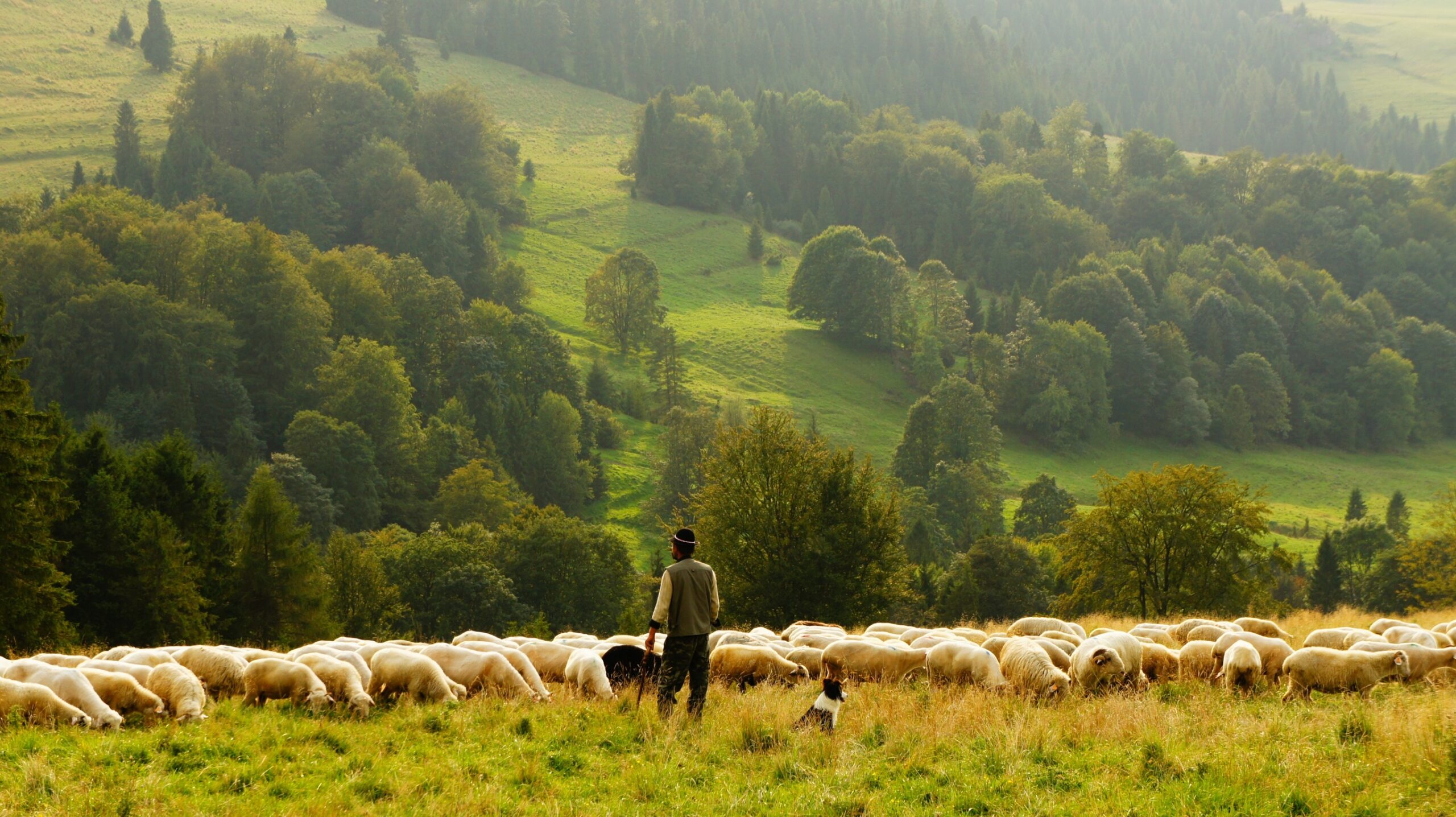
This Sunday’s liturgy pictures Christ as our shepherd.
“Give us new strength from the courage of Christ our shepherd,” we pray in the Opening Prayer.
“The Lord is my shepherd; there is nothing I shall want,” we say in response to Psalm 23.
“I am the good shepherd … I know my sheep, and mine know me,” we quote in the Gospel Acclamation.
“The good shepherd is risen! He who laid down his life for his sheep, who died for his flock, he is risen!” we exclaim in the Communion Antiphon.
“Father, eternal shepherd, watch over the flock redeemed by the blood of Christ,” we pray in the final prayer.
In the Second Reading, St. Peter reassures us: “You were going astray like sheep, but now you have returned to the shepherd and guardian of your souls.”
It is comforting to think of Christ as a shepherd – many people choose Psalm 23 for funerals – but it is disconcerting to think of ourselves as sheep.
Sheep are rather silly animals. I remember, from my boyhood in Ireland, how they go under a hedge to get the greenest and tenderest grass and get their fleece caught. At great labour, I would pull them out – and they would immediately do the same again.
Sheep quickly scatter without someone to herd them. They follow anyone who appears to lead them. They cannot see what is best for them; they need a shepherd to show them.
Unappealing as it may be, it is an image we have to accept, because Christ used it.
What should our response be?
The answer is the one Jesus gave to the rich young man: “Follow me.” The proper thing for sheep to do is follow and obey.
We need a shepherd because the “green pastures” in which Christ will make us lie down and the “still waters” beside which He will lead us to “restore our souls” will often look to us, silly sheep as we are, like Calvary.
To continue his work of shepherding after he left us, Christ instituted the Church. Just before he ascended to heaven, he said to St. Peter, “Feed my lambs; feed my sheep.” That is what Pope Francis does, Peter’s 265th successor as shepherd of Christ’s flock.
We do not like to think of ourselves as sheep. In former days, the Vatican had a list of books we should not read; now, we think, we can decide for ourselves. As one of the people said who take my course on “The Catholic Faith in Plain English,” we “don’t like the idea of blind obedience.”
Our obedience does not have to be “blind.” We believe in order to understand; and we understand, the better to believe, St. Augustine said.
But even when we do not understand, “there should never be a diminishment of that fundamental openness loyally to accept the teaching” of the Church. We “will strive to understand this teaching in its contents, arguments, and purposes.” This will mean “an intense and patient reflection” on our part and “a readiness, if need be, to revise” our own opinions,” as the Vatican said in its “Presentation Note” to Pope John Paul II’s Ordinatio Sacerdotalis.
In his book Milestones, Pope Benedict XVI told of a theologian who, before Mary’s Assumption was dogmatically defined in 1950, argued “passionately” against it. “What will you do if the dogma is nevertheless defined?” he was asked. “Won’t you then have to turn your back on the Catholic Church?” After a moment’s reflection, the theologian replied, “If the dogma comes, then I will remember that the Church is wiser than I and that I must trust her more than my own erudition.”
After all, as G.K Chesterton said, what we need is not really “a religion that is right where we are right;” what we need is “a religion that is right where we are wrong.”







