


Over the past few months, I have been involved in music rehearsals to prepare for Holy Week. One of the selections prepared by my adult choir is titled, “Where are the Shepherds Now?” by J. Paul Williams and James Michael Stevens. I have always been struck by the lyrics and therefore started teaching it to my children’s choir as well.
Linking two pivotal moments in our Christian faith – the birth and death of Jesus – the song invites singers and listeners alike to leave the agony of Calvary for a few moments to reflect on the promise of Bethlehem. “Where are the shepherds? Where are the wisemen? Where are the angels now? Can you tell me where?” The lyricists then take us back to Calvary: “As Christ is nailed on a cross of shame, a crown of thorns pressed on His brow; where are the shepherds now?”
When I introduced this song to the children in my young choir, they could easily recall the feelings of Christmas. They eagerly shared their ideas for why the Nativity sparked so much attention (joy, excitement, hope). They could likewise tell me why they thought people didn’t run to the Crucifixion in the same ways (fear, sadness, disappointment).
The children worked hard to use dynamics as they sang these and the song’s subsequent questions about the needy who received Jesus’ love and help yet seemed to abandon him at the Cross. The children were encouraged to allow their listeners to truly reflect on how Christ was born to die on the Cross, and on how oppositional people’s reactions at Christmas and Easter seemed to be, even today.
The final verse of the song really hit home with all of us. “Where are the faithful? Where are the grateful? Where are the twelve He chose? Can you tell me where? As Christ is hanging between two thieves, a crown of thorns pressed on His brow; where are the faithful now?” The words “Where are the faithful?” are then repeated, and the children’s voices grew quieter, encouraging reflection. Yes, I was directing them, but they seemed to really understand what the song was about.
Even young children know that we ourselves are those called to fall on our knees by the Cross, just as the shepherds and wisemen knelt before the manger. It is appealing to think of visiting a new, perfect baby; it is frightening to think of angry shouts and a brutal murder. Yet the Cross enabled Jesus to fulfill God’s promise. That torturous and humiliating death led to the death of sin, followed by the Resurrection, which promises eternal life.
We believe this. We know the Baby was born to die and rise again. We cannot go from Christmas to Easter without Good Friday. We need to join in Christ’s pain and bear the weight of that Cross. We need to be there. We are “the faithful.”
The Stella Maris Choir was to sing this song on Palm Sunday. The Immaculate Conception “Harmonizers” were to sing it at a Holy Thursday retreat as well as on Good Friday for a children’s Stations of the Cross service. Sadly, due to the COVID-19 outbreak and our need to avoid public gatherings, our choirs and this song will be silenced.
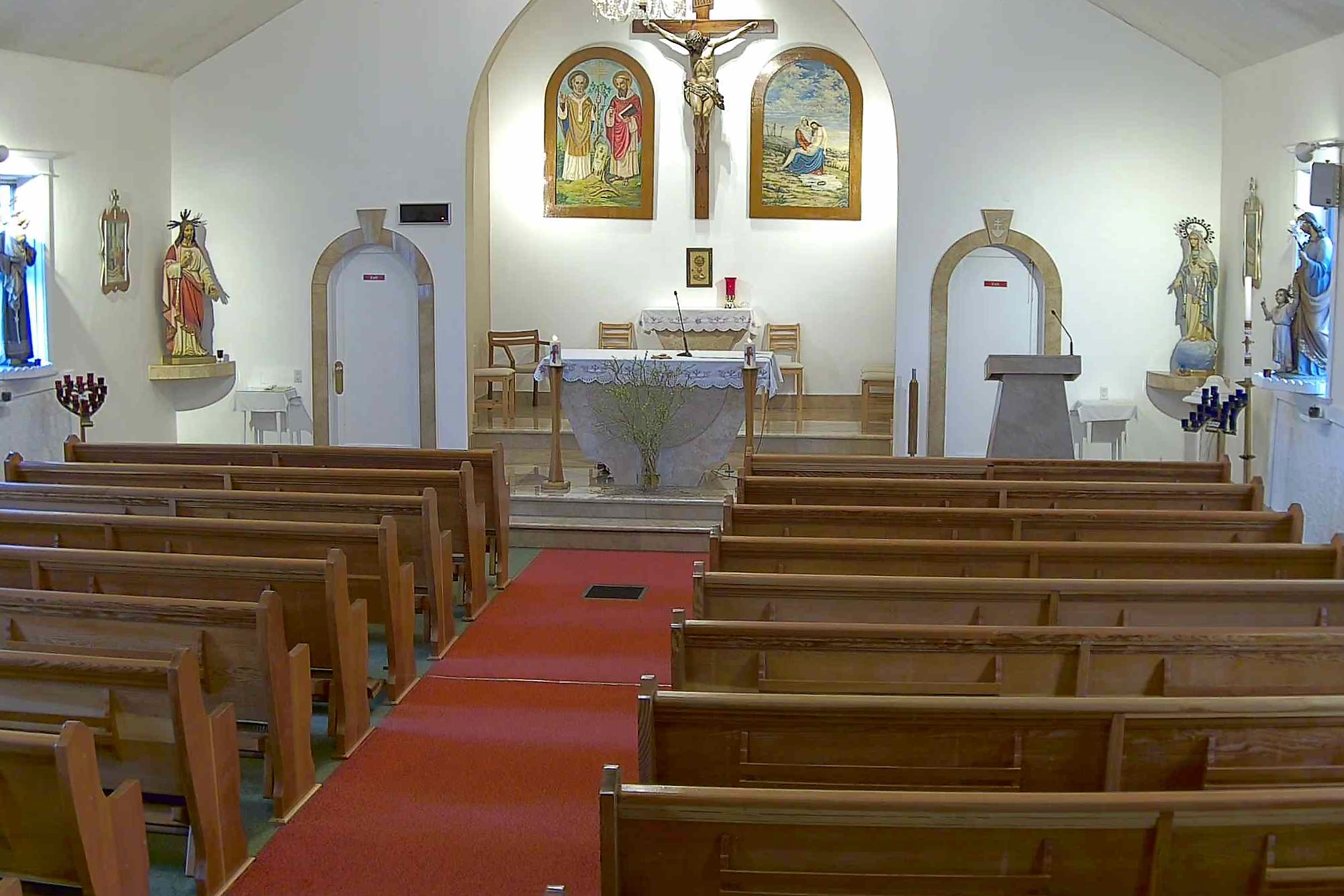
As I watch Masses online, I take note of the eerily empty churches. Although I know why we are all stuck in our homes, I repeatedly question, “Where are the faithful?” Barren churches across the globe on Good Friday and even Easter Sunday will prompt us to ask this question even more earnestly.
In the absence of public worship, we are reminded that while we are called to community, we have also always been called to kneel at the Cross on our own: “But when you pray, go into your room, close the door and pray to your Father, who is unseen. Then your Father, who sees what is done in secret, will reward you” (Mt 6:6).
So, this Easter, where are the faithful? We are praying in secret, watching Mass online, spending time with our families, connecting remotely with others, and eagerly anticipating the opportunity to once again gather in churches with other people of faith.







