

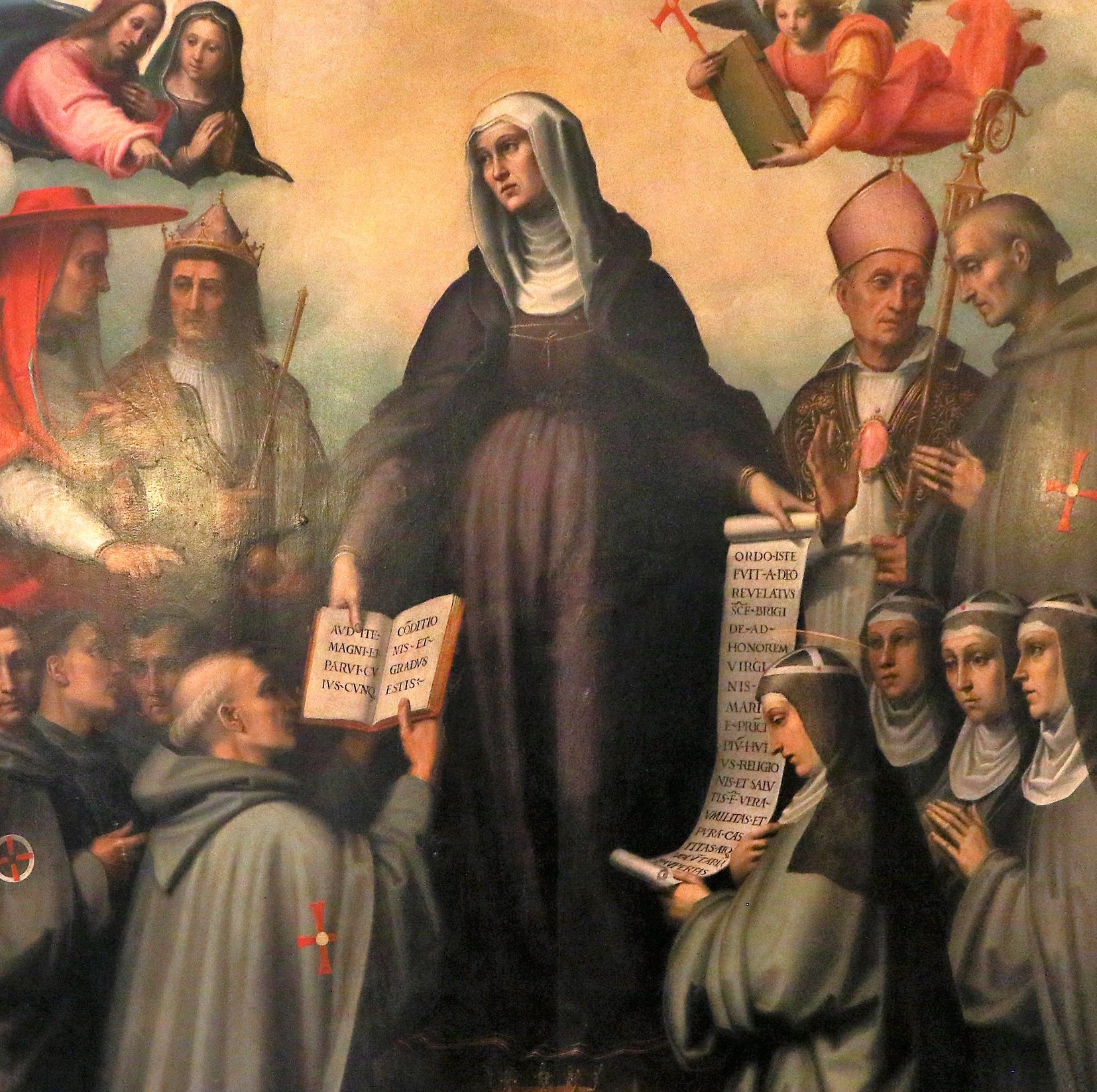

St. Bridget of Sweden (1303-1373) is a co-patroness of the whole of Europe. In declaring that role for her, Pope Benedict XVI said, “Pope John Paul II hoped that St. Bridget – who lived in the 14th century when Western Christianity had not yet been wounded by division – may intercede effectively with God to obtain the grace of full Christian unity so deeply longed for.”
Pope Benedict said, “We can distinguish two periods in this Saint’s life. The first was characterized by her happily married state…. The second period of Bridget’s life began when she was widowed.”
Regarding the first period, St. John Paul II wrote, “Without abandoning the comfortable condition of her social status, she and her husband Ulf enjoyed a married life in which conjugal love was joined to intense prayer, the study of Sacred Scripture, mortification, and charitable works. Together they founded a small hospital, where they often attended the sick. Bridget was in the habit of serving the poor personally.”
Bridget had eight children and was devoted to their education. Her second child was St. Catherine of Sweden (ca. 1331-1381). In 1341, Bridget and her husband made a long pilgrimage to Santiago de Compostela with other members of the family. After the pilgrimage, the couple agreed to live in continence. Ulf entered a Cistercian monastery and died shortly afterwards.
Pope Benedict commented, “This first period of Bridget’s life helps us to appreciate what today we could describe as an authentic ‘conjugal spirituality’: together, Christian spouses can make a journey of holiness sustained by the grace of the sacrament of Marriage. It is often the woman, as happened in the life of St. Bridget and Ulf, who with her religious sensitivity, delicacy and gentleness succeeds in persuading her husband to follow a path of faith.”
As a widow, the saint undertook a severe form of life and received many private revelations. Pope Benedict explained: “St Bridget’s Revelations have a very varied content and style. At times the revelations are presented in the form of dialogues between the divine Persons, the Virgin, the Saints and even demons; they are dialogues in which Bridget also takes part. At other times, instead, a specific vision is described; and in yet others what the Virgin Mary reveals to her concerning the life and mysteries of the Son.”
St. Bridget founded the monastery of Wadstena in Sweden. Leaving Sweden in 1349, Bridget settled in Rome to obtain papal approval for her new religious order. She went on pilgrimage to many shrines in Italy to venerate the relics of saints. Her last pilgrimage was made between 1371 and 1372 to the Holy Land. Bridget died in 1373 and was canonized by Pope Boniface IX in 1391.
Blessed Anne Catherine Emmerich (1774-1824) was a mystic and visionary like St. Bridget. She was born in Germany in 1774 to a poor Catholic peasant family.
Anne Catherine entered an Augustinian convent in 1802 and became bedridden in 1813. She had visions since childhood. She also had the gift of knowing the diseases of the sick and prescribing the proper remedies. Anne Catherine prayed and suffered much for the souls of purgatory whom she often saw.
Anne Catherine had visions concerning the life of Christ, Our Lady, and the saints. The Catholic Encyclopedia states: “Her visions go into details, often slight, which give them a vividness that strongly holds the reader’s interest as one graphic scene follows another in rapid succession as if visible to the physical eye. Other mystics are more concerned with ideas, she with events; others stop to meditate aloud and to guide the reader’s thoughts, she lets the facts speak for themselves with the simplicity, brevity, and security of a Gospel narrative.”
Both St. Bridget and Blessed Anne Catherine were intensely devoted to the Passion of Christ. The contents of their private revelations help the faithful to meditate on the Mysteries of Christ. Father Mark Higgins compiled the visions of these mystics according to the Mysteries of the Holy Rosary and these meditations were published by Catholic Way Publishing in 2019 and 2021.
Share your thoughts by sending us a letter to the editor.
神視者敬禮耶穌苦難
瑞典的聖彼濟達(1303-1373)是整個歐洲的其中一位主保。教宗本篤十六世說:『教宗若望保祿二世在宣佈她那歐洲共同主保,希望聖彼濟達—他生活在14世紀,當時西方基督徒還沒有受到分裂的傷害—願能有效地向天主代求,以獲得深深所渴望的基督徒完全合一的恩典。』
教宗本篤說:『我們可以區分這位聖人一生中的兩個時期。第一個時期的特點是她婚姻幸福的狀態…彼濟達生命的第二個時期始於她喪偶的時候。』
關於第一個時期,聖若望保祿二世寫道:『在不放棄她社會地位的舒適條件的情況下,她和她的丈夫烏爾夫享受了婚姻生活,在這種婚姻生活中,夫妻之愛與強烈的祈禱、聖經研究、補贖和慈善工作相結合。他們一起成立了一家小醫院,經常在那裡照顧病人。彼濟達習慣於親自為窮人服務。』
彼濟達有八個孩子,她最致力於他們的教育。她的第二個孩子是瑞典的聖加大肋納(約1331-1381)。1341年,彼濟達和她的丈夫與其他家庭成員一起前往聖地牙哥德孔波斯特拉朝聖。朝聖后,這對夫婦同意貞節生活。烏爾夫進入了一座熙篤修院,不久后就去世了。
教宗本篤十六世評論說:『彼濟達生命的最初階段幫助我們欣賞今天我們可以描述為真正的「夫妻神修」:基督信徒配偶可以一起踏上由婚姻聖事恩典支撐的成聖之旅。往往是女人,就像聖彼濟達和烏爾夫的生活一樣,她以她的宗教敏感性、細膩和溫柔成功地說服她的丈夫走上信仰之路。』
在作為寡婦的第二個時期,聖人經歷了一種嚴厲的生活形式,並得獲了許多私人啟示。教宗本篤十六世解釋說:『聖彼濟達啟示錄有非常多樣化的內容和風格。有時,啟示至聖聖三、童貞女聖母、聖人甚至魔鬼之間的對話形式呈現;這些對話是彼濟達有所參與的。在其他時候,描述了一個特定的神視;在另一些時候,聖母瑪利亞向她揭示了聖子的生平和奧秘。』
聖彼濟達在瑞典建立了瓦德斯泰納修道院。彼濟達於1349年離開瑞典,定居在羅馬,以獲得教宗對她的修會會規的批准。她前往義大利的許多聖地朝聖,以恭敬聖人的聖髑。她的最後一次朝聖是在1371年至1372年之間前往聖地的。彼濟達於1373年去世,並於1391年被教宗博義九世封為聖人。
真福亞納、加大肋納、艾默裡奇(1774-1824)是像聖彼濟達一樣的神視者。她於1774年出生於德國一個貧窮的天主教農民家庭。
亞納、加大肋納於1802年進入奧斯定修院,並於1813年臥床不起。她從小就有神視能力。她也有瞭解病人疾病和開出適當療法的天賦。亞納、加大肋納於為她經常看到的煉獄的靈魂祈禱和而受苦。
亞納、加大肋納對基督、聖母和聖人的生活都有神視。天主教百科全書指出:『她視象是細節,通常是輕微的,這賦予它們一種生動的感覺,強烈地抓住了讀者的興趣,因為一個圖形場景緊接著另一個圖形場景,就像肉眼可見一樣。其他神視者更關心於思想,她更關心於事件;其他人停下來大聲默想,去引導讀者的思想,她讓事實為它們自己說話以福音陳述的簡單、簡潔和安全來說話。』
聖彼濟達和聖亞納、加大肋納都強烈地敬禮基督的苦難。他們私人啟示的內容幫助信徒們默想基督的奧秘。Mark Higgins神父根據《玫瑰經的奧秘》彙編了這些神視者的視象,這些默想於 2019 年和 2021 年由天主教之路出版社Catholic Way Publishing 以英文出版。







