

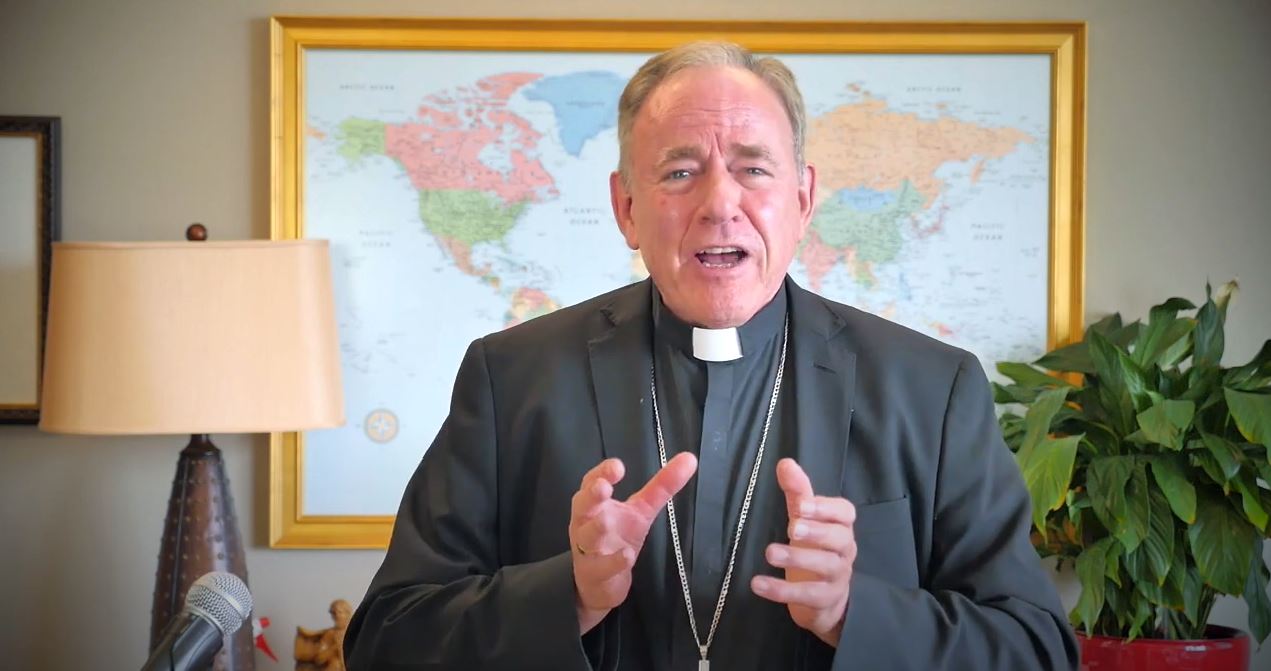

This summer, most Catholics in the Archdiocese of Vancouver have been participating in liturgies through “virtual” Masses and livestreamed prayer events. But these innovations really can’t replace being at Mass in person, receiving the Eucharist, and gathering as a community, says Archbishop J. Michael Miller, CSB.
He recently gave a presentation on the subject as a featured speaker on the online series, Into the Deep. These are excerpts of his remarks.
The outbreak of COVID-19, almost overnight and without time for much preparation, brought the public celebration of Holy Mass with a congregation almost to a standstill.
The lay faithful were deprived of participation at Mass, while their priests continued to offer Mass for them. Even now, for health and safety reasons, our congregations are limited to a maximum of 50 at any one time. As Bishop Robert Barron has said, such a situation strikes “a very serious blow to our incarnational faith.”
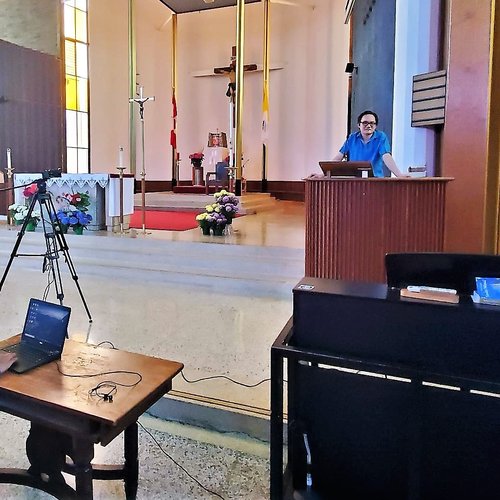
For all Catholics the absence of a normal sacramental life has been, and remains, a heavy burden. We are living a moment of unrest in society and of spiritual trial for the Church, but we are also being given the opportunity to think about the deeper reason why this is so. This raises the theological question about the relationship between the Incarnation, Jesus Christ, the Church, and the sacraments.
In the midst of a pandemic
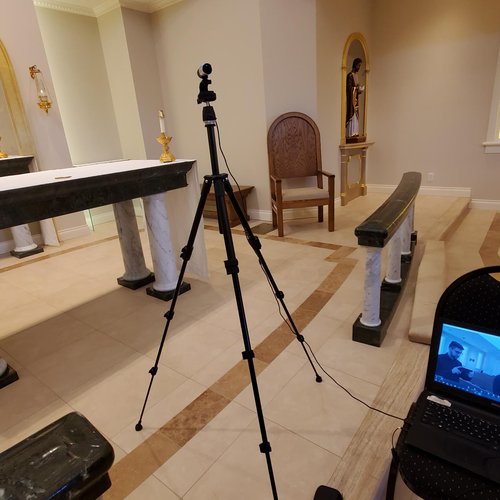
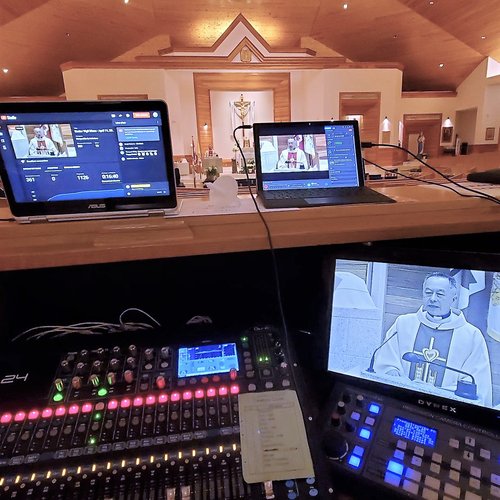
Thanks to the new technologies now available and the zeal and creativity of our priests and parishioners, the livestreaming of Mass and other activities has become widespread across the archdiocese. This is a grace which would have been unknown less than a generation ago and for which we should be grateful.
Yet, despite this gift of social media, I share the warning of Pope Francis. He puts all of us on guard when we look to the post-pandemic future: “Be careful – he says – not to make the Church virtual; not to make the sacraments virtual, not to make the people of God virtual. The Church, the sacraments, the people of God are concrete.”
The question therefore that inevitably arises is this: why is our physical presence, our in-person presence at the Eucharist, such a big deal for Catholics?
Under normal circumstances – and the current pandemic is definitely not a normal situation – we know that watching Mass via live streaming does not fulfill the obligation of attending Sunday Mass. Except for those whose health or particular circumstances prevent in-person attendance, such broadcasts do not, in Pope Benedict’s words, “dispense them from going to church and sharing in the Eucharistic assembly in the living Church.”
The Eucharist, celebrated in a parish community, calls for the bodily, in-person presence of the faithful gathered in a sacred space – a church or chapel – set apart for the worship of God. When livestreamed or videotaped, the “active and conscious” participation of the faithful in the liturgy is simply not there. Moreover, and most significantly, watching Mass makes full participation impossible because we cannot receive Holy Communion digitally.
Let me be honest here. I am very concerned that we not lose understanding why Mass online, while good as a temporary measure at this trying time, is not desirable in the long-run. Father Paul D. Scalia has said technology “cannot actually put us in touch with one another. It only tides us over until authentic human communication – unmediated, face‑to‑face, person‑to‑person – can be recovered.”
The livestreaming of Mass is “a reminder that should increase our yearning for the reality, not satisfy it. When it ceases to increase our yearning, we should forswear watching it at all,” says writer Jeffrey Mirus.
If we begin to think that the distinction between virtual Mass and in-person presence is not really very important, then we will have abandoned the Catholic understanding of the sacramental plan of salvation.
The Incarnation
This English word “incarnation” comes from the Latin incarnatio which means “enfleshing” or “becoming flesh” or, more simply, “becoming a body.” The Incarnation is the becoming man of God’s Eternal Son in the womb of the Virgin Mary. Its basis in Scripture is the prologue of John’s Gospel, where we read that “the Word became flesh and dwelt among us” (Jn 1:14). The Incarnation is the joyful proclamation that “Jesus Christ has come in the flesh” (1 Jn 4:2).
The Incarnation tells us that our salvation by God, who became man in Jesus of Nazareth, was brought through his humanity, through his body crucified and risen.
And who are we, who receive this salvation? We ourselves as human persons are incarnate spirits; that is, beings united in body and soul. We human beings are neither merely matter without spirit nor an angelic incorporeal spirit. The Vatican’s International Theological Commission has said, “What most authentically defines us is that complementary union between the material‑corporeal, visible, and the spiritual‑incorporeal, which is not detached from the material and is made known through it.”
The Incarnation, which emphasizes the bodily coming of God’s Son into the world, has an impact on every aspect of Catholic life.
The Sacraments
Just as our bodies are the means through which we carry out our activity in the world, so in the same way does Christ use the Church as his instrument to accomplish the work of redemption among us. In her teaching and her sacraments, the Church perpetuates through time the original saving words and actions of Jesus.
Every human encounter takes place through created realities. We communicate with others through sight, speech, hearing, smell, and touch. We most fully reveal ourselves and discover others through bodily gestures which demand a physical, not just a virtual, presence.
Our encounters with the Christ follow the same pattern. Divine life comes to us through his saving actions and words, now carried out in the Church by ministers acting in his name and in his person.
The most sublime ways in which we encounter Christ in the Church are the sacraments. “God touches us through material things, through gifts of creation that he takes up into his service, making them instruments of the encounter between us and himself,” says Pope Benedict.
God’s way of saving us is rightly called “incarnational,” because it comes to us through Christ’s sacred humanity and his Body, the Church. We can even say that the Incarnation continues among us in the seven sacraments of the Church, especially in the Eucharist.
The salvation that Jesus offered during his public ministry continues in the Church through the sacraments. In the words of Pope St. Leo the Great: “what was visible in Christ has passed into the sacraments” of the Church.
Above all, it is the Paschal Mystery that brings about salvation. As Christ’s action, it is ever present in the Church in her liturgical celebrations “and in particular in the Sacrament of the Eucharist, which makes the redemptive sacrificial offering of the Son of God present,” says Pope Benedict.
This living and saving presence of Christ transcends all times and places. At Mass we are present with Christ in his Sacrifice on Calvary – and not just in our imagination but in reality.
What I find so wonderful in the sacramental plan of salvation is that, when God communicates with us, he respects our nature and way of acting. He saves us as we are: bodily persons who encounter others through created realities. The sacraments are a “language” that we understand.Bodily Presence and Eucharist
Our sacramental encounter with Christ in the Eucharist is always intimately personal; that is, of a person to a person. He isn’t present to us side by side, as when we sit next to someone at the movies, nor is he present merely in spirit, as when we think fondly of someone who is absent or as in a livestreamed or videotaped Mass.
Christ’s is a bodily presence to us, corresponding to our human makeup as body‑soul beings. His love for us is not just word – “I love you” – but becomes flesh – “This is my Body given up for you. Take and eat.”
Receiving Holy Communion at Mass, united with a community of the faithful, highlights why in-person celebration must be the norm and cannot be replaced by any virtual celebration. At Communion, Christ unites himself personally with each communicant, but he is also uniting himself with the man and woman next to me in my pew.






