


24th Sunday in Ordinary Time, Year C
First Reading: Ex 32:7-11, 13-14
Second Reading: 1 Tim 1:12-17
Gospel Reading: Lk 15:1-32
This Sunday’s Readings are about conversion, which means “changing direction.”
St. Paul describes his own conversion from ignorance, unbelief, blasphemy, persecution, and violence. Jesus describes the younger son’s conversion from greed, wastefulness, and “dissolute living.” God himself, we are told, “changed his mind” about the disaster he had planned to bring on his people.
Of course, God cannot change. Humans can change from one condition to another because we are finite, but God is infinite; there is nothing for him to change to.
The change in God’s relationship with his people, therefore, must be due to a change in them. God is always ready to forgive, as Jesus implies in his parable, but, if forgiveness is to be effective, it must be accepted as well as offered.
To accept forgiveness we must admit our guilt, both objective (we have done wrong) and subjective (we knew it was wrong). We must also intend to change.
Speaking of our own wrongdoing, we sometimes quote, “To err is human.” Everybody commits sins, we argue; God loves us as we are; he will forgive everything. However, we make no move to change; we refuse to be converted.
We are confusing forgiving with excusing or overlooking.
God is truth itself; he cannot excuse or overlook wrongdoing any more than a mathematics teacher can overlook or excuse the statement that 2+2=5.
Moreover, because God loves us, he cares about our happiness. He knows that what is wrong can never make us happy with the deep, unshakable, everlasting happiness he wants to give us.
Jesus was infinitely compassionate to sinful humans. He said to the woman caught committing adultery, “Has no one condemned you? Neither will I condemn you.” He quoted twice from the Old Testament, “It is mercy I desire, and not sacrifice.” In the parable of the vineyard labourers, he promised to accept us no matter how late in life we turn to him. “Christ Jesus came into the world to save sinners,” St. Paul says.
However, alongside this compassion there is an almost intolerable severity. “Go,” he said to the adulterous woman, ”and sin no more.” He warned that we must strive to enter his kingdom through the narrow door, for “many will try to enter and be unable.” He warned us to count carefully the cost of following him, because it means being ready to renounce those closest to us, lop off our hands and feet, and pluck out our eyes. “Be perfect,” he commanded, “as your heavenly Father is perfect.”
Some of his injunctions were so severe that his own disciples asked in amazement, “Then who can be saved?”
Remember his appalling words to some of those who protest that they have eaten and drunk in his company and listened to him teach: “I tell you, I do not know you.”
“Your sins are forgiven; go, and sin no more.” For the past, Jesus offers infinite compassion, complete and untiring forgiveness; for the future, he demands nothing short of perfection.
We must not attempt to make terms with God. “You shall love the Lord your God with your whole heart, with your whole soul, and with all your mind,” Jesus said. We must hold nothing back.
Jesus’ compassion is directed toward raising up the fallen, not making us comfortable in our fallen condition. He is infinitely merciful when we fail, even when we fail repeatedly, but he will not (for he cannot) accept a deliberate compromise.
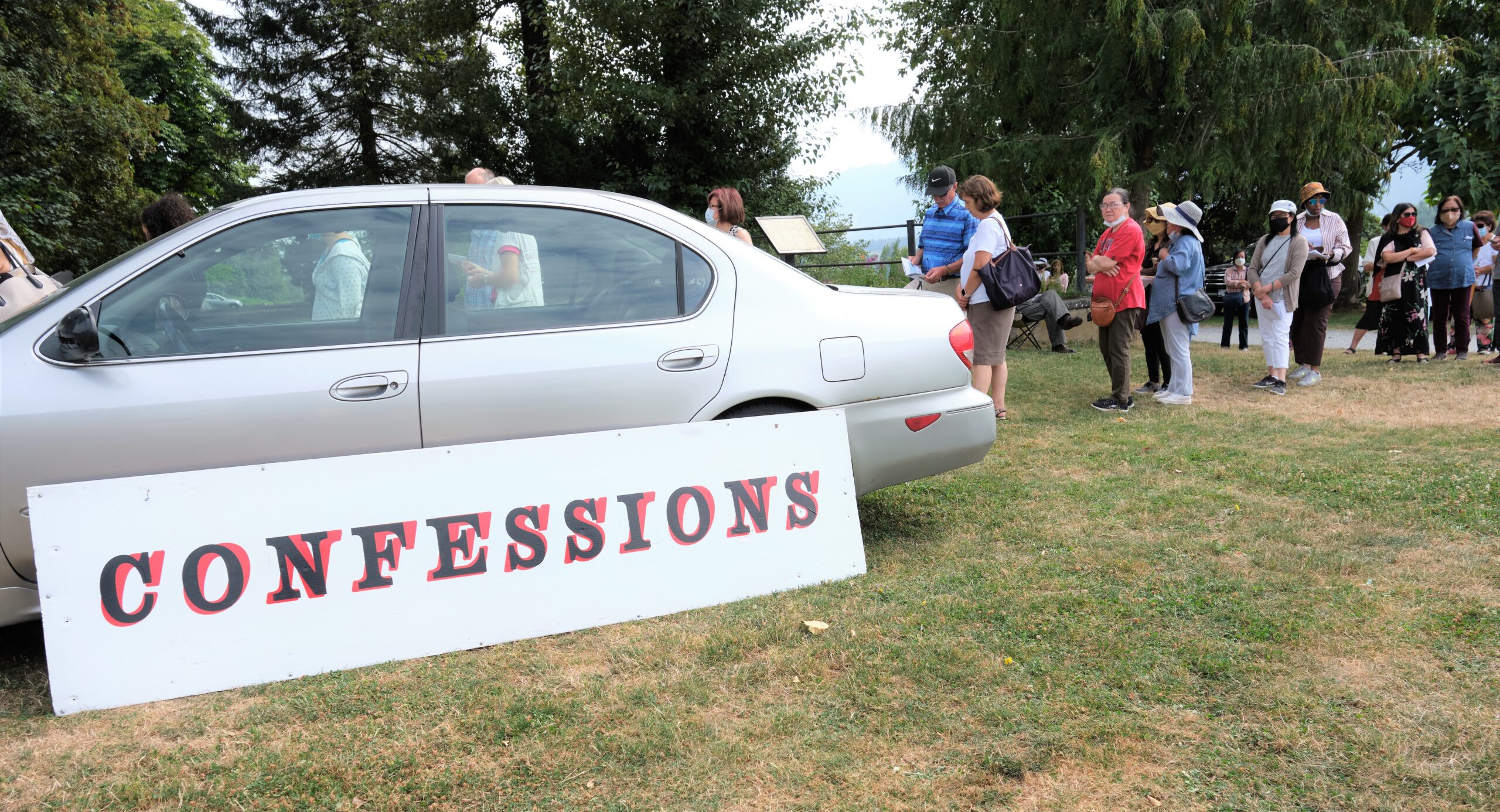
However, his forgiveness is as near as the nearest priest. We should never hesitate to go to confession: to confess our sin, to acknowledge that it is wrong and that we did it through our own fault, and to promise to change and make amends.
Jesus is always waiting for us. At the first sign of conversion, he will run out to meet us. He will never spurn “a humble, contrite heart.”
Father Hawkswell will start teaching The Catholic Faith in Plain English, with new insights, in September. The whole course will be available in written form and, one session per week, in YouTube form at beholdvancouver.org/catholic-faith-course. Father will also be teaching the course in person: on Sundays at 2 p.m. in the John Paul II Pastoral Centre, 4885 St John Paul II Way, Vancouver (on 33rd Avenue between Cambie and Oak Streets) starting Sept. 11; and on Mondays at 10 a.m. in St. Anthony’s Church hall, 2337 Inglewood Avenue, West Vancouver, starting Sept. 12.







