

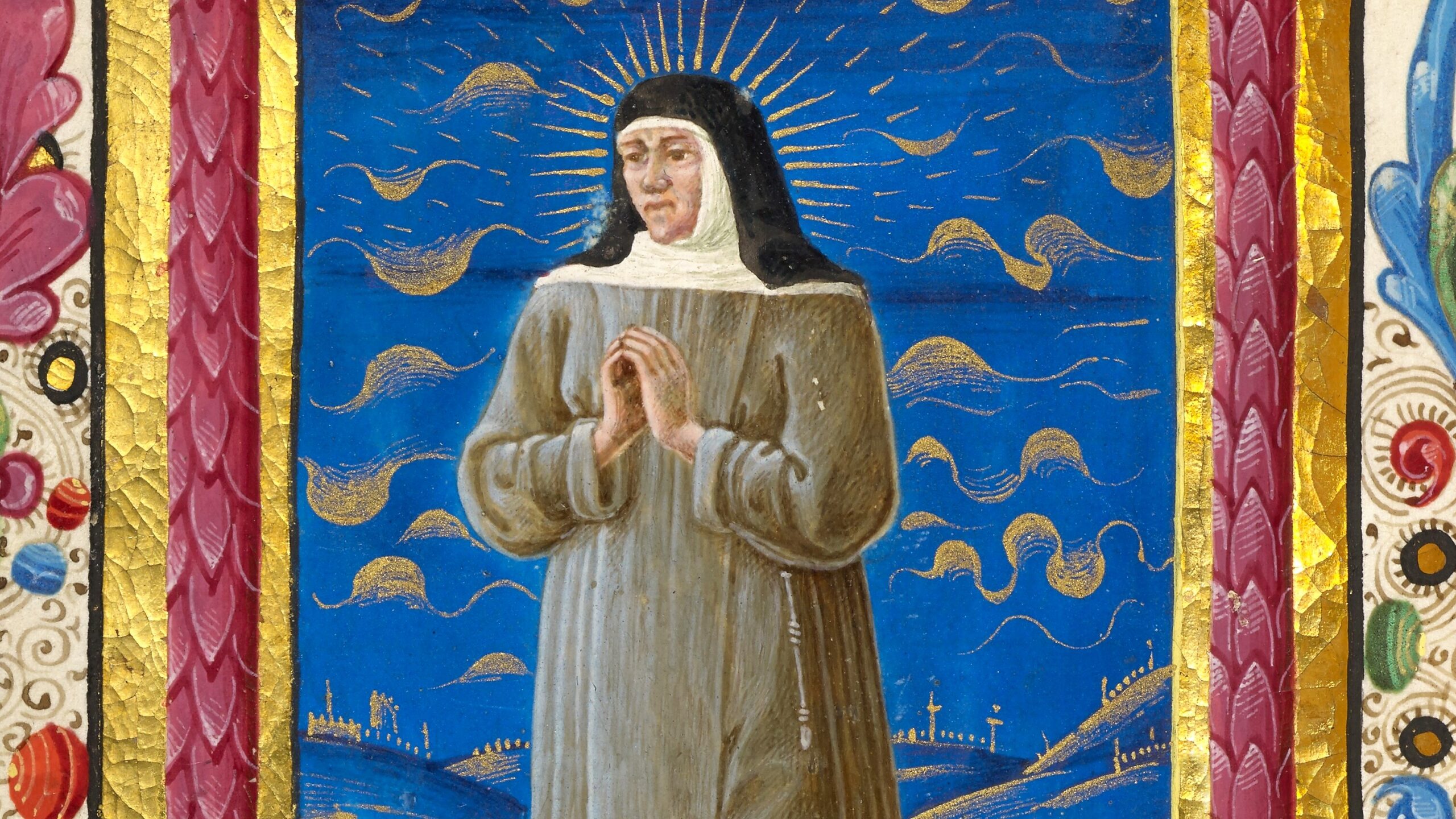

St. Catherine of Bologna was a 15th-century mystic. She was born of noble parentage in Bologna, Italy, in 1413. When she was about 10 years old, Catherine entered the court of Nicholas of Est, Marquis of Ferrara. She served as lady-in-waiting to Margaret, the daughter of Nicholas. In the court, Catherine studied Latin, poetry, music, painting, and dancing.
In 1427, Catherine decided to leave the court to join a community of young noblewomen who dedicated themselves to God. Pope Benedict XVI said, “We know nothing of Catherine’s spiritual path prior to this decision. Speaking in the third person, she states that she entered God’s service, ‘illumined by divine grace … with an upright conscience and great fervour’, attentive to holy prayer by night and by day, striving to acquire all the virtues she saw in others, ‘not out of envy but the better to please God in whom she had placed all her love.’”
Catherine experienced intense spiritual struggles. Pope Benedict explained: “She made considerable spiritual progress in this new phase of her life but her trials, her inner suffering and especially the temptations of the devil were great and terrible. She passed through a profound spiritual crisis and came to the brink of despair. She lived in the night of the spirit, and was also deeply shaken by the temptation of disbelief in the Eucharist. After so much suffering, the Lord comforted her: he gave her, in a vision, a clear awareness of the Real Presence in the Eucharist, an awareness so dazzling that Catherine was unable to express it in words.”
Catherine had gained much experience through spiritual struggles. She wrote The Seven Spiritual Weapons, which identifies seven effective means in the fight against evil. Pope Benedict highlighted them:
1. always to be careful and diligently strive to do good;
2. believe that alone we will never be able to do something truly good;
3. trust in God and, for love of him, never to fear in the battle against evil, either in the world or within ourselves;
4. meditate often on the events and words of the life of Jesus, and especially on his Passion and his death;
5. remember that we must die;
6. focus our minds firmly on memory of the goods of heaven;
7. be familiar with Sacred Scripture, always cherishing it in our hearts so that it may give direction to all our thoughts and all our actions.
Catherine and some members of her community decided to follow the Rule of St. Clare of Assisi. They enjoyed the spiritual support of the Franciscans and had the joy of listening to the preaching of St Bernadine of Siena.
Catherine experienced mystically both the mercy and justice of God. In 1429, she made a good confession to a Franciscan priest and prayed earnestly for the forgiveness of all her sins. In a vision, God revealed to her that he had forgiven everything.
In 1431, Catherine had a vision of the Last Judgment. Pope Benedict said, “The terrifying spectacle of the damned impelled her to redouble her prayers and penance for the salvation of sinners. The devil continued to assail her and she entrusted herself ever more totally to the Lord and to the Virgin Mary.”
Though born of a noble family and had lived in court, Catherine was happy to do humble works in the monastery. She served as novice mistress, and in 1456 she was asked to open a new monastery in Bologna. Catherine died on March 9, 1463 and was canonized on 22 May, 1712. Her incorrupt body is preserved in the monastery of Corpus Domini in Bologna.
Catherine was a woman of great humility. Pope Benedict said, “She was a person who did not want to be someone or something; she did not care for appearances, she did not want to govern. She wanted to serve, to do God’s will, to be at the service of others. And for this very reason Catherine was credible in her authority, because she was able to see that for her authority meant, precisely, serving others.”
We welcome letters to the editor about articles in The B.C. Catholic.
加大肋納使用了七種武器
波羅納的加大肋納是十五世紀的神視者。她於1413年出生於義大利波羅納的貴族家庭。當她大約10歲時,加大肋納進入了費拉拉侯爵埃斯特的尼古拉斯的宮廷。她擔任尼古拉斯的女兒瑪格麗特的侍女。在宮廷里,加大肋納學習拉丁文、詩詞、音樂、繪畫和舞蹈。
1427年,加大肋納決定離開宮廷,加入一個獻身於天主的年輕貴族的女團體。教宗本篤十六世說:『在這個決定之前,我們對加大肋納的靈修路向一無所知。她以第三人稱說話,說她進入了天主的服務,「被神聖的恩典照亮……懷著正直的良心和極大的熱情」,白天晚上都專心於神聖的祈禱,努力獲得她在別人身上看到的所有美德,「不是出於嫉妒,而是更好地取悅祂把所有愛投放在天主身上,這位她傾注她全部的愛的天主」。』
加大肋納經歷了激烈的精神上的掙扎。教宗本篤解釋說:『在她生命的這個新階段,她取得了相當大的屬靈進步,但她的試煉,她內心的痛苦,尤其是魔鬼的誘惑是巨大而可怕的。她經歷了沉重的精神危機,走到了絕望的邊緣。她生活在精神的黑夜,也被不信聖體聖事的誘惑深深震撼。在經歷了如此多的痛苦之後,天主安慰了她:祂在神視中給了她一個清晰的意識,對聖體聖事中真正的臨在,一個如此耀眼的意識,以至於加大肋納無法用語言表達它。』
加大肋納通過精神鬥爭獲得了很多經驗,她寫出了七種精神武器,確定了與邪惡作鬥爭的七種有效方法。教宗本篤十六世強調了以下七種武器:
『1.時刻要小心,勤奮努力做好事;2.相信我們永遠無法獨自做一些真正好事;3.信靠天主,為了愛祂,在與邪惡的鬥爭中永不畏懼,無論是在世界上還是在我們自己身上;4.經常默想耶穌生平的事件和話語,特別是他的受難和死亡;5.記住我們必須死;6.把我們的思想牢牢地集中在對天國財寶的記憶上;7.熟悉聖經,永遠珍藏在我們心中,以便它可以指導我們所有的思想和行動。』
加大肋納和她的團體的一些成員決定遵循阿西西聖嘉勒的規則。他們享受著方濟各會的精神支援,並樂於聆聽錫耶納聖伯納定的講道。
加大肋納奧秘地體驗了天主的慈悲和公義。1429年,她向一位方濟各會神父辦了個好的告解,並懇切地祈禱赦免她所有的罪孽。在神視中,天主向她啟示說,祂已經原諒了她的一切。
1431年,教宗本篤說:『加大肋納看到了最後的公審判。喪亡者的那些可怕景象促使她加倍祈禱和懺悔,以拯救罪人。魔鬼繼續攻擊她,她更加完全地將自己交託給我主和童貞瑪利亞。』
雖然加大肋納出生於一個貴族家庭,曾在宮廷生活過,但他很樂意在修道院裡做一些卑微的工作。她擔任初學侍女,1456年,她被要求在波羅納開設一座新修道院。大肋納於 1463 年 3 月 9 日去世,並於 1712 年 5 月 22 日封聖。她不腐朽的身體仍保存在波羅納的聖體修院。
加大肋納是一個非常謙遜的人。教宗本篤說:『她是一個不想成為某人或某事的人;她不在乎外表,她不想管治。她只想服侍,遵行天主的旨意,為他人服務。正因為如此,加大肋納在她的權力中是可信的,因為她能夠看到,為她來說權力正是意味著為他人服務。』
We welcome letters to the editor about articles in The B.C. Catholic.







