

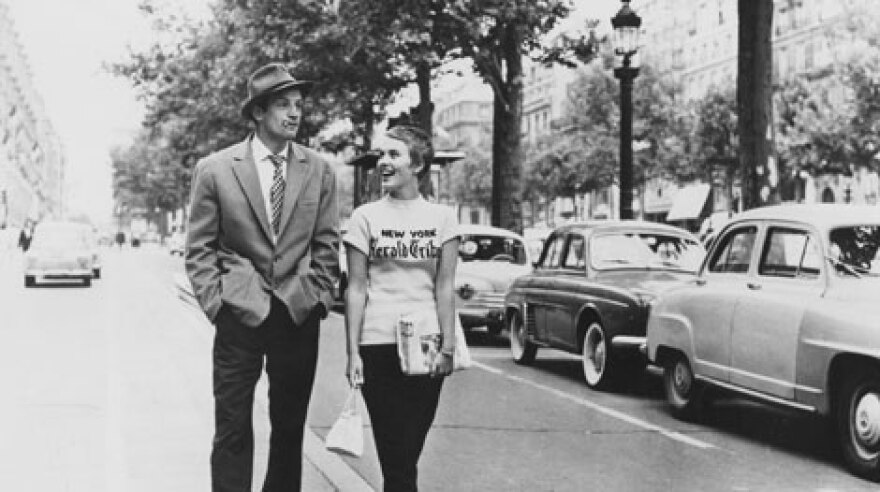

Understandably overshadowed by recent events, the death of film-maker Jean-Luc Godard went largely unnoticed. However, the French film director’s contribution to the art of cinema is enormous.
Sadly, many of his films are difficult to access; however, one could certainly do worse than watch Breathless, the film that essentially launched his career and, to a large extent the whole French “New Wave” of cinema. Fortunately, the full movie is available on YouTube and for anyone interested in the development of cinema it remains essential viewing.
I remember when Breathless first came out in the early Sixties and, heady with the excitement of such other films of the period as Four Hundred Blows, Ashes and Diamonds, The Seventh Seal, and Hiroshima Mon Amour, we were ready to greet it with what seemed proper enthusiasm.
To my later regret, I came to realize that I was certainly not ready for it. With all the narrow-mindedness of youth which knows exactly what is “right,” I dismissed the film as simply a portrayal of an amoral thug and his relationship with an equally amoral woman. And in a sense, that is an accurate summation of the story of Breathless. However, having re-visited the film from time to time, I have come to realize it is much more than its narrative. Far more important is its contribution to the development of cinema.
The techniques that Godard employed were largely revolutionary in that they forced the viewer to remain outside of the film, looking at it objectively as a creation rather than inviting one to lose oneself in the action. Startling jump-cuts, “long shots,” and characters directly addressing the audience were quite evolutionary at the time, though they have been widely used since. More importantly, the distancing effect of such techniques invited the audience to think about what they were seeing at the time it was happening. It was an invitation to evaluate the film as one watched it.
Then, too, there was the whole ambience of the film. The then-unusual use of hand-held cameras gives the film a compelling sense of immediacy. Stunningly accurate in its portrayal of the real Paris of the period, Godard approached his film with a documentary-like clarity. This was no conventional Hollywood attempt at suffusing even the dreariest drama with glamour or fake sets. Yet, somehow, Paris has never been more inviting – or perhaps this is my subjective reaction, born of my first unforgettable visit to the city near that time.
As to my concern with the amorality of the characters, I feel that here is where Godard is the most relevant to today’s world. His anti-hero (played with superb directness by Jean-Paul Belmondo) and the object of whatever affections he can muster (the radiant Jean Seberg) are a reflection, some 60 years ahead of their time, of so many 21st-century disillusioned youth. They are anxious to imitate their media heroes (for the main character, a determination to imitate and act according to the film persona of Humphrey Bogart, while the female lead is determinedly reminiscent of the charming Audrey Hepburn – think Roman Holiday).
Both characters are clearly obsessed with the materialism that is so much a part of modern materialistic culture – in the case of the film, he with American cars, she with a Dior-like chic. Yet both characters are clearly aware of other values than the merely materialistic as is evidenced by the references to Renoir and Picasso, as well as Mozart. At the same time, their fumbling attempts to differentiate between real love and having a passing affair raise questions of morality which are even more relevant today. Their confusion certainly still resonates. It’s all there and part of the achievement and continued relevance of the film.
This is not to say that one can watch the film with unalloyed pleasure. Its story of a man on the run is stretched a little too far beyond its dramatic limits, while the lengthy sections of dialogue between the two main characters, startlingly clever at times, do tend to go on a little too long.
Or is that the point? As has been already indicated, clearly Godard is demanding that as we watch his movie, we have time to consider it objectively. He wants us to stand outside, observe, and evaluate. I can think of no better example of other films so superbly and clearly inspired by Breathless than Pulp Fiction; Quentin Tarantino was clearly inspired by Godard, as were many others.
That ultimately is why we need to revisit Godard. He pioneered the way for much modern cinema, helping to raise to new heights one of the only two art forms started and developed in the last century; perhaps that is what prompted Godard’s use of the companion genre, jazz, as the perfect accompaniment to his innovative work.
Godard was indeed a master of film. It is only fitting that at his passing we render him the gratitude and respect he deserves.







