

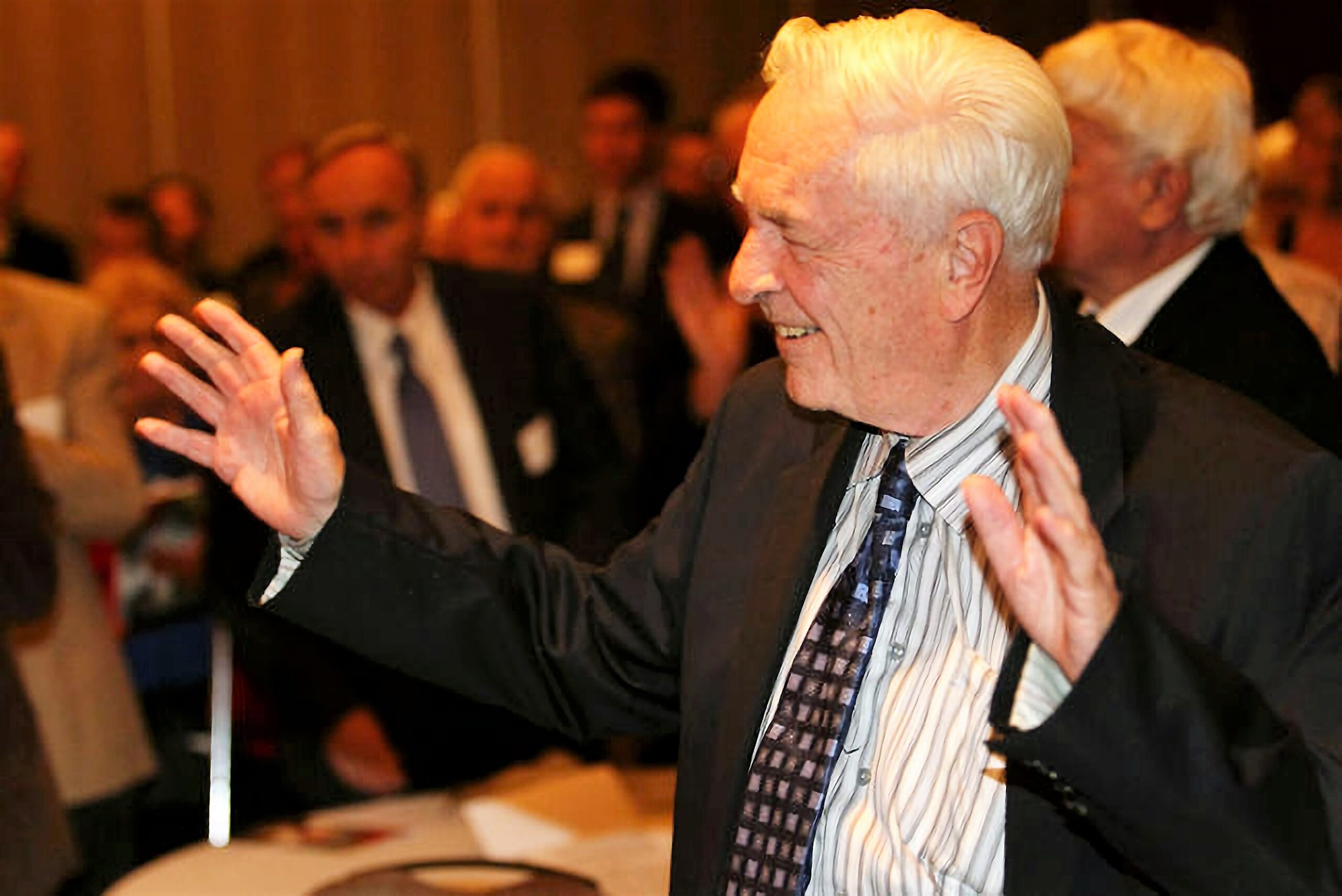

In the days following Ted Byfield’s death at his Edmonton home on Dec. 23, commentators throughout Canada eulogized him as a champion of Western Canada, a man who helped shaped Canadian politics through his unflappable conservative, free-enterprise principles. All this is true, but the eulogizers scarcely mentioned a distinguishing characteristic that in my mind was the foundation for all this – his great Christian faith.
The reports did state that Ted, who was 93 when he passed away, was an iconoclastic educator, having established independent boys’ schools rooted in traditional curriculum and Christian values; that he had established a string of Western-Canadian newsmagazines, all of which wore their geographic and political biases on their sleeves and, in doing so, were instrumental in the rise of the Reform Party of Canada; and that he later published two series of books, one on the history of Alberta and one on the history of Christianity.
They also wrote that he was charismatic, politically incorrect, visionary, acerbic at times, witty, a great storyteller, and volcanic when he lost his temper. In short, he was one very interesting man.
But as someone who got to know Ted intimately while editing one of his magazines, B.C. Report, through the 1990s, I think the eulogizers didn’t devote enough space to the significance of Ted’s Christianity and to his spectacular determination to put that faith into action.
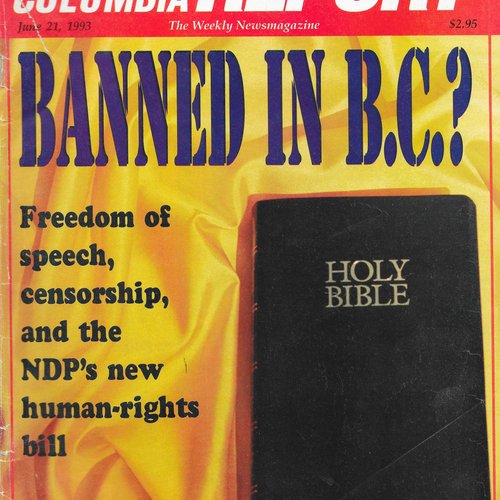
Ted was not a Roman Catholic, but his favourite author was the great Catholic apologist G.K. Chesterton, and he always struck me as a crusader, only that he wielded a pen and typewriter in place of a sword and shield.
Ted awoke to Christianity as a young man, inspired first by the Anglican writer C.S. Lewis, and then writers Chesterton and Dorothy Sayers, who described herself as “Anglo-Catholic.” The eye-opening realities of the Second World War and the challenges of raising a young family also sparked his eventual embrace of Anglicanism.
He later left the denomination when it started adopting what he thought were hare-brained and offensive liberal policies and practices. He found a new home in the Eastern Orthodox Church, where he told me he was confident that he wouldn’t have to stomach any novel and possibly heretical teachings.
His commitment to traditional Christianity was behind his decision to write a weekly religious-affairs column, “Orthodoxy,” the title a nod to Chesterton’s classic book of the same name.
“People have fallen into a foolish habit of speaking of orthodoxy as something heavy, humdrum, and safe,” Chesterton wrote in that book. “There never was anything so perilous or so exciting as orthodoxy. It was sanity: and to be sane is more dramatic than to be mad.” Byfield’s column was a living example of truth of this insight.
The column, which he co-wrote with his wife, Virginia (who predeceased him by seven years), was not aimed at arguing fine points of theology but, in typically combative Byfield fashion, was directed at exposing the ways in which the modern world misconstrued, ignored, or opposed time-tested, “orthodox,” Christian principles and practices.
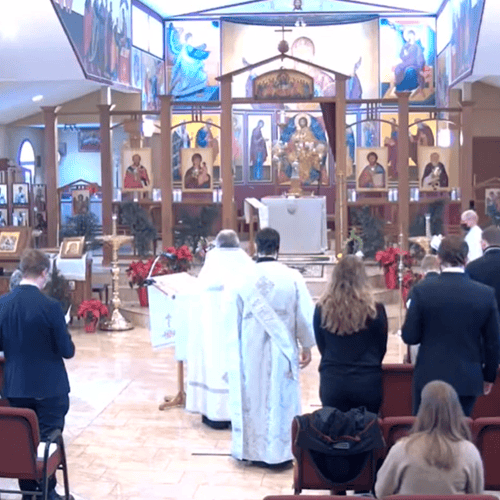
Ted Byfield’s funeral at St. Herman Orthodox Church Edmonton Dec. 30.
The couple often employed the column to challenge or correct the mainstream media’s treatment of Christianity. In January 1998, for example, they took on Maclean’s for its coverage of Christmas, in which the national magazine interviewed eight “experts” who denied traditional Christian tenets around the birth of Christ, and only one who defended them.
In that same column, the Byfields reported that “Vancouver’s ultra-liberal” Anglican Bishop Michael Ingham had recently published “a confession of his own disbeliefs,” which the Byfields then linked to the Anglican church’s decline in membership.
At the foundation of all this was Ted’s commitment to Truth with a capital T. This encompassed not only his belief that Christ was God, died on the cross, and was resurrected, but also his complete certainty that such a thing as “truth” existed, even though it could not necessarily be completely known by we imperfect humans.
This meant, of course, that the modern idol of relativism was Ted’s great enemy. And so it was that Ted waged unrelenting war against weasel-worded politicians, relativistic moralizers, and muddle-headed educators.
I must declare here that, the more I came to understand the dimensions of this war, the more engaging, engrossing, and even thrilling it became to me.
When I went to work for Ted, I had just emerged, battered and bruised, from the grinder of image-and-emotion-driven television news. It had brought out the worst in me, and I was ready to leave journalism altogether.
Ted’s guidance and encouragement allowed me to re-embrace the trade I had been ready to abandon and to discover how to use the information I gathered in my reporting to attempt to tell the truth, and not merely to dump a load of sensational facts at the foot of the reader.
A key moment came when he brought me into his office one afternoon and told me that I was the most organized journalist he had ever encountered, but also the one that was most in need of “reading,” by which he meant a far broader selection of books than the novels I had read to earn my English degree – including biography, philosophy, theology, and, especially, history.
And so began a transformation. The exercise not only led to my discovering that I was more of a conservative that I had cared to imagine, but also to my re-embracing of my lapsed Catholic faith. I attribute all the success I have enjoyed since then – in journalism, public speaking, the broadcast media, and politics—to that awakening.
And, yes, there’s a direct connection between this personal renaissance and my current work for this newspaper.
I am not the only Catholic to have been motivated by Ted in this way. Foremost in my mind is the unflappable, eagle-eyed Tom McFeely, who worked for more than a decade in the Report family of magazines and is now news editor of the National Catholic Register, a job he manages to perform from his home office in Saanich.
Other Catholics similarly encouraged by Ted include the academic and author Joe Woodard, who was the Western Report’s religion editor; Celeste McGovern, now a regular contributor to LifeSite News; and B.C. Catholic contributor Steve Weatherbe, who began as a teacher in one of Ted’s schools.
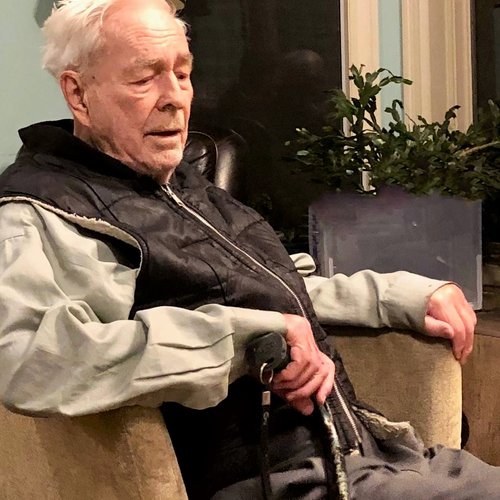
A photo of Ted Byfield from 2021. The late publisher spawned a number of journalists who were Catholic or reported fairly on conservative issues, writes Terry O’Neill.
Ted’s magazines also spawned a number of other journalists who, while not necessarily Christian, often carried the flag for socially conservative policies or reported on them fairly and accurately. A number of these Report grads worked with The National Post, including the likes of Kenneth Whyte, the Post’s founding editor who later edited Maclean’s, and current Post commentator Colby Cosh, who had only a fine-arts background when he began working with Ted. Others, such as Paul Bunner, moved to Ottawa to work with Stephen Harper when he was prime minister.
It must also be noted that two of Ted and Virginia’s sons, Link and Vince, converted to Catholicism, as did at least two couples who worked with the Byfields.
We’ve all been engaged in the good fight, one in which we may lose many of our battles in this modern, post-Christian world, but also one in which we, like Ted, believe that truth will prevail.
Chesterton wrote, “Great truths can only be forgotten and can never be falsified.” This knowledge certainly sustains journalists such as us.
Lest I end this reflection by leaving the impression Ted was some sort of holier-than-thou prophet, wagging his finger at a world he believed was going to hell in a handbasket, in truth he was almost impossible to dislike, had a magnificent Mark-Twain-like sense of humour, and wasn’t one to hold grudges.
There’s a famous story from the early 1970s when Ted staked out the back entrance of a courthouse in Edmonton to get a photo of the secretive Ghermezian family (who went on the develop the West Edmonton Mall), members of which were on trial for trying to bribe an Edmonton alderman. Ted snapped a photo of Rafi Ghermezian, only to have the businessman attack Ted and destroy his camera. A CBC cameraman filmed the entire episode.
It was an open-and-shut case of assault, but Ted never pressed charges and never filed a lawsuit. “This drew the respect and admiration of Rafi and all his brothers,” Vince Byfield told me earlier this month. “Ted bumped into Rafi at a pub a few months later and quipped, ‘you want to take another crack at me?’ Rafi just laughed and the two were friends from then on,” Vince said.
“This is very much how Dad operated, and how so many people who one would think would be his enemies became friends and admirers instead.”
That certainly describes Ted – a crusading journalist and muscular Christian who loved his enemies, even while instructing them on their multiple shortcomings.







