


Before life as we knew it shut down in mid-March, people began to hoard, creating what could (almost) laughably be known as a toilet paper crisis. While panic grew, I remember questioning why people were so worried about running out of toilet paper; as someone who bakes, I felt it would be more prudent to stock up on flour.
I seem to have been on to something. Over the past few weeks Instagram has been flooded with photos of homemade bread and myriad other baking projects. Facebook memes insinuate we are all going to come out of quarantine a little thicker around the waist and thighs. And grocery store baking shelves have been bare, aside from a bit of dust where bags of flour and sugar used to be.
With more time at home and reduced exposure to restaurants and grocery stores, people are discovering the joys of returning to basics and creating food from scratch. They are realizing what – as a farm girl – I have long known: not only does homemade bread taste the best, there is joy in witnessing a bowl of ground wheat transform into a delicious loaf of sustenance through the addition of yeast.
In Jesus’ very short parable of the leaven, he states, “To what shall I compare the kingdom of God? It is like yeast that a woman took and mixed with three measures of wheat flour until the whole batch of dough was leavened” (Lk 13:20-21).
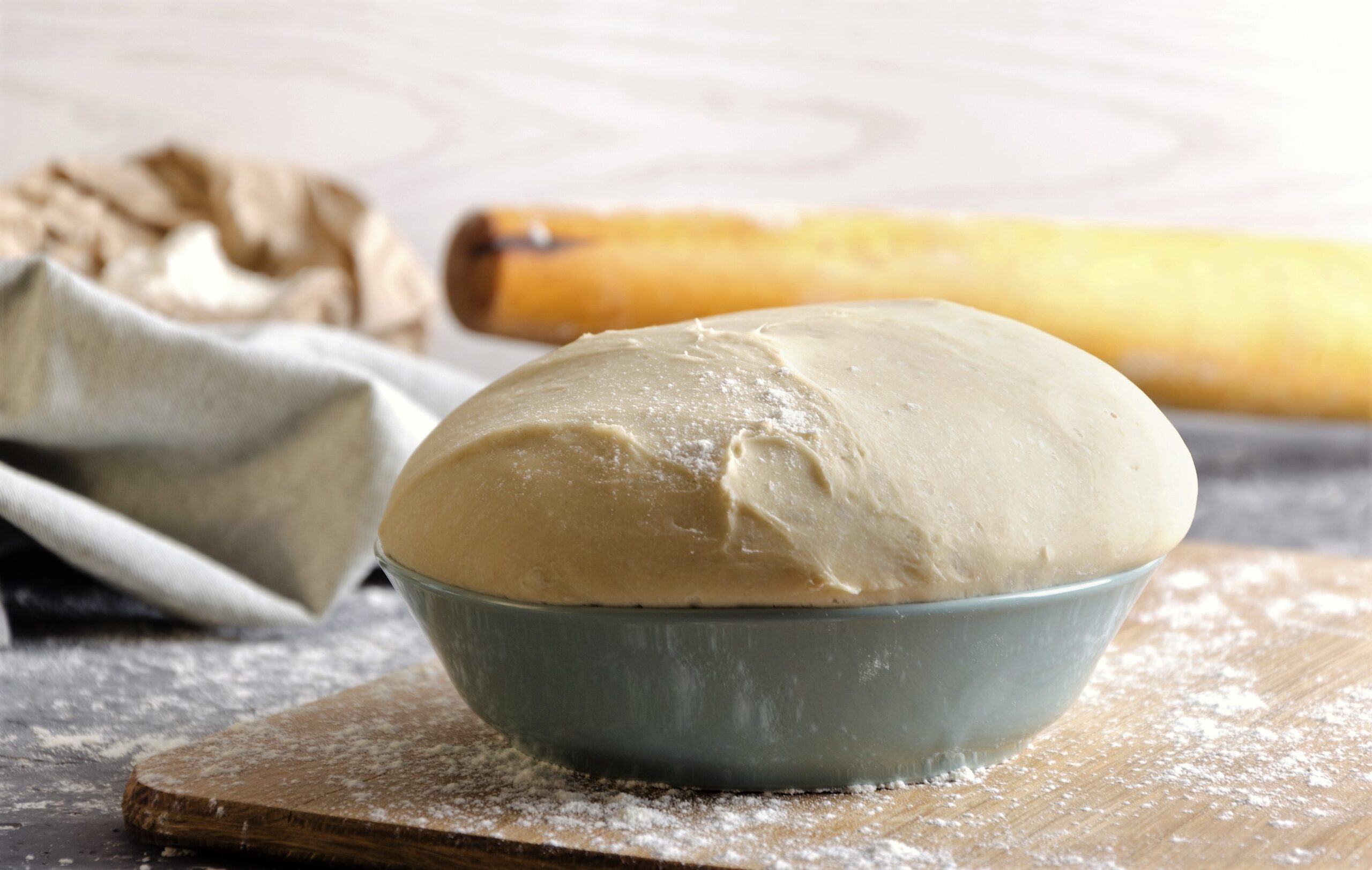
Anyone who has worked with yeast – a community that I believe has grown exponentially over the past two months – knows that tiny beads of yeast under the right conditions of moisture, warmth, and sweetness multiply quickly. They have the almost miraculous power to allow flour to outgrow the bowl in which it is placed.
Recently a friend who is a catechist filmed herself making bread dough while orally commentating on the parable of the leaven for her young religion students. In her video, she converted the amounts in the parable to modern-day units, explaining that a “measure” of flour would be equivalent to 144 imperial cups of flour; therefore, three measures would be 432 cups or approximately 216 pounds of flour.
She showed the children a few cups of flour and asked them to imagine how much flour Jesus was talking about in his parable, compared to the comparatively small amount in her bowl. As she mixed the yeast with flour, water, sugar, and salt, she demonstrated how quickly the yeast transformed the mixture into something far bigger than its original self. She likewise pointed out that kneading dough is hard work, just as working to grow God’s kingdom involves effort.
It would be impossible to separate minuscule beads of yeast from handfuls of flour once someone had started to mix them together. All of the flour would be leavened – changed forever with a potential for growth far bigger than we could ever imagine.
Like the kingdom of God, once “beads” of faith are planted so is possibility. With warmth and sweetness, that yeast has the capacity to grow, taking the flour along with it. With love and kindness, with charity and mercy, with a little patience and hard work, God’s kingdom on earth swells in individual hearts. Like bread dough rising in a bowl, it is often deflated but has the strength to rise again. The love eventually expands beyond the heart it is in, overflowing into the heart of another.
The parable of the leaven tangibly reminds us of the power of God. If a tiny granule of yeast holds so much promise, what more can we do in our quest to expand the kingdom of God? God plants the seeds; we must labour to produce the harvest.
New or once-dormant bakers are stripping the shelves of flour. They are making daily bread and witnessing the power of yeast in their kitchens. May we, as Christians, make “bread” as well by frequently revisiting the parable of the leaven and striving to spread God’s love – to be leaven – in the hearts of a challenged world.
“Give us this day our daily bread” (Mt 6:10-11).







