


4th Sunday of Lent, Year C
First Reading: Josh 5:9a, 10-12
Second Reading: 2 Cor 5:17-21
Gospel Reading: Lk 15:1-3, 11-32
“Today I have rolled away from you the disgrace of Egypt,” God told Joshua.
In Egypt, the Israelites had been slaves. Their liberation had begun at the Pasch—the Passover— in which they had sacrificed lambs.
The Church has always seen the Pasch as a prefiguring or foreshadowing of our own liberation from sin, which began when Christ, the “Lamb of God,” sacrificed himself for us. Just as God rolled away the disgrace of slavery from the Israelites, so Christ rolled away the disgrace of sin from us. “In Christ, there is a new creation,” St. Paul says: “see, everything has become new!”
In Jesus’ parable, we see how complete God’s forgiveness is. There, says the Catechism of the Catholic Church, we see sin, conversion, and repentance in detail: “the fascination of illusory freedom, the abandonment of the father’s house; the extreme misery in which the son finds himself after squandering his fortune; his deep humiliation at finding himself obliged to feed swine, and still worse, at wanting to feed on the husks the pigs ate; his reflection on all he has lost; his repentance and decision to declare himself guilty before his father; the journey back;” and the father’s “generous welcome” and “joy.”
“Only the heart of Christ, who knows the depths of his Father’s love, could reveal to us the abyss of his mercy in so simple and beautiful a way,” the Catechism says.
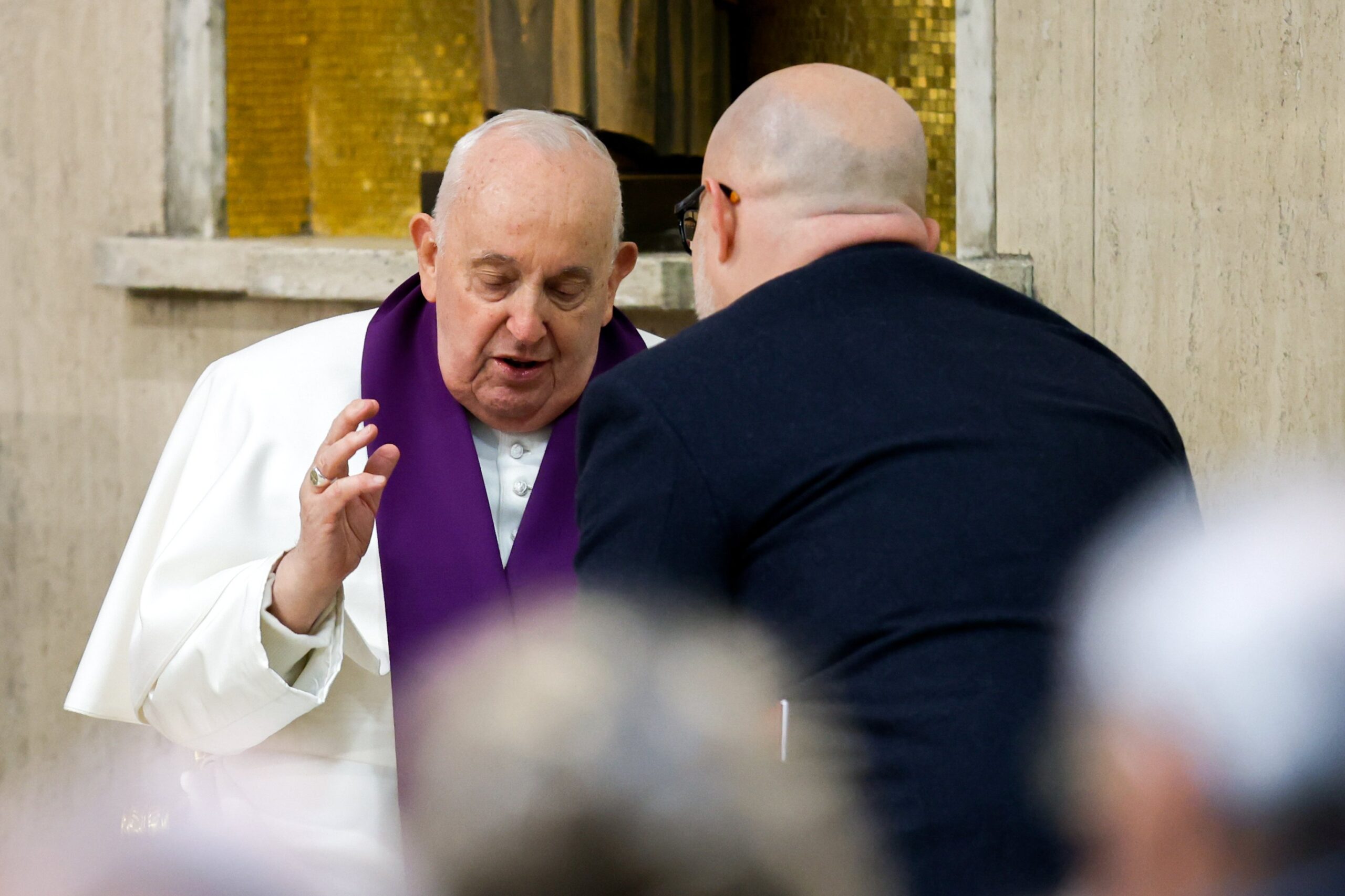
In Christ’s passion, death, and resurrection, God reconciled the world to himself, St. Paul says, but he entrusted the “message” and the “ministry” of reconciliation to the Church, a ministry she carries out in the sacrament of penance, where we ask our loving Father for forgiveness and receive assurance that we are forgiven.
Why, if God is willing to forgive us whenever we do wrong, do we have to ask for forgiveness?
The explanation is that forgiveness is what linguists call a speech act: an act that we can perform only by saying something.
For example, it is only by the words of the marriage ceremony that a man and a woman become spouses; by the words of inauguration that a person becomes prime minister; by the words of the oath of allegiance that a person becomes a citizen of a country.
Speech acts are mental acts, but they can be social or solitary. For example, the mental acts of seeing, remembering, and reasoning are solitary, for we can perform them alone; but the mental acts of promising and forgiving are social, for they are performed by one person and accepted by another.
Now a solitary mental act need not be expressed, but a social mental act cannot exist without being expressed in words or signs that make it known to the other person involved.
Jesus told us to ask for forgiveness when he said, “Say ‘Our Father … forgive us our trespasses.’” He gave his apostles power to forgive sins when he breathed on them and said, “Receive the Holy Spirit. If you forgive men’s sins, they are forgiven them; if you hold them bound, they are held bound.”
Clearly, then, the priest must know what our sins are. Moreover, by confessing them aloud, we put them “out there,” admitting that they are objectively evil and taking responsibility for them.
The words in which we confess our sins to a priest may be the most difficult we ever utter. However, the words of absolution are surely the most consoling, for by them “God, the Father of mercies,” brushes away our offences “like a cloud,” our sins “like the morning mist,” as he told Isaiah. We leave the confessional knowing that “everything old has passed away.”
Accordingly, the Church insists that the priest keep our sins absolutely secret, with no exceptions. In fact, he is forbidden to refer to them again in any way at all—even to us (unless we ourselves reopen the subject).
Father Hawkswell is again teaching The Catholic Faith in Plain English, with new insights. The whole course is available in written form and, one session per week, in YouTube form at beholdvancouver.org/catholic-faith-course. Father is also teaching the course in person: on Sundays at 2:00 p.m. in the John Paul II Pastoral Centre, 4885 St. John Paul II Way, Vancouver (33rd and Willow); and on Mondays at 10:00 a.m. in St. Anthony’s Church hall, 2347 Inglewood Avenue, West Vancouver. The title of next week’s talk is Sin and Forgiveness.
Your voice matters! Join the conversation by submitting a Letter to the Editor here.







