

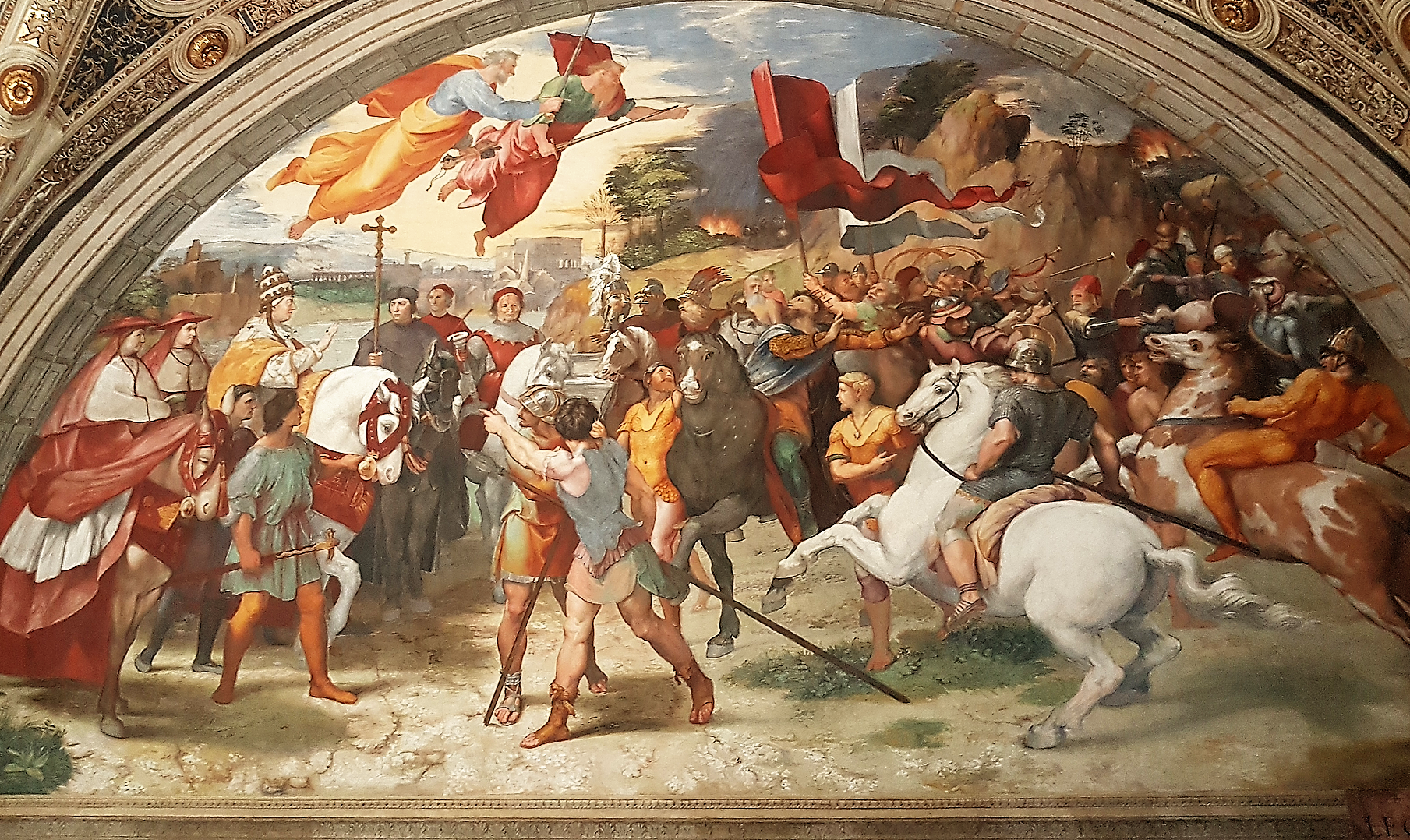

St. Leo was probably born in Rome around 400 into a family of Tuscan origin. Leo was a deacon under Popes Celestine I (422–32) and Sixtus III (432–40), both of whom had entrusted him with diplomatic missions.
In 440, Leo travelled to Gaul on a mission to make peace between two generals. While still in Gaul, Leo learned about the death of Pope Sixtus and his own election as successor to the Chair of Peter. Having returned to Rome, the new Pope was consecrated on Sept. 29, 440.
The pontificate of Leo lasted 21 years and he is one of three popes designated as “the Great,” meriting the title because of his teaching and his governance.
As a pastor of souls, Leo taught the faith through preaching, and approximately 100 of his sermons have been preserved. Leo constructed his sermons very carefully – with an introduction, a theme with examples, and a definite conclusion.
Leo delivered the sermons during liturgies, preaching on love of God and neighbour, articles of the Creed, fidelity to the will of God, practise of virtues, mortification, and daily prayer.
The Council of Chalcedon took place during the pontificate of Leo the Great. Pope Benedict XVI said, “This Council, held in 451 and in which 350 Bishops took part, was the most important assembly ever to have been celebrated in the history of the Church. Chalcedon represents the sure goal of the Christology of the three previous Ecumenical Councils: Nicaea in 325, Constantinople in 381 and Ephesus in 431. By the sixth century these four Councils that sum up the faith of the ancient Church were already being compared to the four Gospels. This is what Gregory the Great affirms in a famous letter: ‘I confess that I receive and revere, as the four books of the Gospel so also the four Councils’, because on them, Gregory explains further, ‘as on a four-square stone, rises the structure of the holy faith’. The Council of Chalcedon, which rejected the heresy of Eutyches who denied the true human nature of the Son of God, affirmed the union in his one Person, without confusion and without separation, of his two natures, human and divine.”
Leo expressed faith in Christ in an important letter to Archbishop Flavian of Constantinople. In the letter Leo states: “In this preservation, then, of the real quality of both natures, both being united in one person, lowliness was taken on by majesty, weakness by strength, mortality by the immortal.” The Tome to Flavian was read at the Council of Chalcedon, where the bishops acclaimed: “Peter has spoken through the mouth of Leo.”
With regard to governance, Leo stressed the primacy of the Roman See in his dealings with the rest of the Catholic world.
Pope Benedict XVI pointed out that from the interventions which Leo made during the Christological controversy, “it is clear that the Pope felt with special urgency his responsibilities as Successor of Peter, whose role in the Church is unique since ‘to one Apostle alone was entrusted what was communicated to all the Apostles’, as Leo said in one of his sermons for the Feast of Sts. Peter and Paul. And the Pontiff was able to exercise these responsibilities, in the West as in the East, intervening in various circumstances with caution, firmness and lucidity through his writings and legates. In this manner he showed how exercising the Roman Primacy was as necessary then as it is today to effectively serve communion, a characteristic of Christ’s one Church.”
In 452, near Mantua, Leo confronted Attila the Hun and persuaded him to withdraw, and on meeting the Vandal Gaiseric outside Rome in 455, Leo induced him to spare the city from fire and massacre.
Pope Leo died Nov. 10, 461. Pope Benedict XIV declared him a doctor of the Church in 1754.
聖伯鐸藉教宗大聖良說話
聖良大概在公元400年出生於羅馬,來自托斯卡尼一個家庭。教宗聖雷定一世(422-432年)和聖思道三世(432-440年)時,尚是執事聖職的良,掌管外交事務。
公元440年,良在高盧設法調停兩位將軍的紛爭時,教宗思道三世逝世,他被無異議地選作繼任伯鐸之位。440年9月29日,良在羅馬即位教宗,在位共二十一年;因他的訓導與管理才能,他是三位被尊為「大」的教宗其中一位。
身為靈魂的牧者,良講道時教授信德;約一百篇他的講道被保存下來。良常很細心整合他的講道 ── 開端語、利用例子引出主題、強而有力的終結語。
良禮儀上講道的領域廣闊,包括愛主愛人、信經、忠於主旨、修德、克苦和每日祈禱。
良在位時,領導加采東大公會議。教宗本篤十六世說:「該大公會議在451年召開,有350位主教參與,被視為教會有史以來最重要的會議。加采東大公會議無異議地確認先前三個大公會議對基督論的敲定:325年的尼西亞大公會議、381年的君士坦丁大公會議和431年的厄弗所大公會議。六世紀時,綜合古代教會信仰的這四個大公會議,比對四部福音。教宗大國瑞在他有名的信函中肯定:『我宣認我接受和尊崇這四個大公會議有如四部福音書。… 就如在四方石上,築上我們神聖信德的結構。』加采東大公會議推翻了否定聖子人性的歐迪奇異端,重申聖子一位格內絕無混淆和那不可分割的兩性—–天主性和人性。」
在他致君士坦丁堡總主教聖夫拉維亞有關基督的信條重要信函中,良聲明:天主性和人性在基督一位格內,是實在而又全然的:尊貴攝取卑微、力量攝取軟弱、不朽攝取死亡。在加采東大公會議中,這牧函被讀出,眾主教都不其然讚嘆說:「伯多祿藉良的口講話!」
管治教會方面,良向天主教會強調宗座的首席權。教宗本篤十六世指出,當教宗良介入基督論的爭議時,「作為伯多祿的繼承人,明顯地他迫切地自己的責任。在一個聖伯多祿聖保祿宗徒瞻禮日講道時,他説:『傳達給所有宗徒的都只委託給一位宗徒』。而且有能力通過他的文字和出使,在不同環境下,用小心、堅定和明確的方法,在東方和西方完成他的責任。良藉此顯示出羅馬首席權,為在基督唯一教會內,有效地維持共融共通是必要的。」
452年,良在曼圖阿面對入侵的匈人首領阿提拉,要求他撤退。又在455年,勸攻擊到羅馬外圍的該賽利,免去一次可能發生的火災和屠城。
461年11月10日教宗良逝世。1754年教宗本篤十四世尊他為教會的聖師。







