

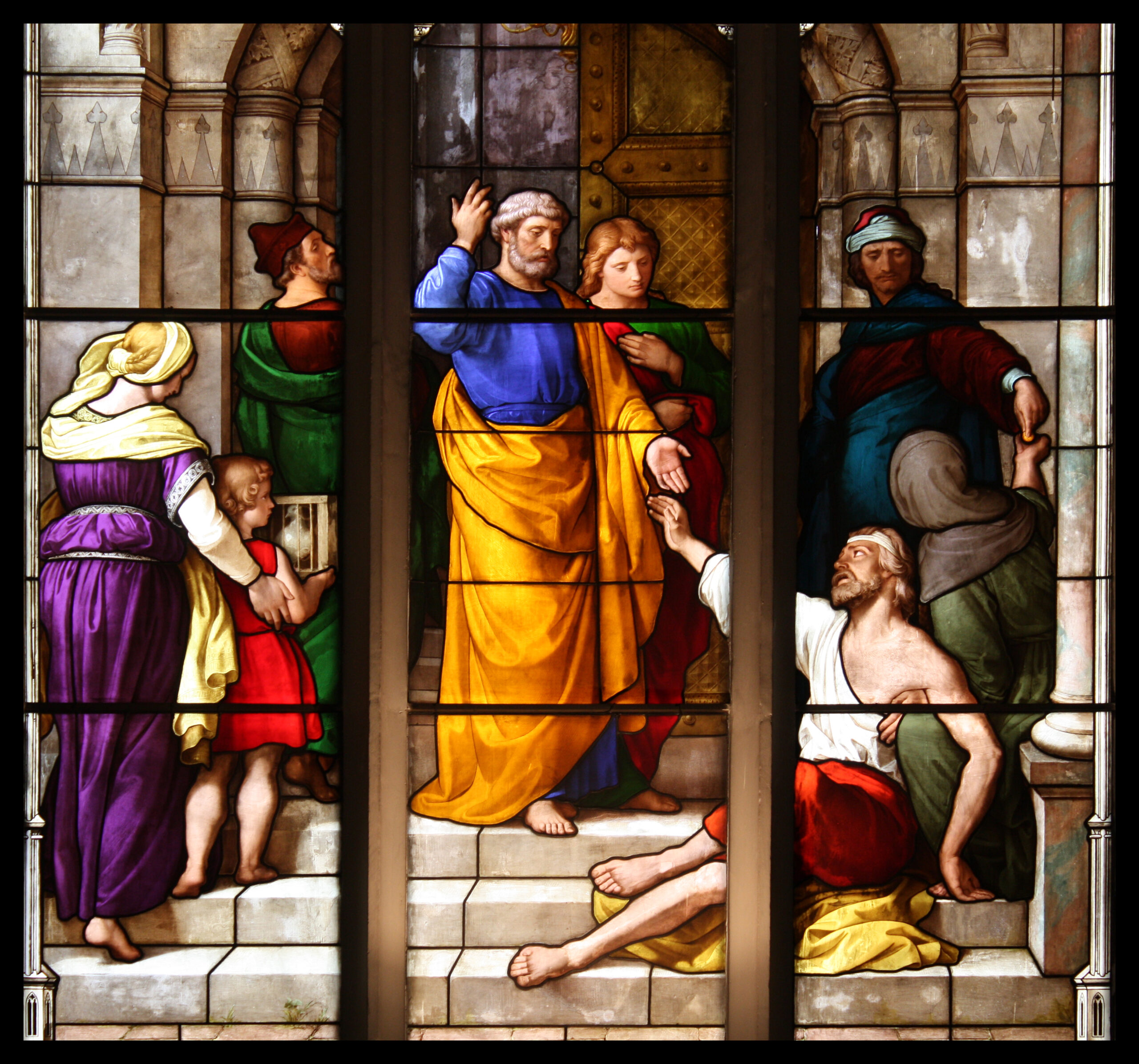

Acts 3 opens at three in the afternoon—the hour of the evening sacrifice. St. Peter and St. John walked toward the Beautiful Gate of the temple. A man lame from birth was there daily to beg from those entering the courts of God.
The lame man occupied this threshold not by choice but by necessity. He could not enter; he could only be placed at the entrance and ask. St. Bede saw in this arrangement a theology of Israel’s own condition. Just as Jacob received a blessing but walked away from his wrestling match with the angel with a limp, so Israel was both chosen and halt.
For St. Bede, the gate itself is a figure of Christ: “The beautiful gate of the temple is the Lord. Whoever enters through him will be saved. Enfeebled Israel, being unable to walk to this gate, was brought there by the words of the law and the prophets.”
The man saw Peter and John and asked for alms. Peter looked at him with fixed intensity and said, “Look at us.” What the man expected and what he received were entirely different things.
St. John Chrysostom drew out the contrast between the apostles’ material emptiness and their spiritual fullness: Peter “did not despise him; he did not look about for some rich subject.” Peter said, “I have no silver and gold, but what I do have I give to you. In the name of Jesus Christ of Nazareth, rise up and walk!” (Acts 3:6)
Chrysostom comments: “Let no one then be humiliated on account of his poverty: it is not poverty that humiliates, but wealth.” Origen adds: “Earthly possession cannot bestow those riches.” And St. John Cassian points out the source of the healing power: “a power that could never have any force except through the name of him who gave it.”
Peter speaks the Name, takes the man by the right hand, and raises him up. “And immediately his feet and ankles were made strong.” The man leaps, walks, enters the temple, and praises God. For Chrysostom, the gesture of Peter raising the man is itself a proclamation: “This act made manifest the resurrection, for it was an image of the resurrection.”
The healed man clung to Peter and John in Solomon’s Portico, and the crowd gathered. Peter’s first move is to refuse their admiration. Theophylact explains: “Nothing benefits listeners more than when the speaker not only refrains from boasting but also actively prevents others from exalting him.”
Peter proclaimed that the one they killed is “the Author of Life.” Chrysostom commented: “The author of life must be the one who has life from himself.” Peter was speaking not only of physical life but of spiritual life—the life of grace.
St. John Chrysostom commented on Acts 3:17–18: “As [Peter] had been hard on them and had shown that He whom they crucified had risen, he now relaxes, by giving them the power of repentance: ‘And now, brothers, I know that you acted in ignorance, as did also your rulers.’ This is one ground of excuse. The second is of a different kind. As Joseph says to his brothers, ‘God sent me before you.’”
The saint added: “If indeed it was all the prophets and not only one of them who said this, it follows that, although the event took place through ignorance, it did not take place contrary to God’s ordinance. See how great is the wisdom of God, when it uses the wickedness of others to bring about what must be.”
Peter called the people to repentance: “Repent therefore, and turn back, that your sins may be blotted out” (Acts 3:19). These people who crucified the Author of Life are not cast out. Chrysostom wrote: “The crucified one blesses his crucifiers.”
Acts 3–4 is held together by a single thread: the name of Jesus Christ of Nazareth. It is spoken over a lame man, and he walks. It is proclaimed to a crowd, and thousands believe. It is defended as the only name under heaven by which human beings can be saved.
Your voice matters! Join the conversation by submitting a Letter to the Editor here.
那治癒的聖名
「宗徒大事錄」第3章的開始發生在下午三時—即獻晚祭的時辰。聖伯多祿和聖若望正走向聖殿的名叫麗門的殿門。一位從母胎中便瘸腿的男子天天被人抬到那裡,向進入天主殿宇的人求施捨。
這位瘸子佔據著門口的位置,並非出於選擇,而是出於無奈。他不能進入聖殿,只能被放在門口求助。聖伯達(St. Bede)在這安排中看見以色列自身處境的神學意義:正如雅各伯在與天使搏鬥後雖得祝福卻跛著腳離去,以色列同樣是被揀選的民族,卻也帶著缺陷。
對聖伯達而言,這扇門本身就是基督的預像:「聖殿那扇美麗的門就是主本身。凡由祂進入的,必然得救。軟弱的以色列因不能自行走到這扇門前,只能由法律和先知的話語帶領至此。」
那人看見伯多祿和若望,便向他們求施捨。伯多祿定睛看著他,說:「你看我們。」那人所期待的與他所要領受的,完全不同。
金口聖若望(St. John Chrysostom)指出宗徒們物質上的貧乏與屬靈上的豐富形成鮮明對比:伯多祿「沒有輕視他,也沒有四處張望尋找富人」。伯多祿說:「銀子和金子,我沒有;但把我所有的給你:因納匝肋人耶穌基督的名字,你【起來】行走罷!」(宗 3:6)
金口聖師評論說:「不要因貧窮而自卑;使人受辱的不是貧窮,而是財富。」奧利振(Origen)補充:「世上的財物不能賜予真正的富裕。」聖若望格西安(St. John Cassian)指出治癒力量的來源:「若非藉由那位賜予者的聖名,這力量毫無效力。」
伯多祿呼喊主名,握住他的右手,拉他起來;「他的腳和踝骨就立即強壯了。」那人跳起來,行走,進入聖殿,讚美天主。對金口聖師而言,伯多祿扶起他的動作本身就是宣講:「這行動彰顯了復活,因為是復活的形象。」
那痊癒的人在「撒羅滿廊」柱下緊抓著伯多祿和若望,群眾也聚攏過來。伯多祿首先拒絕他們的讚美。特敖斐拉托(Theophylact)解釋:「對聽者最有益的,就是講者不僅不自誇,還主動阻止他人高舉他。」
伯多祿宣告:他們所殺害的那一位,就是「生命之源」。金口聖師說:「生命之源必然是那位本身擁有生命者。」伯多祿所說的,不僅是肉身的生命,更是靈性的生命—恩寵的生命。
金口聖師在宗 3:17–18的註釋時說:「伯多祿先前嚴厲指出他們所釘死的那位已復活,如今他放鬆語氣,給他們悔改的機會:『弟兄們!我知道你們所行的,是出於無知;你們的首領也是如此。』這是第一個理由。第二個理由則不同,如若瑟對兄弟們所說:『天主派遣我在你們以先來。』」
他又補充:「若所有先知而非僅一位都預言了這事,那麼雖然此事因無知而發生,卻並非違背天主的安排。看天主的智慧何其偉大,竟能利用他人的邪惡成就祂必要完成的事。」
伯多祿呼籲群眾悔改:「你們悔改,並回心轉意罷!好消除你們的罪過。」(宗 3:19)
那些曾經釘死「生命之源」的人並未被棄絕。金口聖師寫道:「被釘死的那一位祝福了釘死祂的人。」
「宗徒大事錄」第3至第4章由一條主線貫穿:納匝肋人耶穌基督的聖名。這聖名臨於瘸子,使他行走;向群眾宣講,使成千上萬的人信從;並被宣示為天下人間唯一能使人得救的聖名。
Your voice matters! Join the conversation by submitting a Letter to the Editor here.







