

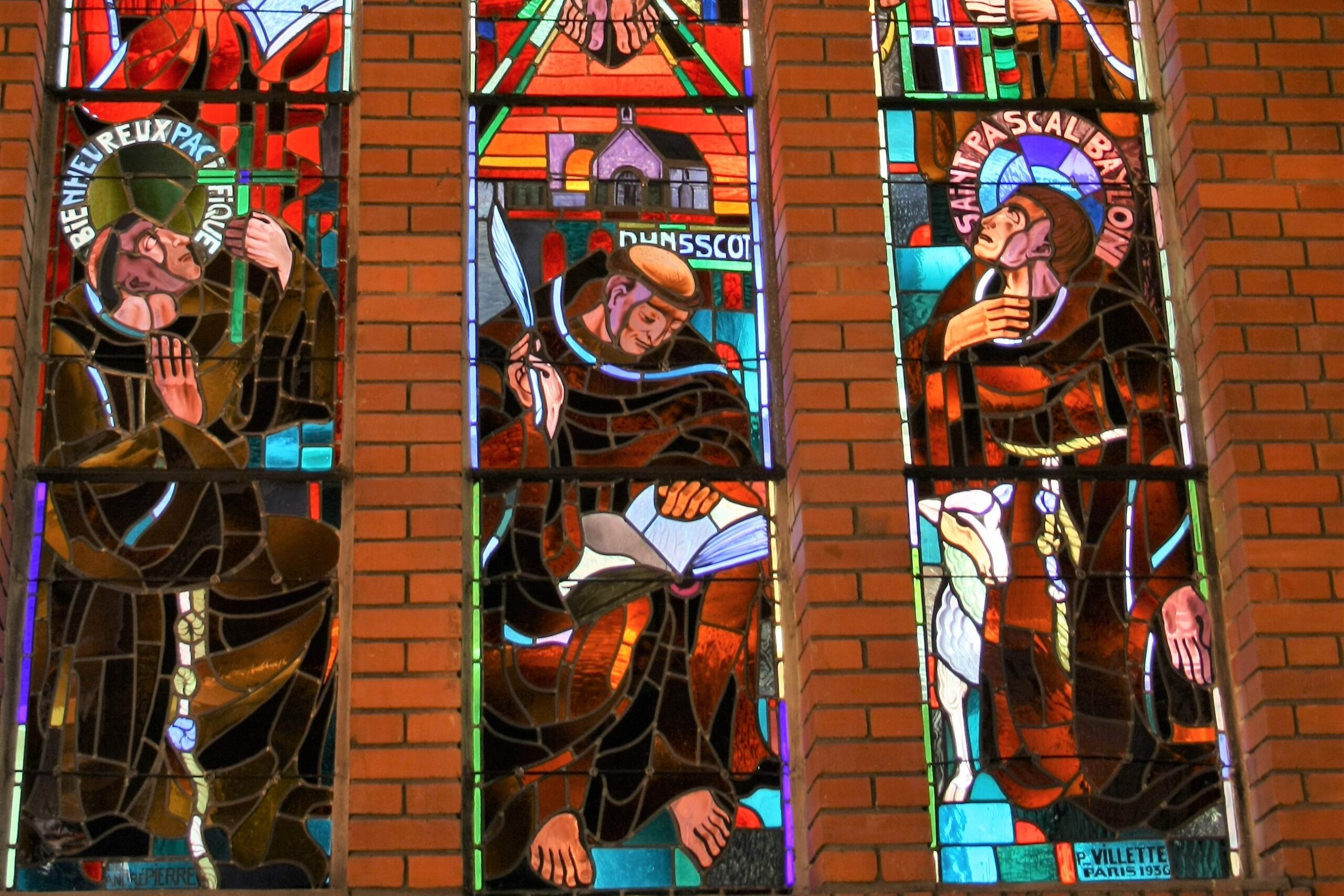

Blessed John Duns Scotus was a Franciscan theologian who lived at the end of the 13th century. An epitaph on his tombstone states: “Scotland bore me, England received me, France taught me, Cologne in Germany holds me.”
Duns Scotus was probably born in 1266 in the village of Duns near Edinburgh. He joined the Franciscan order and became a priest in 1291. He studied philosophy and theology at the Universities of Oxford and Paris. He then taught theology at the Universities of Oxford, Cambridge, and Paris.
In 1303, a serious dispute broke out between King Philip IV the Fair and Pope Boniface VIII. King Philip tried to enlist the University of Paris on his side and Duns Scotus chose voluntary exile rather than signing a document hostile to the Pope.
Friendly relations between the King of France and the successor of Boniface VIII were soon restored and in 1305 Duns Scotus returned to Paris. In 1307, he was assigned as professor of the Franciscan Studium of Theology in Cologne. He died on November 8, 1308, at the age of 43.
Duns Scotus was beatified on March 20, 1993 by John Paul II, who described him as the “minstrel of the Incarnate Word and defender of Mary’s Immaculate Conception.”
Duns Scotus held that the Son of God would have been made man even if humanity had not sinned. He said, “To think that God would have given up such a task had Adam not sinned would be quite unreasonable! I say, therefore, that the fall was not the cause of Christ’s predestination and that if no one had fallen, neither the angel nor man in this hypothesis Christ would still have been predestined in the same way.”
Pope Benedict XVI said: “In the opinion of Duns Scotus the Incarnation of the Son of God, planned from all eternity by God the Father at the level of love is the fulfilment of creation and enables every creature, in Christ and through Christ, to be filled with grace and to praise and glorify God in eternity.”
For Duns Scotus, the love of God is also manifested in the mystery of the saving Passion of Christ and the sacrament of the Real Presence of Jesus.
The spirituality of Duns Scotus reminds me of that of St. Alphonsus Liguori. A Redemptorist website states: “Three great images, basic to the Christian faith, formed the heart of Alphonsus’ preaching and teaching – Jesus an infant in the crib, Jesus crucified on the Cross, and Jesus vibrantly alive and filled with love for all in the Eucharist. To this he added the image of Mary, the Mother of the Redeemer.”
18th-century Marian saints such as St. Alphonsus Liguori and St. Anthony of St. Ann Galvão enthusiastically defended the Marian title of the Immaculate Conception.
Their defence relied on the argument of “preventive redemption” proposed by Duns Scotus. Benedict XVI explained that according to this argument, “the Immaculate Conception is the masterpiece of the Redemption brought about by Christ because the very power of his love and his mediation obtained that the Mother be preserved from original sin. Therefore Mary is totally redeemed by Christ, but already before her conception.”
On Dec. 8, 1854, Pope Blessed Pius IX used the argument of Duns Scotus when he solemnly defined the dogma of the Immaculate Conception of Mary: “We declare, pronounce, and define that the doctrine which holds that the most Blessed Virgin Mary, in the first instance of her conception, by a singular grace and privilege granted by Almighty God, in view of the merits of Jesus Christ, the Saviour of the human race, was preserved free from all stain of original sin, is a doctrine revealed by God and therefore to be believed firmly and constantly by all the faithful.”
Benedict XVI commented: “Concerning the teaching on the Immaculate Conception, important theologians like Duns Scotus enriched what the People of God already spontaneously believed about the Blessed Virgin and expressed in acts of devotion, in the arts and in Christian life in general with the specific contribution of their thought…. In this sense, the People of God is the ‘teacher that goes first’ and must then be more deeply examined and intellectually accepted by theology. May theologians always be ready to listen to this source of faith and retain the humility and simplicity of children!”
Share your thoughts by sending us a letter to the editor.
董思高為聖母無原罪辯護
真福董思高脫是一位方濟各會神學家,生活在13世紀末。他墓碑上的墓誌銘上寫著:『蘇格蘭讓我厭煩,英格蘭接待我,法國教我,德國的科隆擁抱我』。
董思高可能出生於1266年愛丁堡附近的鄧斯村。他加入了方濟各會,並於1291年成為一名神父。他曾在牛津大學和巴黎大學學習哲學和神學。隨後,他在牛津大學、劍橋大學和巴黎大學教授神學。
1303年,國王菲力浦四世和教宗博義八世之間爆發了一場嚴重的爭端。菲力浦國王試圖爭取巴黎大學站在他一邊,董思高選擇自願流亡,而不是簽署一份敵視教宗的文件。
法國國王和博義八世的繼任者之間的友好關係很快恢復,董思高於1305年返回巴黎。1307年,他被任命為科隆方濟各會神學學院的教授。他於1308年11月8日去世,享年43歲。
董思高於1993年3月20日被聖若望保祿二世列入真福。若望保祿二世形容他是『道成肉身的吟遊詩人和聖母無原罪的捍衛者』
董思高認為,即使人類沒有犯罪,天主聖子也會降生成人。他說:『如果認為假若亞當沒有犯罪,天主會放棄這樣的工作,這是非常不合理的!!因此,我說,墮落不是基督預定的原因,如果沒有人墮落,在這個假設中,不論天使和人,基督仍然會以同樣預定方式而來。』教宗本篤十六世說:『在董思高看來,天父從永恆中計劃在愛的層面上,天主的兒子道成肉身是創造的成全,使每一個受造物,在基督內,通過基督,都能充滿恩典,並在永恆中讚美和榮耀天主。』
對於董思高來說,天主的愛也體現在基督救贖受難的奧秘和耶穌真實臨在的聖事中。董思高的靈性讓我想起了聖亞豐索·利古力。一救贖主會網站指出:『三個偉大的形象,是基督宗教信仰的基礎,構成了亞豐索講道和教導的核心——耶穌是馬槽床上的嬰兒,耶穌被釘在十字架上,耶穌在聖體聖事中充滿活力,充滿了對所有人的愛。除此之外,他還加上了救世主之母瑪利亞的形象。』
18世紀的敬禮聖母的聖人,如聖亞豐索·利古力和聖安納·加爾旺的聖安多尼,熱情地捍衛聖母的無染原罪。他們的辯護依賴於董思高提出的『先贖論』。本篤十六世解釋說,根據這一論點,『聖母無原罪是基督帶來的救贖的功勳,因為祂的愛和中保的力量使母親免於原罪。因此,瑪利亞完全被基督救贖,而且已經在她受孕之前了。』
1854年12月8日,教宗庇護九世在莊嚴地定義聖母無原罪教條時使用了董思高的論點:『我們聲明、宣告和欽定至福的童貞瑪利亞在受孕之初,因全能的天主賜予獨特的恩竉和特權,鑒於人類救世主耶穌基督的功勞,被免於任何原罪的污點, 是天主啟示的教義,因此所有信徒都要堅定並恆久地相信。』
本篤十六世評論說:『關於聖母無原罪的教導,像董思高這樣的重要神學家豐富了天主子民已經自發地相信的關於聖母,並在敬禮的行為、藝術和一般基督徒生活中所表達出來的,他們的思想的具體貢獻…從這個意義上說,天主的子民是「先行的老師」,然後必須被神學更深入地檢查和接受。願神學家隨時準備聆聽這信仰的源泉,並保持孩子們的謙卑和純樸!』







