


Third Sunday of Easter, Year A
First Reading: Acts 2:14, 22b-28
Second Reading: 1 Pt 1:17-21
Gospel Reading: Lk 24:13-35
“Christ was destined before the foundation of the world,” but he was not revealed until “the end of the age,” St. Paul says.
From Abraham, through whom God initiated salvation history, to Jesus, who fulfilled it, God took about 2,000 years. During that time, he offered his chosen people “covenants” and “through the prophets taught them to look forward to salvation.”
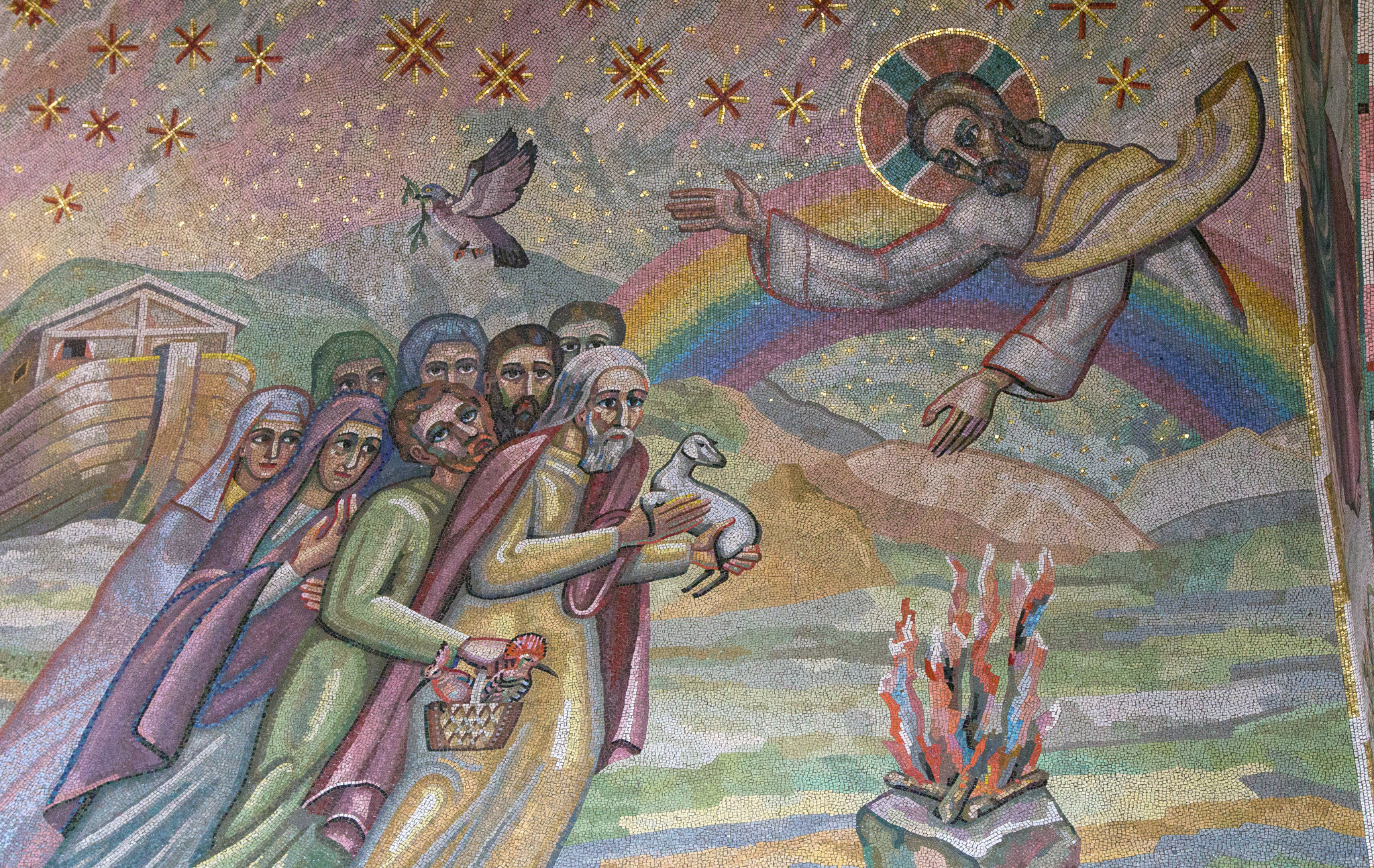
God made five “old” covenants: with Adam, Noah, Abraham, Moses, and David. A covenant is like a contract, but it involves an exchange of persons instead of goods or services. Moreover, it is sealed with not just a promise, but an oath solemnized by a sacrifice. God used covenants to forge bonds of sacred kinship with his people: “I will be your God, and you shall be my people.”
Prophets speak, act, or write under the extraordinary influence of God to make known God’s counsels and will. Often, by God’s power, they foretell future events, but only so as to confirm that they are indeed speaking and acting for God.
The Old Testament contains 18 prophetic books. The four “major” prophets (so called because their books are longer) are Isaiah (700 BC), Jeremiah (600), Ezekiel (580), and Daniel (570). The twelve “minor” prophets are Hosea (730), Joel (815), Amos (760), Obadiah (845), Jonah (755), Micah (720), Nahum (640), Habakkuk (610), Zephaniah (630), Haggai (512), Zechariah (500), and Malachi (430); plus John the Baptist, born six months before Jesus.
However, in spite of all this preparation, many people did not recognize Jesus when he came.
“Oh, how foolish you are, and how slow of heart to believe all that the prophets have declared!” Jesus said to his own disciples on the road to Emmaus. “Then, beginning with Moses [1350 BC] and all the prophets, he interpreted to them the things about himself in all the Scriptures.”
Christ, then, knew firsthand how difficult people found it to believe. How could he ensure that people of all the world, for all time, could come to know and believe him?
Luther and other Protestant reformers held that he had given us the Bible as a written constitution. Apparently, they thought that if people read the Bible for themselves, they would all understand it the same way. However, there are now tens of thousands of different Protestant denominations in the United States alone, each based on a different interpretation of part of the Bible.
Similarly, the men who wrote the U.S. Constitution thought that it would clearly bind all future generations. However, says the late U.S. Supreme Court Justice Antonin Scalia, many of the “rights” the court claims to have “found” in the Constitution for the last 40 to 50 years “clearly did not exist” when the documents were written.
Would it have helped for Jesus to stay on earth to guide us himself? Apparently not, for many people had already withstood the power of his teaching and his miracles.
Besides, that does not seem to be God’s style: he seems to do nothing of himself that he can possibly delegate to us.
Moreover, at the Resurrection, says the Catechism of the Catholic Church, Jesus, in his risen body, passed “from the state of death to another life beyond time and space,” a life in which his humanity could “no longer be confined to earth,” but belonged “henceforth only to the Father’s divine realm.”
What Jesus did to continue his work on earth was to found his Church.
However, he did not leave his Church “orphaned,” but promised to send his Holy Spirit. “I have much more to tell you,” he said, “but you cannot bear it now. When he comes, however, being the Spirit of truth, he will guide you to all truth.”
The Holy Spirit accomplishes this work – in a visible way, as our nature requires – through Sacred Tradition and Sacred Scripture, both interpreted authoritatively by the Catholic Church.
Father Hawkswell is again teaching The Catholic Faith in Plain English, with new insights in both print and YouTube form at beholdvancouver.org/catholic-faith-course. Father is also teaching the course in person on Sundays from 2 to 4 p.m. at the John Paul II Pastoral Centre (4885 Saint John Paul II Way, 33rd Avenue and Willow Street, Vancouver) and on Mondays from 10 a.m. to noon in St. Anthony’s Church Hall, 2347 Inglewood Avenue, West Vancouver. Next week’s topic is “Love of God and Neighbour.”
Fix your eyes on Christ and his Church
Fourth Sunday of Easter, Year A
First Reading: Acts 2:14a, 36b-41
Second Reading: 1 Pt 2:20b-25
Gospel Reading: Jn 10:1-10
“Save yourselves from this corrupt generation,” St. Peter urges. It is a warning we should take seriously.
Of our three enemies—the world, the flesh, and the devil—the first is the most subtle: the world’s false assumptions and the society of those who love its vanities, riches, and pleasures better than God.
In times of persecution, we know we have to be different in order to be faithful to Jesus. Life is a battle, with the battle lines clearly drawn.
However, today, we take pride in our tolerance. We know that God loves everyone and that the Church sees all goodness and truth found in other religions to be God’s gift and “a preparation for the Gospel.”
Accordingly, we may forget that God has made his Church “the instrument for the salvation of all humanity,” as Dominus Iesus says. This “does not lessen” the Church’s “sincere respect” for other religions, but “it rules out, in a radical way, that mentality of indifferentism” and “religious relativism” which holds “that one religion is as good as another.”
The truth is that, objectively, non-Catholics are in a “gravely deficient situation” compared to us, for through the Church we have “the fullness of the means of salvation.” We are therefore in a position to make “an extraordinarily valuable contribution” to society, helping to ward off “a headlong plunge into the most dangerous crisis” that can afflict the world, namely a “confusion between good and evil,” Pope St. John Paul II said.
We have what the world needs. We should not be conceited about it, but we should never hesitate to affirm that the truth about God and human beings is found in the Catholic Church, not in the world.
We live in the world, but we cannot be of the world, for, as Jesus warned, no one “can serve two masters.”
Nevertheless, we remain vulnerable to the world’s temptations. “Everybody does it,” the world cries, and it seems priggish and intolerant to affirm otherwise.
Clear examples are artificial contraception, artificial insemination, abortion, euthanasia, fornication, and the use of non-therapeutic drugs.
One not-so-clear example is the exaltation of money-making. I know a practising Catholic couple who, when I ask them about their daughter, always reply enthusiastically, “She’s doing very well!” because she has become very wealthy – although she has not attended Mass since she left her Catholic high school.
Another example is the fascination with Buddhist and New Age practices. Many Catholics, mistakenly believing “that the Christian religion does not inspire a profound spirituality,” seek “elsewhere,” we read in Jesus Christ: The Bearer of the Water of Life. They are like a wife who “keeps an eye” open for other men in case they can offer her something more. No, says the Catechism of the Catholic Church: “it is through the Catholic Church alone, which is the universal help toward salvation, that the fullness of the means of salvation can be obtained.”
A third example is the indifference with which many young Catholics date atheists, agnostics, or members of non-Christian religions. “Do not yoke yourselves in a mismatch with unbelievers,” St. Paul warned. “What fellowship can light have with darkness?” Once a couple have fallen in love, it is hard to convince them of the dangers of such a “mismatch”: religious indifference and tension in educating children.
As long ago as 1985, Cardinal Joseph Ratzinger, later Pope Benedict XVI, warned that we must “reacquire the consciousness of belonging to a minority” that is opposed to the spirit of the world. We must “find again the courage of nonconformism, the capacity to oppose many of the trends of the surrounding culture.”
We must love worldly people as Christ did, doing all we can to bring them the truth; but we must remember what the Book of Sirach says: “He who associates with an impious man learns his ways.”
Father Hawkswell is again teaching The Catholic Faith in Plain English, with new insights in both print and YouTube form at beholdvancouver.org/catholic-faith-course. Father is also teaching the course in person on Sundays from 2 to 4 p.m. at the John Paul II Pastoral Centre (4885 Saint John Paul II Way, 33rd Avenue and Willow Street, Vancouver) and on Mondays from 10 a.m. to noon in St. Anthony’s Church Hall, 2347 Inglewood Avenue, West Vancouver. Next week’s topic is “Catholic Spiritualities.”







