

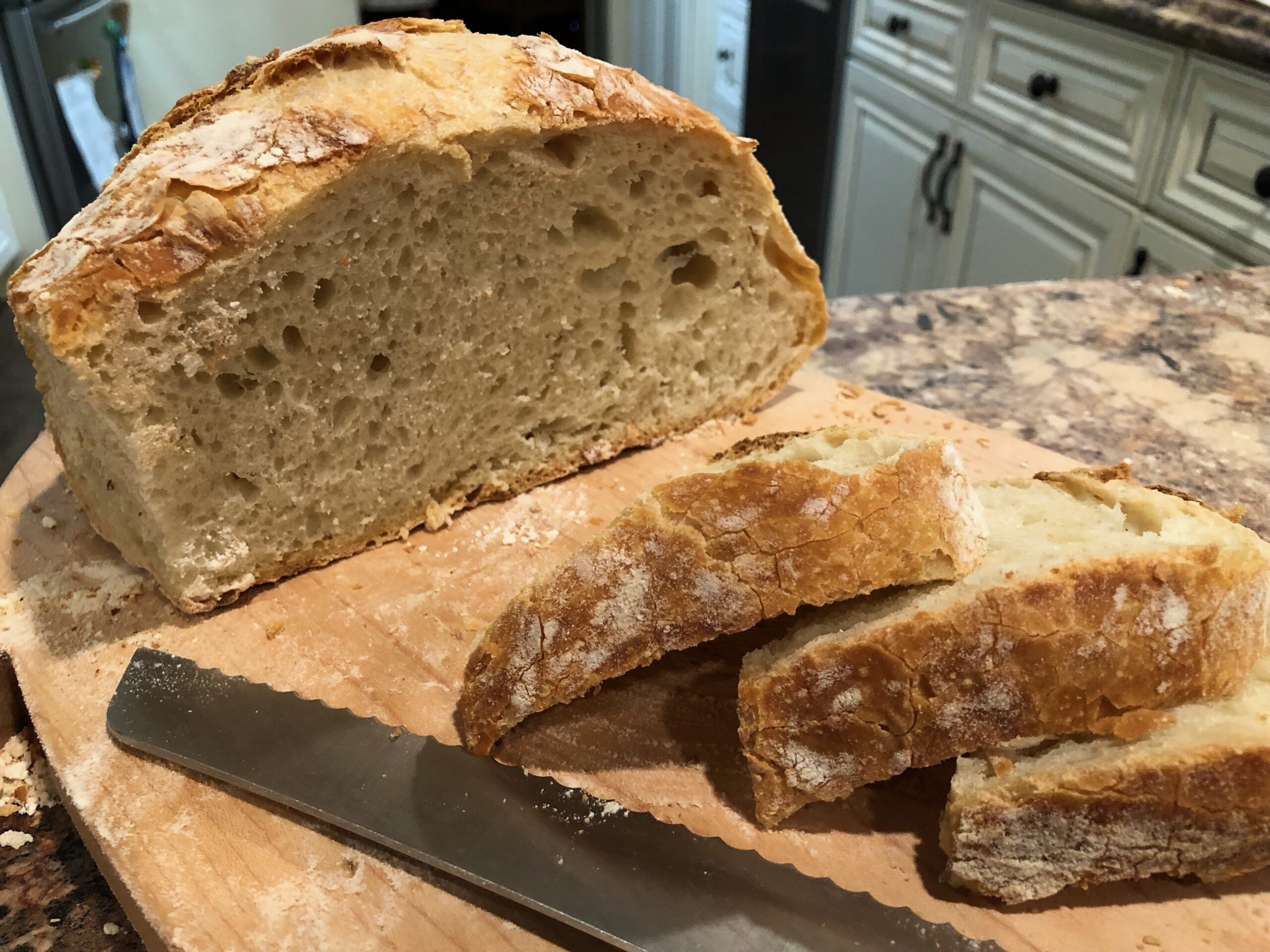

A new year has come, and I find myself drawn to such rudimentary activities as making bread and reading Scripture, seeking a grounding in the fundamentals of life. I’m a firm believer in the spiritual benefits of baking bread. Making bread requires not just movements of the body and calculations of the mind, but an effort of the soul. That the combining of the primordial ingredients of flour, water, yeast, and salt can result in life-sustaining food is nothing short of a miracle, one that we are reminded of every time we say the Our Father.
“Give us this day our daily bread,” Jesus taught us to say. Jesus wasn’t just talking about actual bread here, but indeed, as the Douay–Rheims Bible states in Matthew 6:11, “Give us this day our supersubstantial bread.” The Douay–Rheims Bible is the English translation of the Latin Vulgate Bible that was translated directly from the original Hebrew, Aramaic, and Greek by St. Jerome in the fourth century.
In an article called “Our Supersubstantial Bread” on catholicexchange.com, theologian Brian Kranick notes the importance and uniqueness of the word “epiousios” in the passages about the Our Father. This word, translated by St. Jerome as “supersubstantial,” is identified as Greek but is seen nowhere else in the Bible. It has a meaning akin to “daily” but signifies much more.
“The root words are: epi, meaning ‘above’ or ‘super,’ and ousia, meaning ‘being,’ ‘essence,’ or ‘substance.’ When they are read together, we come to the possible translations of ‘super-substantial,’ ‘above-essence,’ or, in effect, ‘supernatural’ bread,” writes Kranick.
It is significant that Christ uses the image of the provision of daily bread as the pivotal idea in the prayer he taught us. We might call bread the “staff of life” or we might even be living gluten-free, but there is a timeless meaning to the image of bread as something without which we cannot live. This is why making bread with one’s own hands, as humans have been doing for centuries, can be a spiritual experience. The mixing, the kneading, the rising, the baking are all symbolic of our dependence on God’s goodness but also our own response to what he offers. Of course, Christ himself is the “supersubstantial” bread that our souls cannot live without, far above the level of a loaf of bread.
During the Covid lockdowns, it was an interesting phenomenon that so many people turned to baking bread to pass the time. I’m convinced that this activity was really an attempt, most often subconscious, to connect to something spiritual and fundamental at a trying time. People were cut off from each other and cut off from their usual public expressions of faith, including reception of the Eucharist, and many responded with a natural (perhaps reaching for the supernatural) activity – baking bread. The action of providing “daily bread” for themselves while the rest of their world was in chaos, helped restore a sense of normalcy and spiritual grounding in their lives.
Over the years, I’ve become a bread maker, though rather reluctantly. I don’t particularly enjoy kneading dough by hand, especially the way the dough sticks to my hands and is frustrating to remove. However, I have come to realize that the uncomfortable stickiness of dough on my fingers is a good sacrificial exercise for me – somewhat metaphoric of the messy situations we encounter in life to get to the good parts. The end result of several golden loaves that fill the house with yeasty aroma and feed our family for a few days is worth the effort and mess – perhaps a foretaste of that heavenly reward that comes from faithfully receiving supersubstantial bread. If the messiness is off-putting, start with a no-knead recipe, which still provides satisfying loaves, but is a good way to ease into providing your own daily bread. I highly recommend the rustic bread I discovered during lockdown at No Knead Dutch Oven Bread Recipe | Girl Versus Dough or the soft French loaves at Easy Homemade French Bread Recipe | Mel’s Kitchen Cafe (melskitchencafe.com).
As you set out on the next leg of your faith journey in 2022, gather the kids in the kitchen, get messy and get back to the basics by making your own “daily bread.” Pray the Our Father together and talk about the differences and similarities in the bread you make and the “epiousios” bread God provides. Be thankful for both.
Lazzuri writes from her home in Nova Scotia, where she lives with her husband, six children, and her mom. She can be reached at clarelazzuri@gmail.com.







