


Passion Sunday, Year C
First Reading: Is 50:4-7
Second Reading: Phil 2:6-11
Gospel Reading: Lk 22:14-23:56
The Church’s Holy Week liturgy is (in Hebrew) a zikaron of the first Holy Week, re-presenting, re-actualizing, and re-newing it so that we truly re-live it and participate in it, not just remember or commemorate it. The more we know about it, therefore, the better.
About 600 BC, Daniel had foretold that Judea would be conquered by Babylon, Persia, Greece, Rome, and then “the God of heaven.” Under Rome, therefore, Jesus’ contemporaries expected the Messiah, their hereditary King, to come soon to save them from Rome.
Jesus had avoided earlier attempts to crown him, but on Palm Sunday – knowing that “the hour” had come – he asked for an ass and her colt, mounted, and so entered Jerusalem, fulfilling the prophecies of a King who would come “riding on an ass.” Accordingly, the people greeted him as Saviour and King.
(They rejected him on Friday because, seeing him in Roman custody, they thought he had deceived them.)
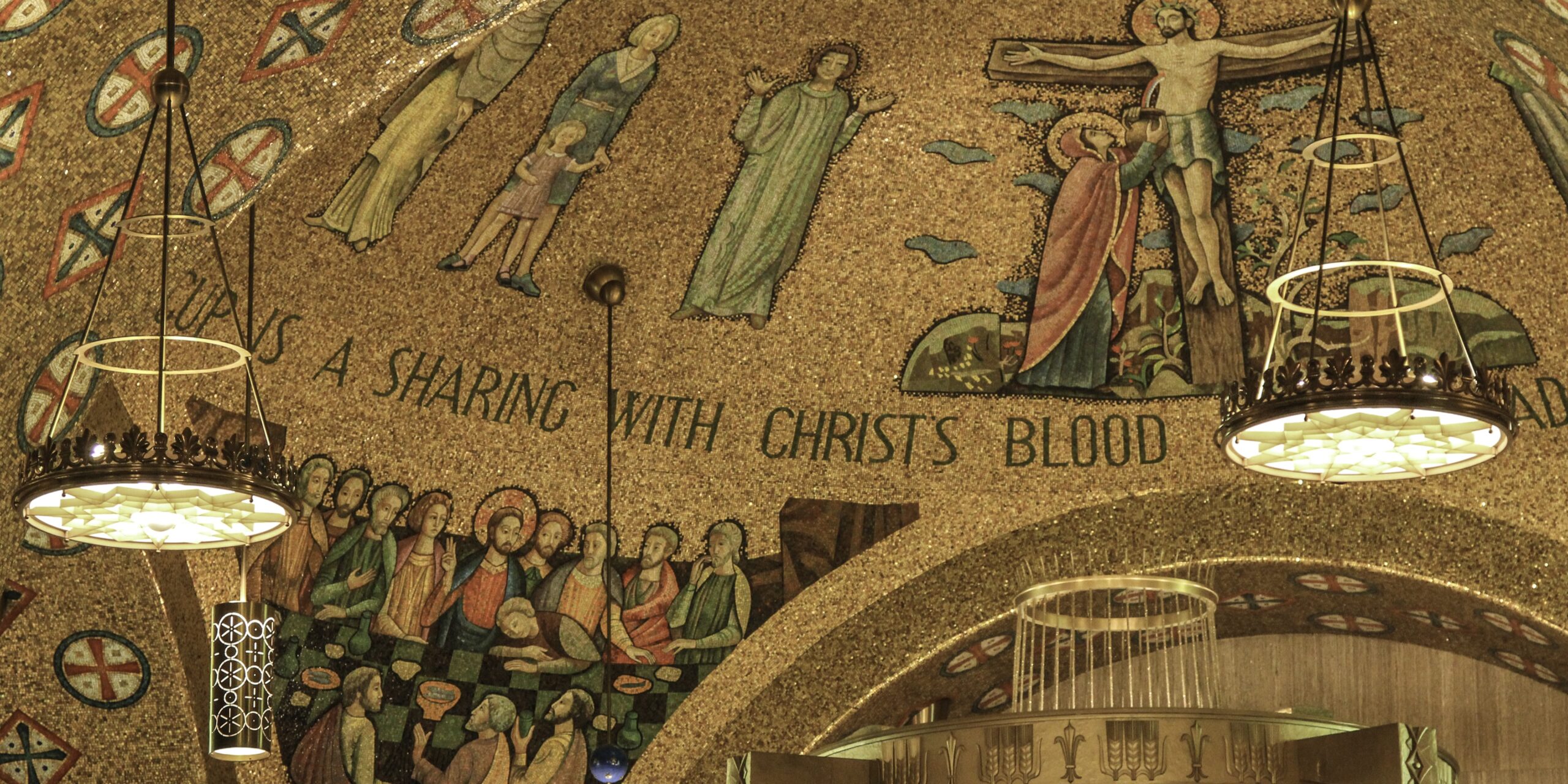
During the next three days, Jesus prepared for the Passover, the Jews’ annual zikaron of the Pasch, which included sacrificing and eating the Paschal lambs. “I have greatly desired to eat this Passover with you before I suffer,” he told his apostles on Thursday evening. However, this Passover was different.
First: the lambs were slaughtered in the temple at twilight on Friday and eaten in the people’s homes on Saturday, but Jesus started his Passover after twilight on Thursday.
Second: there was no ordinary sacrificed lamb. Instead, Jesus took bread and said, “This is my body.” Then he took a cup and said, “This is my Blood, the blood of the covenant, to be poured out on behalf of many for the forgiveness of sins.”
Third: the final cup of wine was omitted; Jesus declared that he would not drink wine again “until the day when I drink it new with you in my Father’s reign.” Accordingly, he refused wine on his way to crucifixion. Only on the cross did he take it and say, “It is finished.”
Jesus died at 3 p.m. on Friday – before sunset, and therefore, by Jewish reckoning, on the same day as he had begun his Last Supper. Together, the Last Supper and the Crucifixion comprised what Christians soon came to regard as Christ’s Passover.
Jesus began it sacramentally at his Last Supper on Thursday evening, under the appearances of bread and wine, but he could not finish it until his bloody death on the cross, for in the new Passover, he himself was the sacrificed Lamb.
The new Passover – Christ’s Last Supper/Crucifixion – like the old, comprised a sacrifice and a meal. The meal revealed his death to be a sacrifice, not an execution; his death revealed the meal to be a sacrament.
Without the Last Supper, we could never have grasped how Jesus’ death could be “the act of perfect worship, pleasing to the Father,” says Pope Francis. “Only a few hours after the Supper, the apostles could have seen in the cross of Jesus, if they could have borne the weight of it, what it [had] meant for Jesus to say, ‘Body offered,’ ‘Blood poured out.’”
Immediately after saying that, Jesus said, “Do this as a zikaron of me,” thus instituting the Sacrament of Holy Orders.
That zikaron is the Mass. At Mass, we are actually present at Christ’s Last Supper/Crucifixion. We see not only Christ the victim under the appearances of bread and wine, but also Christ the priest under the appearance of the ordained celebrant.
To stress the unity of the Last Supper/Crucifixion, the Church prescribes that there be no blessing or dismissal in the Holy Thursday evening Mass and no other Good Friday Mass. The Holy Thursday Mass may be called the “first act” in a liturgy that continues with the Good Friday service and concludes only with the Easter Vigil on Holy Saturday.
Don’t miss it.
Father Hawkswell is again teaching “The Catholic Faith in Plain English,” with new insights, in both print and YouTube form, at beholdvancouver.org/catholic-faith-course. He is also teaching the course in person on Sundays (2 – 4 p.m. at the John Paul II Pastoral Centre, 4885 Saint John Paul II Way, 33rd Avenue and Willow Street, Vancouver) and Mondays (10 a.m. – noon in St. Anthony’s Church Hall, 2347 Inglewood Avenue, West Vancouver). The title of next week’s talk is Holy Week.
Your voice matters! Join the conversation by submitting a Letter to the Editor here.







