

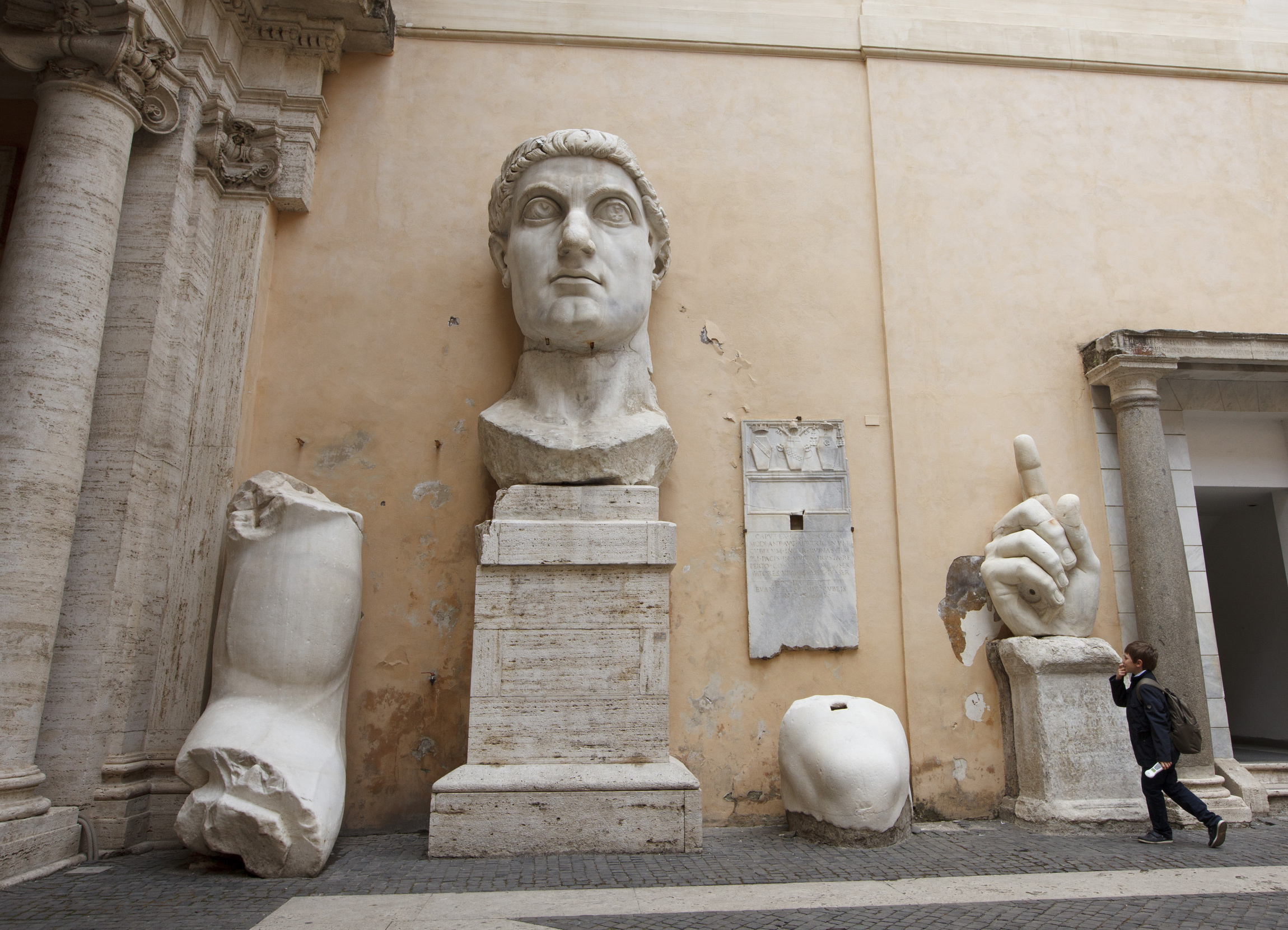

Some contend that the Church originally founded by Jesus on earth – the Catholic Church – became paganized and then completely apostatized, falling away from the truths Jesus left it, shortly after he established it.
While dates around this supposed apostasy vacillate wildly from group to group, many suggest the Christian conversion of the pagan Roman Emperor Constantine in the fourth century as a likely starting point for this collapse.
To answer these charges, let’s first turn to Scripture, and then finish by examining the reign of Constantine himself.
Recall that Jesus didn’t first instruct that a Bible be written, although of course he wanted it written. He first founded his Church, the “body of Christ” with Jesus as “the head of the body, the church” and “in him all things hold together” (Col 1:17-18). Could anybody truly believe that this Church might then implode a few centuries later?
Indeed, Scripture opposes such a view. In Matthew 7:24-25, the wise builder builds his house on rock and it does not fall, no matter the storms.
Similarly, in Matthew 16:16-19 Jesus, the wisest of builders, builds his house. St. Paul calls the Church “the house of God” in 1 Timothy 3:15, and it is built on Peter (which means “rock” in Greek). “You are Peter; and upon this rock I will build my church, and the gates of hell shall not prevail against it.”
Jesus then gives Peter a share in his own incredible authority, handing him “the keys to the kingdom of heaven” and the power to bind and loose on earth and in heaven.
Similarly, in Mark 3:27, Jesus states, “No one can enter a strong man’s house to plunder his property unless he first ties up the strong man. Then, he can plunder his house.” Jesus is the “strong man” guarding his Church, “the house of God,” from attack and plunder, and Jesus’ house will never fall.
Jesus then promises his disciples he will be with them “always” (Mt 28:20] and says, “The Father … will give you another Advocate to be with you always, the Spirit of truth … He will guide you into all the truth” (Jn 14:14-17, 16:13).
Similarly, St. Paul makes the powerful statement that the Church is “the pillar and foundation of truth” (1 Tim 3:15).
With promises like these from Jesus, how could the pillar of truth, “the household of God, built upon the foundation of the apostles … Christ Jesus himself being the cornerstone” (Eph 2:20-21), ever fall away? It would be a direct contradiction to Jesus’ teachings and promises: “The Lord God will give to him the throne of his father David.” This is both an earthly and a heavenly throne. “And of his kingdom there will be no end” (Lk 1:33).
Even the Old Testament clearly rejects such a belief. Isaiah 9:6-7 promises, “To us a child is born … Of the increase of his government … there will be no end.”
Similarly, Daniel 7:13-14 states, “There came one like a son of man … his dominion is an everlasting dominion … and his kingdom one that shall not be destroyed.”
The Catechism of the Catholic Church adds insight for us, reaffirming that the kingdom of God is present on earth as the Church – in seed form, but growing like a mustard tree: “The kingdom of heaven was inaugurated on earth by Christ … The Church is the seed and beginning of this kingdom” (CCC 567, 763).
With this overwhelming scriptural evidence to the contrary, where do some people get the notion that the Catholic Church apostatized early in its history? They quote verses like 2 Thessalonians 2:3-4: “The rebellion comes first, and the man of lawlessness … takes his seat in the temple of God, proclaiming himself to be God.” They then try to apply this verse to both the Pope and the Catholic Church, claiming this rebellion is a turning away from God incited by false Catholic teaching.
But when read in context, it quickly becomes evident the verse has nothing to do with a total apostasy in our history, but with a partial rebellion that will occur at the end of time – “at the coming of … Jesus,” when Jesus will “destroy” the man of lawlessness.
To drive the point home that he is talking about Jesus’ final coming and not some point in history, St. Paul again warns them: “Let no one deceive you in any way; for that day [Jesus’ return] will not come, unless the rebellion comes first, and the man of lawlessnessis revealed” (2 Thes 2:3).
Matthew 24:4-12 invariably gets quoted as well: “They will deliver you up to tribulation … And then many will fall away, and betray one another … And many false prophets will arise and lead many astray … most men’s love will grow cold. But he who endures to the end will be saved.”
Again, the verse is being used out of context. Jesus is prophesying about the tribulation that will surround the destruction of the Jewish temple in 70 AD, saying many will be led astray: “most men’s love will grow cold,” but everyone. “He who endures to the end will be saved.”
The text is not talking about a total apostasy of the Church Jesus founded, but in fact the survival of his Church during intense persecution.
Amos 9:8-10 is also often quoted: “Behold, the eyes of the Lord God are upon the sinful kingdom, and I will destroy it from the surface of the ground.” But this verse is talking about an apostasy in Old Testament Israel, not the New Testament Church. Additionally, the apostasy and destruction will clearly not be total, as Amos adds: “’except that I will not utterly destroy the house of Jacob,’ says the Lord.”
Perhaps the favourite “apostasy verse” is Acts 20:29-31: “He sent to Ephesus and called to him the elders of the church … he said to them … fierce wolves will come in among you, not sparing the flock; and from among your own selves will arise men speaking perverse things, to draw away the disciples after them.”
But St. Paul is referring to “wolves” attacking and “not sparing” the Church/flock specifically at Ephesus, not the universal Church.
Similarly, Matthew 7:15 is also often quoted: “Beware of false prophets, who come to you in sheep’s clothing but inwardly are ravenous wolves. You will know them by their fruits… Every tree that does not bear good fruit is cut down and thrown into the fire. Thus you will know them by their fruits.”
When Jesus speaks of trees not bearing good fruit and being thrown into the fire, he is not talking about the Church, but of individuals: “You will know them by their fruits.” He is warning people about “wolves,” false prophets, how to spot them, and what will ultimately happen to them.
Another well-worn verse is 2 Timothy 4:3-5: “For the time is coming when people will not endure sound teaching … they will accumulate for themselves teachers to suit their own likings and will turn away from listening to the truth and wander into myths.”
Ironically, this verse is better directed back at Protestantism in general. The nature of Protestantism is extremely subjective, with people reading Scripture and deciding what it means to them individually. There is no church to guide their interpretations – no higher authority than themselves.
They claim the inspiration of the Holy Spirit, but their countless personal interpretations constantly run contradictory to each other. Time and again, people make the Bible and the “church” into their own image, resulting in thousands of different and conflicting denominations. All of this comes as a result of personal interpretation of Scripture severed from the moorings of the authoritative Church Jesus built and left the Holy Spirit to guide.
So while throughout history we see people falling away from the true faith and often trying to lead others away, there is not a single verse in all of Scripture that remotely suggests a future collapse and total disappearance of the Church Jesus founded.
As for the claim that Constantine paganized the Catholic Church, or the wilder claim that he invented the Catholic Church itself, such an historically inaccurate proposition conflicts with well-documented history of this period. See my next column for the rest of the story.







