

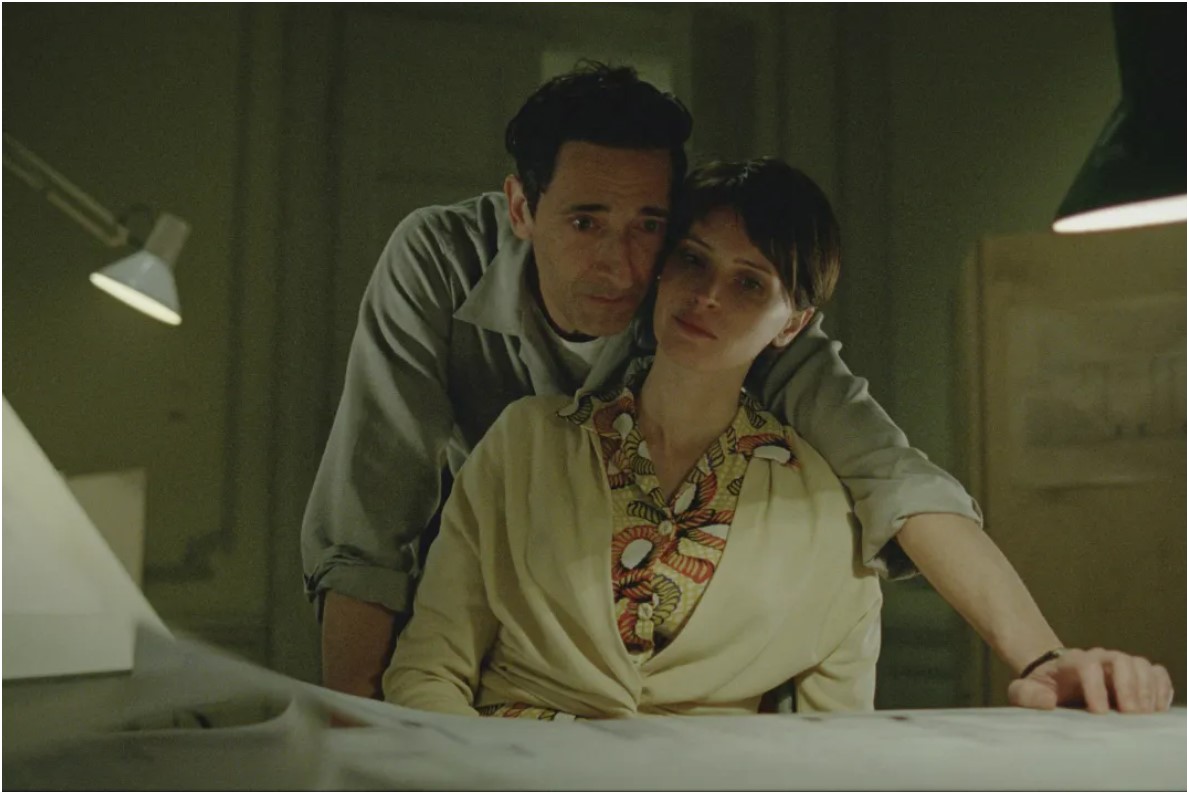

It is rather obvious that, had its leading actor not been awarded an Oscar for his performance, The Brutalist might have attracted little attention. As it is, with its running length of more than three hours (including a scheduled 15-minute intermission), as well as parts of it being subtitled, many potential viewers may well be discouraged from watching. This is a pity since, despite being challenging viewing, The Brutalist offers much to think about, as well as boasting some excellent performances and stunning cinematography.
The Brutalist tells the story of architect Laszlo Toth (Adrian Brody). Born in Budapest, he and his family suffer internment in a concentration camp in the latter years of the Second World War. After the war, Toth is able to emigrate to the United States, though without his wife and beloved niece.
What follows is a film concerned as much with politics (particularly the politics of immigration and racism) as art.
Though full of hope as Toth arrives in America, the notion that his experience will be less than optimal is symbolized by a view of the Statue of Liberty upside down. As a Jew and an immigrant, he finds himself battling for survival, at one point being reduced to shovelling coal, at another, resorting to drugs.
Things take a turn for the better when he receives a commission to design the library of a capitalist, Harrison Lee Van Buren (Guy Pearce). However, Van Buren disapproves of the result and refuses to pay Toth. When, however, Van Buren discovers that Toth’s design has been hailed by the public as superb, he changes his mind, pays the outstanding debt, and commissions Toth, in memory of his mother, to design and build a community centre. It is a mark of the film’s view of the egocentricity of capitalists that the centre is not to include a swimming pool because Van Buren himself does not swim. Indeed, it is apparent that the title of the film applies as much to the capitalist as it does to the artist.
As the film further unfolds and Toth’s extremely complex journey continues, one sees his fortunes rise and fall and rise again, as he is reunited with his wife and niece, subjected to outrageous abuse by the capitalist, and encounters further triumphs and difficulties.
It is a journey that certainly challenges the staying power of the viewer, though I found myself totally caught up in the many conflicts—personal, artistic, and societal—that Toth and those associated with him experience. Despite its length, I wished, at the end of it all, that we had been able to explore much further Toth’s artistic achievement, though to a large extent this is compensated for by the brilliance with which the film itself is directed and photographed.
Particularly stunning are sequences where Toth goes to the famous Carrara marble quarry and another set against the construction of the community centre—scenes that remind one of the masterful Fellini in their impact, both visual and dramatic. They serve to show why, under the skilful direction of Joe Alwyn, the film was in the running for the Best Picture Oscar. Indeed, in my opinion, it was more fully deserving of the Oscar than the film that won, the decidedly flawed Anora. In this regard, The Brutalist is a film that, despite the challenges it contains, I eagerly anticipate viewing again.







