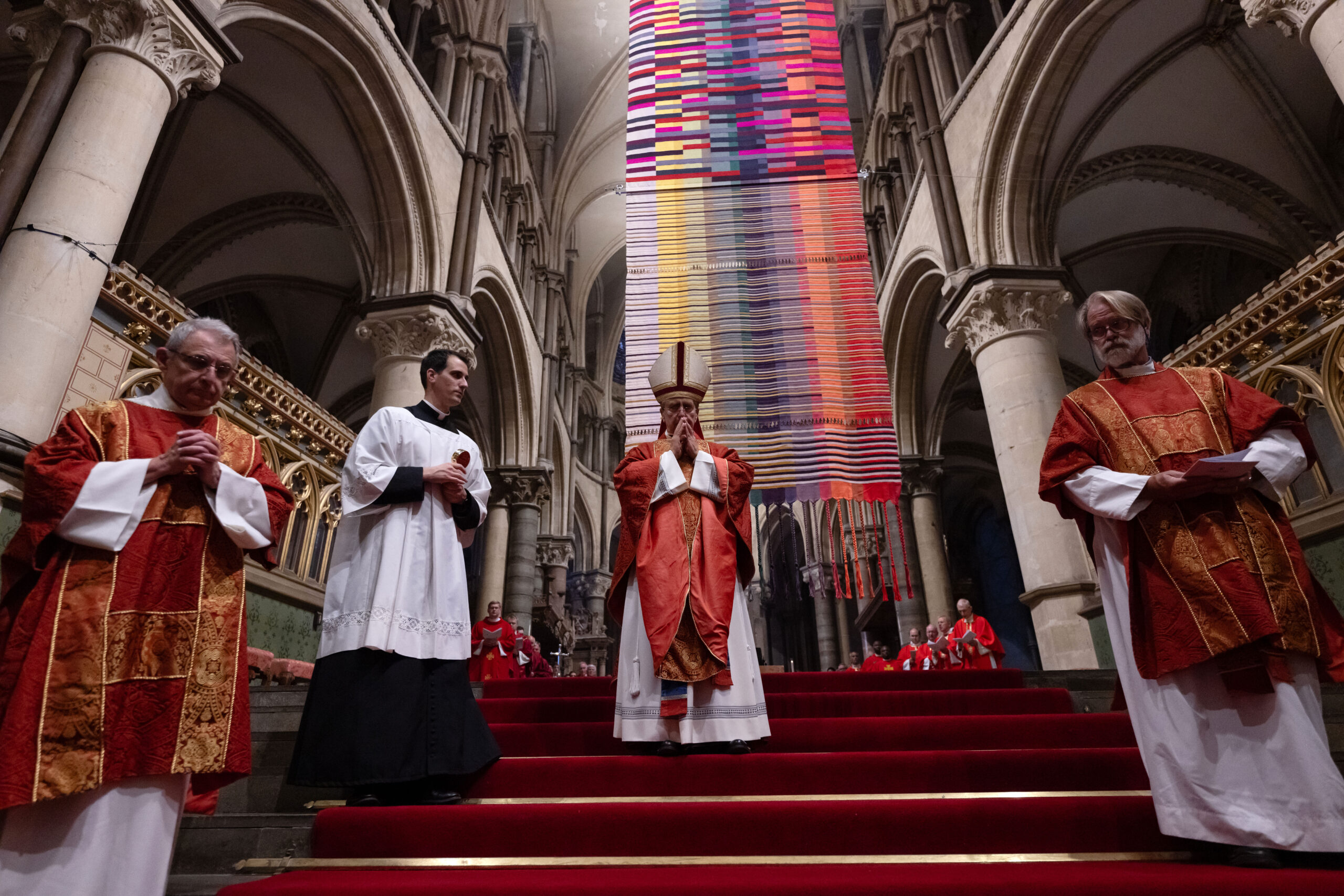

Earlier this month, something quite significant happened in Canterbury, England. On July 7, Archbishop Miguel Maury Buendía, Papal Nuncio in England, celebrated a Catholic Mass at Canterbury Cathedral, which has been under the auspices of the Church of England for almost the last five centuries. This was an extraordinary moment for several reasons.
The Mass was celebrated in recognition of the translation, or transfer, of the remains of St. Thomas Becket, who was martyred inside the Cathedral in 1170. St. Thomas was the Archbishop of Canterbury and had a rather tumultuous relationship with King Henry II, whose knights set off to kill Thomas after they heard the king say, perhaps metaphorically, “Will no one rid me of this meddlesome priest?”
On July 7, 1220, St. Thomas’s remains were translated, and a shrine was erected in the Cathedral, which became a popular pilgrimage site. In 1538, during the Protestant Reformation, King Henry VIII ordered the shrine destroyed, and the Cathedral was taken over by the Church of England.
Though Catholic Masses have been celebrated on July 7 in Canterbury Cathedral before now, this is the first time that an official representative of the Pope has been the main celebrant. We know from Church history that the blood of the martyrs is a seedbed for the growth of the faith. This is exactly why King Henry VIII destroyed the shrine of St. Thomas, as he knew that Catholics drew strength and inspiration from the example of the saint. The following of St. Thomas Becket has never really waned, even inspiring such great literary works as The Canterbury Tales and Murder in the Cathedral.
In light of this historic Mass, it is no coincidence that there is a resurgence of Catholic faith in England. The Catholic Herald newspaper, based in London, ran an article on April 9 entitled “Catholics set to exceed Anglicans for first time since Reformation due to younger churchgoers.” For the past few years, record numbers of people have been joining the Catholic Church in England.
When my daughter and I visited England last year, we visited several Catholic churches and saw evidence of this growth, with large numbers in attendance at both daily and Sunday Mass and Eucharistic adoration. My heart was bolstered by this sight, which I was not expecting in a country that is not known for being Catholic. At St. Aloysius Church in Oxford, where we attended Sunday Mass, we walked up to the church and into a full courtyard of young families just getting out of early morning Mass. The Mass we attended, one of four that day, was equally as full, and a large number of the congregation, including my daughter and me, stayed for social time at the parish-run café afterward.
There seems to be a shift in the spiritual landscape in England, though this should be no surprise. With the blood of martyrs running deep in the country’s Catholic veins, it is no wonder that Catholicism is coming alive at a time when faith is being challenged all over the world and, perhaps, with particular vehemence in Great Britain.
While touring Canterbury Cathedral, we also noticed there is no denying the building was built by and for Catholics. Not only does the place echo with the story of St. Thomas Becket, but several other pre-Reformation Catholics are also interred there, perhaps the most important being St. Anselm, who lived from 1033–1109, and also served as Archbishop of Canterbury. A humble man who preferred monastic living, St. Anselm is considered one of the Church’s greatest theologians.
The recent Mass at the Cathedral was well attended, with some people having to stand outside. Pope Leo XIV’s papal blessing was imparted by his nuncio within the walls that are really an homage to the roots of the Catholic Church in England, with the Pope exhorting everyone to pray for England’s conversion.
Is this Mass another sign of hope in this Jubilee Year of Hope? Together with the many recent and ongoing conversions to Catholicism in England (and elsewhere), along with the dynamic liturgical and parish activities in parts of the country, it seems the signs are more hopeful than not. Is there still work to be done? Certainly. But the blood of the martyrs, and there were so many more of them during the Reformation years, is a powerful thing, even after several hundred years. God never fails to honour the sacrifices of those who keep the faith, though his timing is his alone, and hope never disappoints.
Lazzuri writes from her home in Nova Scotia, where she lives with her husband, four of her six children, and her mother. She can be reached at clarelazzuri@gmail.com.