


Why do good people suffer? Simply put, because they are the most effective. That’s the short answer. The long answer is the Gospel. Or Salvifici Doloris, St. John Paul II’s apostolic letter on the Christian meaning of human suffering.
Suffering is a great evil that has plagued us since the beginning of time. This is why God has completely turned everything upside down in sending Christ to suffer and die so that evil would never again have the last say for any of us. Jesus Christ was a perfect person and yet his mission was to suffer. So the greatest evil – suffering – has become the greatest source of life and power. When Jesus died, he gifted us the prerogative to “laugh at the days to come” (Prv 31:45) even in the face of suffering.
It is a sign of compassion to pray for an end to someone’s suffering, but it is a sign of spiritual immaturity to refuse to see the value in suffering. It is expected that we pray for an end to suffering always (!), but we must pray with a childlike humility that sometimes “the cup will not pass” and that is somehow the best possible answer to our prayer.
A 30-year-old cancer patient who goes by the name Nightbirde sang on America’s Got Talent recently. Her audition featuring her original song “It’s OK” went viral. Mostly, her wisdom went viral; her capacity for peaceful suffering went viral. When people suffer beautifully it speaks to us of the kind of love for which we were made. And we need to buzz about it. It’s the stuff of the greatest stories because its fragrance is legacy – imprinting and dignified. Graceful suffering is disarming and astonishing because it calls us to a new plane of existence, a new framework with new values. When we see someone suffering graciously, we want to be better humans. We see all that is noble in humanity, all that is pure and beautiful.
This is why good people suffer. Because in them we see what God can do with evil.
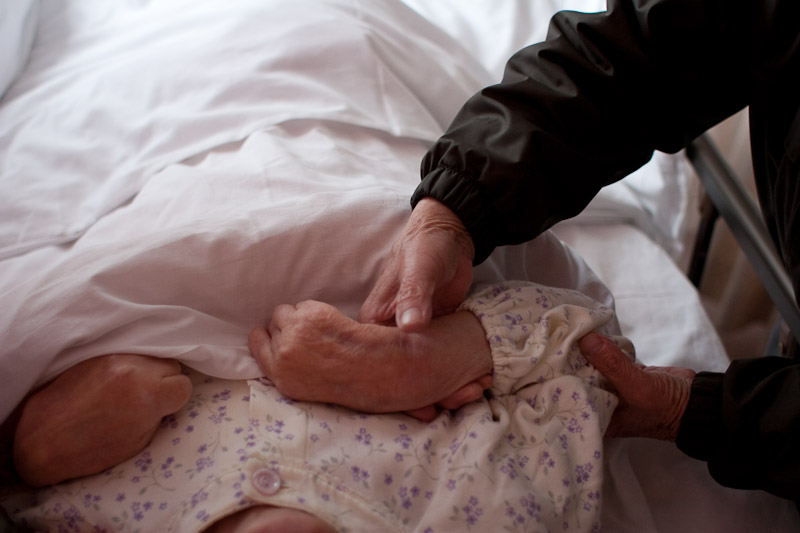
If you’ve ever been at the bedside of a peaceful dying person, it has undoubtedly shaped your heart in ways you may not understand. If you have held hands with someone undergoing cancer treatments or sat on the bathroom floor with them, you know what it is to be powerless before what can only be described as cruelty.
To acknowledge the injustice and the evil of suffering does not equate or presuppose that we are conquered by it. We are allowed to say how angry we are. We can say that we don’t understand. We can even say that we wish we had something to say. Or we can just keep holding hands. As Nightbirde wrote of her journey with cancer treatments, “God is on the bathroom floor.”
“Christ did not conceal from his listeners the need for suffering,” writes St. John Paul II in Salvifici Doloris. “He said very clearly: ‘If any man would come after me … let him take up his cross daily,’ and before his disciples he placed demands of a moral nature that can only be fulfilled on condition that they should ‘deny themselves.’ The way that leads to the Kingdom of heaven is ‘hard and narrow,’ and Christ contrasts it to the ‘wide and easy’ way that ‘leads to destruction.’”
Not only is an easy ride ineffective, it is destructive. The most intense love is always linked very closely to suffering alongside. This is why to truly love someone who is grieving or suffering, we need to sit in the suffering with them.
Christianity is not about tying up people’s burdens and their messes with neat little maxims about heaven getting new angels or wings or “God needing more help up there.”
We need to allow our presence to communicate hope, and to do this we need to be people of radical faith in God’s will. If the ultimate good, eternal life, came from God’s death, we really have to live out of that place and wait for the signs of life that will come.







