

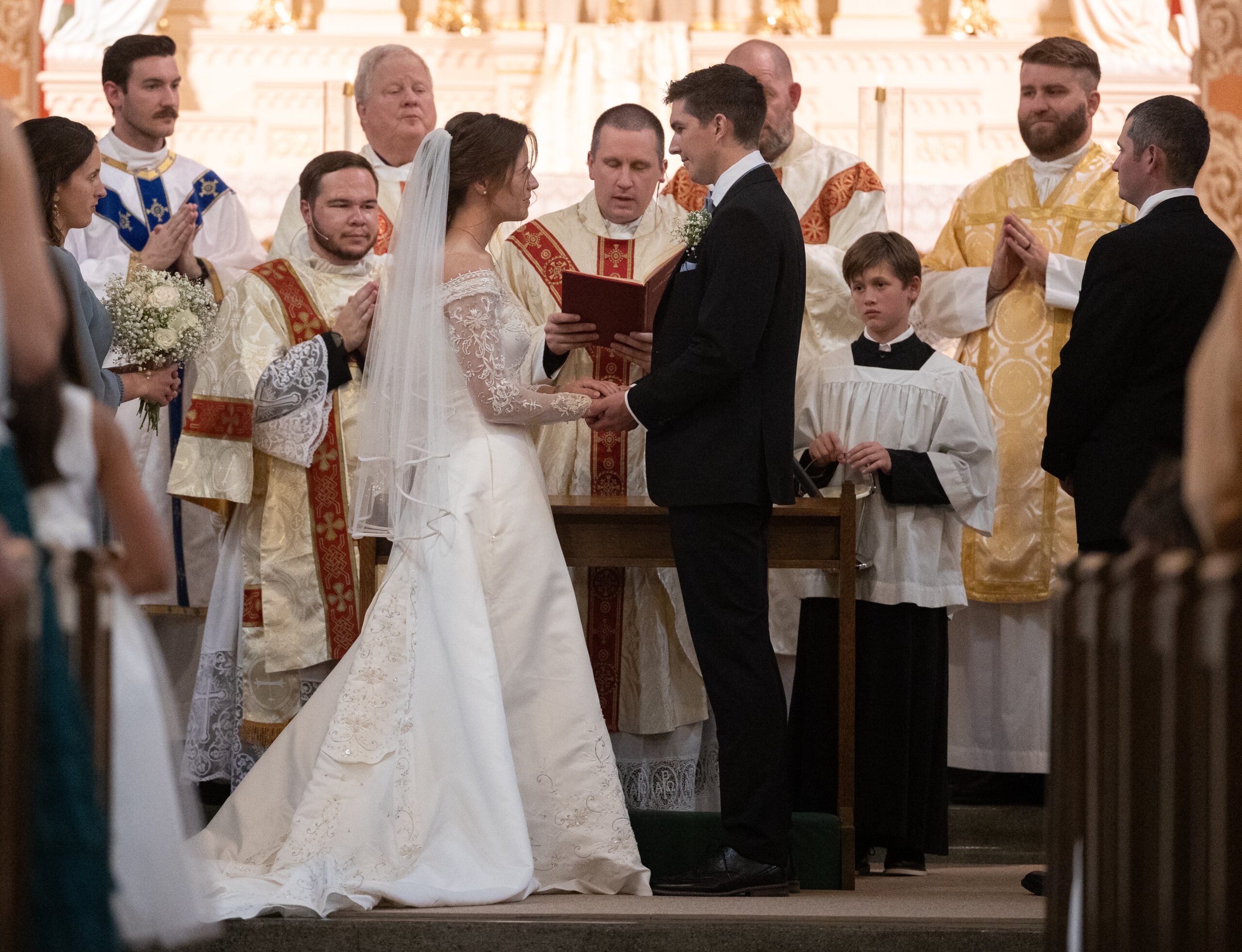

In the first part (Chapters 1–6) of the First Letter to the Corinthians, St. Paul rebuked the wrongdoings of the Corinthians. In the second part (Chapters 7–15), St. Paul gave general instruction in Christian moral life.
In Chapter 7, St. Paul gave instruction concerning marriage and virginity. Catholic author Stephen K. Ray commented, “He is being extremely practical, holding up marriage as an antidote to sexual impurity. Nevertheless, simply being married is not all that is needed. The man and woman must each fulfill their ‘conjugal rights’ (duty in Greek).”
This was revolutionary, Ray notes, because in Greco-Roman society, “a wife belonged to her husband and must remain sexually faithful to him, while the husband had no such restrictions. Paul now imposes equal ownership and laws upon both the husband and the wife. Paul’s words shook the foundations of Roman society and laid the groundwork for a woman’s equal rights and dignity… Paul wishes all were single and celibate like himself, but he knows that each man has his own gift from God; he is making a concession for those who do not have the gift to remain celibate. The Church has always been wise in this matter. It acknowledges, praises, and institutionalizes both the married and the celibate states.”
St. John Chrysostom wrote, “Whoever condemns marriage also deprives virginity of its glory; whereas whoever praises it makes virginity more attractive and luminous. Something which seems good only when compared with something bad, is not very valuable; but when it is greater than things which everyone gives great value to, then indeed it is good to a superlative degree.”
St. John Paul II wrote something similar: “Virginity or celibacy for the sake of the Kingdom of God not only does not contradict the dignity of marriage but presupposes it and confirms it. Marriage and virginity or celibacy are two ways of expressing and living the one mystery of the covenant of God with his people. When marriage is not esteemed, neither can consecrated virginity or celibacy exist; when human sexuality is not regarded as a great value given by the Creator, the renunciation of it for the sake of the Kingdom of heaven loses its meaning.”
Venerable Fulton J. Sheen wrote, “Both celibacy and marriage have the same passion of love except that celibacy is immediate though imperfect, while marriage is mediate and also imperfect… God has two kinds of lovers—those who go directly to the ultimate, such as the celibate, and those who go mediately through marriage.”
Regarding virginity and celibacy, St. Paul wrote, “I want you to be free from anxieties. The unmarried man is anxious about the things of the Lord, how to please the Lord. But the married man is anxious about worldly things, how to please his wife, and his interests are divided. And the unmarried or virgin woman is anxious about the things of the Lord, how to be holy in body and spirit. But the married woman is anxious about worldly things, how to please her husband.” (1 Cor. 7:32–35)
Stephen K. Ray commented: “The wife will give up prayer and devotion to cook, change diapers, and please her husband. The husband will not have much time for spiritual things because he has to earn a living and support his family… Paul, on the other hand, was a single man without the burdens of a family. He could drive himself to the limit, stay up all night, and accept all kinds of suffering and abuse.”
Pope Pius XII stated: “This is the main purpose and primary reason for Christian virginity—to dedicate oneself exclusively to divine things, giving them all one’s attention and love, thinking of him constantly and consecrating oneself to him completely, body and soul.”
St. Therese of the Child Jesus described her vocation: “To be your spouse, O Jesus … by my union with you to be the mother of souls.”
Your voice matters! Join the conversation by submitting a Letter to the Editor here.
聖保祿尊崇婚姻和貞潔
在格林多前書的第一部分(第1至第6章),聖保祿斥責了格林多人所犯的錯誤。在第二部分(第7至第15章),聖保祿對基督徒的道德生活定下了普通原則。
在第7章中,聖保祿對於婚姻與貞潔給予了教導。天主教作家Stephen K. Ray評論道:「他極實際地指出,婚姻是對抗不貞潔的解藥。然而,僅僅結婚並不足夠,丈夫與妻子必須『各自』履行彼此的『婚姻權利』(希臘文用『義務』)。這在當時的希臘羅馬社會是革命性的,因為在當時的文化中,妻子屬於丈夫,必須對丈夫保持性忠貞,而丈夫則沒有這樣的限制。聖保祿現在對丈夫和妻子施以平等的擁有權與法律規範。保祿的話震撼了羅馬社會的根基,並為婦女的平等權利與尊嚴奠定了基礎…。保祿希望所有人都像他一樣單身和獨身守貞,但他也明白每個人都有天主所賜的恩寵;他對那些沒有保持獨身守貞恩寵的人作出讓步。教會在這一問題上一貫地展現出智慧,不僅承認和讚美婚姻與獨身守貞生活,甚至使之制度化。」
金口聖若望曾寫道:「誰若譴責婚姻,也剝奪了貞潔的榮耀;然而,誰若讚美婚姻,就使貞潔更具吸引力和光輝。一樣東西若只有在與壞事相比時顯得好,那就不算有價值;但當對比眾人極為重視的事物為更高超時,才確實是極好的。」
聖若望保祿二世也寫下了類似的話:「為天主的國度而守貞或獨身,不僅不與婚姻的尊嚴相矛盾,反而以婚姻為前提並予以肯定。婚姻與貞潔或獨身守貞是表達和活出天主與祂子民盟約的奧蹟的兩種方式。當婚姻不被珍視時,奉獻的貞潔或獨身守貞也無法存在;當人類的性行為沒有被視為創造者賜予的一項重大價值時,為天國而放棄此行為就失去了意義。」
真福Fulton J. Sheen總主教曾寫道:「獨身守貞與婚姻擁有同樣愛的熱情,只是獨身守貞是直接雖然並不完美,而婚姻是間接的,同樣也不完美…。愛天主的人有兩種 – 那些如獨身守貞者般直接奔向最終目標的人,以及那些通過婚姻間接奔向最終目標的人。」
關於貞潔與獨身守貞,聖保祿寫道:「我願你們無所掛慮:沒有妻子的,所掛慮的是主的事,想怎樣悅樂主;娶了妻子的,所掛慮的是世俗的事,想怎樣悅樂妻子:這樣他的心就分散了。沒有丈夫的婦女和童女,所掛慮的是主的事,一心使身心聖潔;至於已出嫁的,所掛慮的是世俗的事,想怎樣悅樂丈夫。」(格前7:32–35)
Stephen K. Ray評論道:「妻子會為了烹飪、換尿布和取悅丈夫而放棄祈禱和神修;丈夫則因必須謀生養家而沒有太多時間投入於神修…。而聖保祿則是未婚之人,沒有家庭的重擔。他能夠將自己推向極限,通宵不眠,接受各種痛苦和虐待。」
教宗庇護十二世說:「基督徒貞潔的主要目的和首要原因 – 將自己完全奉獻於神聖事務,專注並熱愛這些事務,不斷思念祂,並將自己完全奉獻給祂,身心合一地歸屬於祂。」
聖女小德蘭形容她的聖召:「成為祢的新娘,噢耶穌 … 藉著與祢的結合,成為眾靈的母親。」
Your voice matters! Join the conversation by submitting a Letter to the Editor here.







