

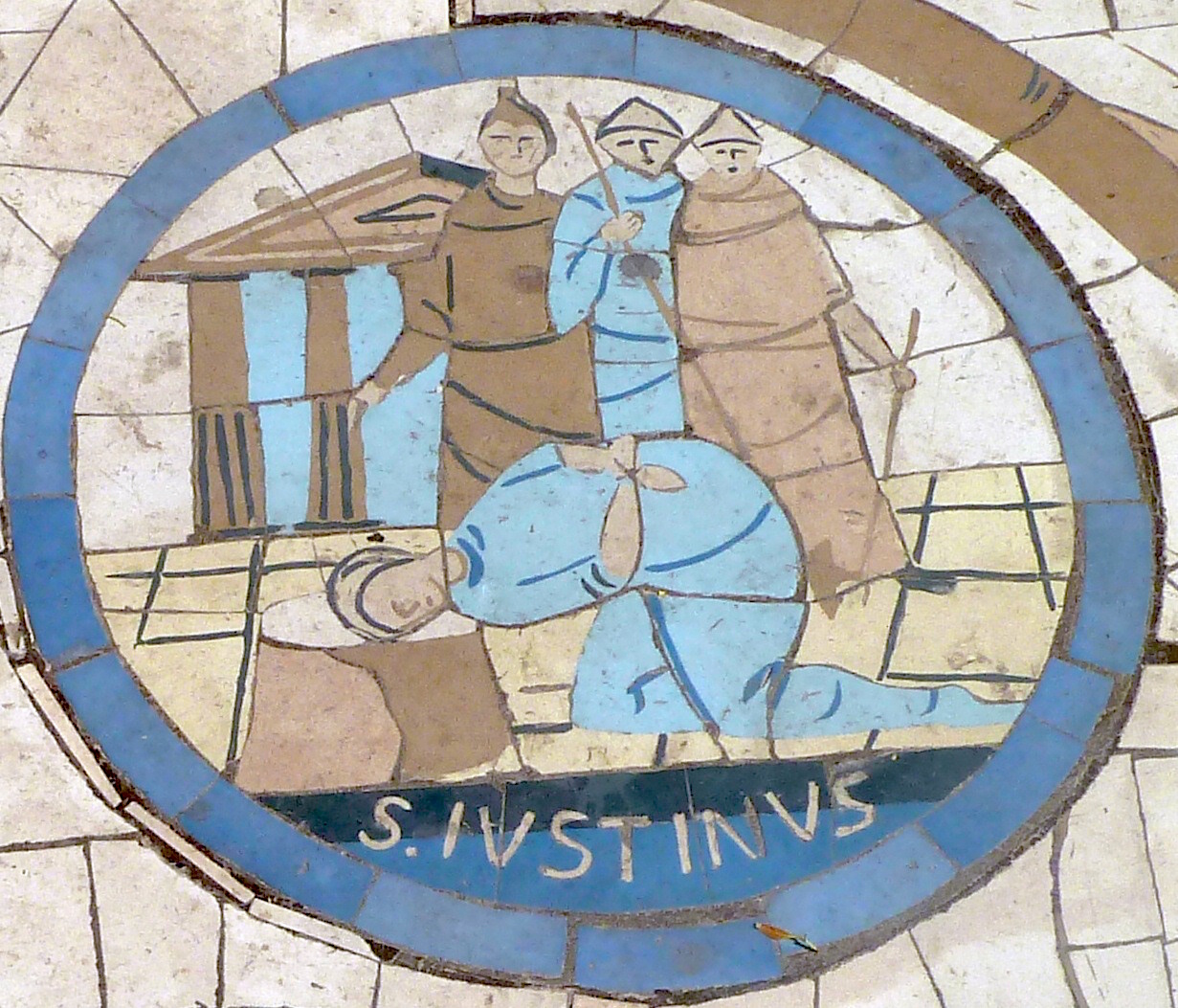

In face of growing hostility in the second century, Christians sought to refute objections and calumnies and at the same time tried to justify their faith rationally. As a result, many apologetical literatures were composed in the second century.
Pope Benedict XVI explained: the word “apologist” designates those ancient Christian writers who set out to defend the new religion from the weighty accusations of both pagans and Jews, and to spread the Christian doctrine in terms suited to the culture of their time.
Thus, the apologists had a twofold concern:
- that most properly called “apologetic” – defending the newborn Christianity (apologhía in Greek means, precisely, “defence”)
- and the pro-positive “missionary” concern, explaining the content of the faith in a language and on a wavelength comprehensible to their contemporaries.
Many apologists were laymen-philosophers who converted to Christianity. The most important apologist in the second century is St. Justin, born of Greek parents around 100 AD.
Justin was a philosopher who became a Christian in 130 AD after an elderly man he met on the seashore spoke to him about the prophets of the Old Testament and about Christianity.
After his conversion, Justin taught Christian philosophy at Ephesus. In 135 AD, Justin went to Rome where he opened a Christian school. Around 165 AD, Justin was scourged and beheaded for the faith with six other Christians. In his writings, Justin demonstrated the divinity of Christ by means of both prophecies and philosophy. He also gave detailed description of the rites of baptism and the Eucharist.
Justin clearly attested belief in the Real Presence of Christ in the Eucharist. He wrote: “And the food is called by us Eucharist, of which no one is allowed to partake but he who believes the truth of our doctrines, and who has been washed with the washing that is for the forgiveness of sins and to regeneration, and who so lives as Christ has directed. For we do not receive them as ordinary food or ordinary drink; but as by the word of God Jesus Christ our Saviour was made flesh, and took upon him both flesh and blood for our salvation, so also the food which was blessed by the prayer of the word which proceeded from him, and from which our flesh and blood, by transmutation, receive nourishment, is, we are taught, both the flesh and blood of that Jesus who was made flesh.”
Justin taught that Greek philosophy was not opposed to Gospel truth. For him, the Old Testament and Greek philosophy were two paths that lead to Christ. He wrote, “The truths which men in all lands have rightly spoken belong to us Christians. For we worship and love, after God the Father, the Word who is from the Unbegotten and Ineffable God, since He even became Man for us, so that by sharing in our sufferings He also might heal us. Indeed, all writers, by means of the engrafted seed of the Word which was implanted in them, had a dim glimpse of the truth.”
In Fides et Ratio, St. John Paul II wrote, “A pioneer of positive engagement with philosophical thinking – albeit with cautious discernment – was Saint Justin. Although he continued to hold Greek philosophy in high esteem after his conversion, Justin claimed with power and clarity that he had found in Christianity ‘the only sure and profitable philosophy.’”
During the trial before his martyrdom, the prefect asked Justin, “Do you think that by dying you will enter heaven and be rewarded by God?”
Justin replied, “I do not think, but I know and am fully persuaded of it.”
聖猶斯定護衛信德 何庭耀
在第二世紀,基督徒面對倍增的敵對浪潮,要駁斥一切反對及誹謗的同時,設法以理性去印證信德;結果,很多護教的作品亦因應而生。
教宗本篤十六世解釋:「護教者」特指古時的基督徒作家,要在異教及猶太人施加沉重的指控下,廣泛宣傳這個初生教會的教理,是絕對可以完全融入當時的文化。所以,當時的護教者要兼顧兩個大綱:「護教學」必須能夠好好守護初生教會的基督教教理;在傳道時,必須能夠用是時廣為接受及領略的言語,解釋基督教教理。
很多護教者都是平信徒 ── 皈化基督教的哲學家。其中在第二世紀的表表者,是聖猶斯定。約在公元100年,猶斯定出生於希臘家庭。公元130年,在聽過一位長者論及舊約先知事蹟,和相關的基督教教理後,猶斯定信奉聖教。皈化後,猶斯定在厄弗所教授基督教哲學;公元135年,他到羅馬開辦基督教學校。公元165年,因為基督教信仰,猶斯定和另外六名人士,被鞭打後,被砍去頭顱殉道。
在他的箸作中,猶斯定利用先知預言和哲學的角度,闡釋基督的天主性;他也詳加敘述了聖洗和聖體聖事的禮儀。
猶斯定清晰地證實「基督真實臨在聖體聖事中」的信條;他寫道:「這糧 ── 我們稱之為『聖體』── 只有那些完全相信我們教理的真道、得到罪之赦的更新,和依從基督訓導而生活的人,才可以領受。我們不能領受這神糧,與進食世上的俗糧無異;因為這神糧是『道成肉身』的基督,藉祂犧牲體血的救贖,也藉祂的言令使酒餅變化成了祂的體血,讓我們可以領受,得到靈魂的滋養。」
猶斯定聲明,希臘哲學並不對抗福音真理。為他來說,舊約和希臘哲學是殊途同歸,步向基督。他寫道:「各地正確地宣講真理的,都是基督徒;因為我們所崇拜和愛的,在不可言喻的天主聖父之後,是祂所生的聖言。聖言為了我們成了血肉,分擔我們的苦痛,甚至治癒我們。的確,那些內心深植聖言種籽的作家們,給了我們看到真理小小的曙光。」
聖若望保祿二世教宗,在他「信德的連結」中稱許說:「能夠正確地把哲學的思維和謹慎的洞悉,互相揉合起來的,聖猶斯定就是先驅。雖然在他皈化後,仍高格調地秉持希臘哲學,卻有權威地澄清,在基督教內,蘊藏著『唯一真確及富裨益的哲學』。」
殉道前他被主審者質問:「你認為殉道後,真的可以直奔天堂,得天主的賞報嗎?」猶斯定答道:「我沒有認為,而是真的知道和確信!」







