

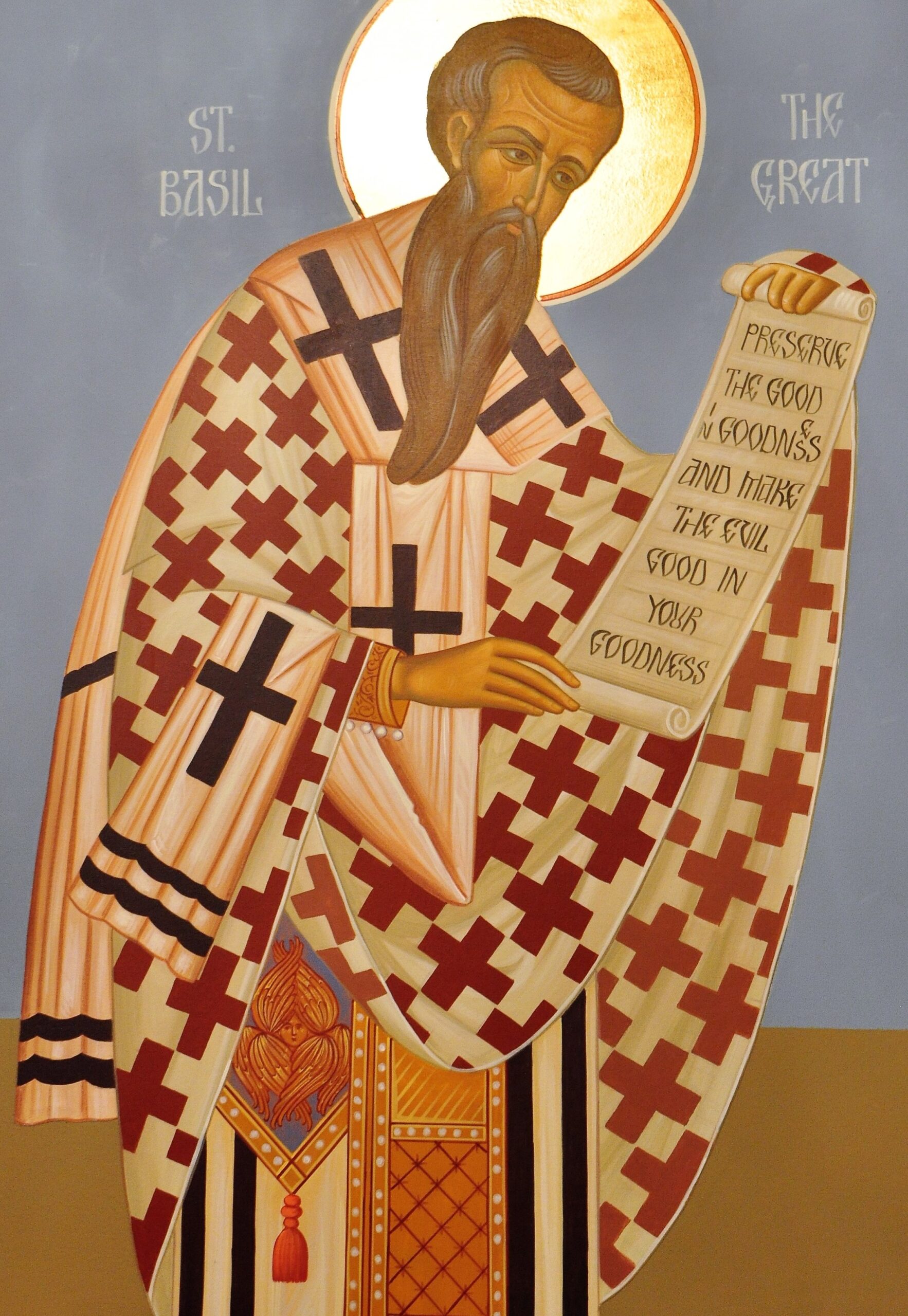

St. Basil the Great (330-379) is one of three Cappadocian Fathers in the Cappadocia region of what is now modern-day Turkey.
The two other fathers were his brother St. Gregory of Nyssa (ca. 330-395) and a close friend, St. Gregory of Nazianzus (329-389).
Scholars note that Basil was “the man of action,” Gregory of Nazianzus “the orator,” and Gregory of Nyssa “the thinker.” All three Cappadocian Fathers were bishops and doctors of the Church.
Basil was born in Pontus, Asia Minor, one of 10 children in a remarkable family of saints. St. Macrina the Elder was his grandmother by the father’s side, his parents were St. Basil the Elder and St. Emmelia, his eldest sister was St. Macrina, and Sts. Gregory of Nyssa and Peter of Sebaste were his brothers.
He studied rhetoric in Caesarea (now Kayseri, Turkey), Constantinople (modern Istanbul), and Athens, where he and St. Gregory Nazianzen became great friends.
Basil taught oratory in Caesarea, but dreading the honours of the world, he gave up all and embraced the monastic life. In 357 Basil travelled over Syria, Mesopotamia, and Egypt, visiting monasteries and hermits of the deserts in those countries and carefully learning all the duties and exercises of a monastic life.
Basil founded monasteries and wrote the Longer and Shorter Rules for their directions, becoming the father of the monastic life in the East. He was a man of discipline and prayer and said that prayer seasoned our daily work with hymns as we season food with salt.
The Arian heretics, supported by the court, were then persecuting the Church, and Basil was summoned from his retirement by his bishop to help respond.
Eventually, he was chosen Bishop of Caesarea. When St. Basil was required to admit the Arians to Communion, the prefect, finding that soft words had no effect, said to him, “Are you mad, that you resist the will before which the whole world bows? Do you not dread the wrath of the emperor, nor exile, nor death?”
Basil said calmly; “No, he who has nothing to lose need not dread loss of goods; you cannot exile me, for the whole earth is my home; as for death, it would be the greatest kindness you could bestow upon me; torments cannot harm me: one blow would end my frail life and my sufferings together.”
The perfect said, “Never has anyone dared to address me thus.” Basil suggested, “Perhaps you have never met a bishop, or he would have spoken in exactly the same way, having the same interests to defend.” Basil was so fearless and influential that even the Arian emperor Valens was afraid to depose him.
As a theologian, Basil taught the doctrine of the Trinity with the formula of one substance (nature) in three hypostases (persons). Basil had a great love for the poor and the needy. He built orphanages, schools, hospitals, and homes for the aged. He organized a society of women for the caring of the poor sick and the needy. After an earthquake, he worked for days without sleep to dig through rubble with his own hands to save those trapped.
In his book Church Fathers: From Clement of Rome to Augustine, Pope Benedict XVI said, “Basil’s profound thought stands out in this evocative sentence: ‘All the destitute look to our hands just as we look to those of God when we are in need’.”
Benedict XVI also pointed out that “in spite of his constant concern to do charitable acts which is the hallmark of faith, Basil was also a wise ‘liturgical reformer.’” Eucharistic Prayer IV in the Roman Missal was a composition influenced by the style of the liturgical prayer the Anaphora of Saint Basil.
Basil died in 379 and is venerated as a doctor of the Church.
巴西略 ── 一個「行動的人」
卡帕都西亞地域,位處今天的土耳其。教會在卡帕都西亞出了三位教父,是聖大巴西略(公元330-379年),他的兄弟聖國瑞.賴薩(大約公元330-395年),和他們的一個好朋友,聖國瑞.納祥(公元329-389年)。學者注意到,巴西略是一個「行動的人」,國瑞.納祥是一個「宣講者」,國瑞.賴薩則是一個「思想家」。這三位同是來自卡帕都西亞的教父,均是教會的主教及聖師。
巴西略被加尊稱為「大」,約於公元329年,在現今土耳其、小亞世亞的龐特斯出生。他出自一個傑出的聖善家庭;祖母是聖長瑪潔娜,父親是聖長巴西略,母親是聖艾美儷雅。他的姐姐是聖瑪潔娜,聖國瑞.賴薩和聖伯鐸.沙伯棣是他的兄弟。
大巴西略分別在凱撒肋亞(今日土耳其的畿塞利)、君士坦丁堡(今天伊斯坦堡)和雅典修讀修辭學。他在雅典成為聖國瑞.納祥的好朋友。
公元357年,他到過敘利亞、美索不特米亞和埃及,走訪不同的隱修院、在荒漠的隱修士,小心研究他們的隱修生活和操守。他自己亦創辦隱修院,寫下指導性的大小規則,成了東方教會的隱修鼻祖,是一位嚴明的紀律者,認為祈禱與聖詠是用來調劑生活,猶如鹽是食物的調味品一樣。
亞略異端藉著相應的政權,極度猖獗地打壓教會,大巴西略從隱修生活中被召回,協助對抗異端,後來晉牧成為凱撒肋亞主教。當他與異端教長對質時,他的嚴正立場使對方一籌莫展,不禁出言恐嚇,說:「整個世界都在臣服之際,你不怕惹怒君王,把你放逐、把你處死嗎?」大巴西略平靜地反駁道:「一個一無所有的人,不怕失去財產。你不能放逐我,因為我四海為家;致於處死,那是你對我最大的恩待;酷刑不能傷害我: 一擊便一并終結我脆弱的生命和痛苦。」官長回答:「從沒有人敢這樣向我回話!」大巴西略解釋說:「可能你從未遇見過一個主教吧!」他的無畏和說服力,連異端的瓦倫斯王也不敢惹他。
作為一位神學家,大巴西略指出聖三奧蹟,就是一個性體中有三個位格。他對貧苦有需要的人,顯示關懷:他建立孤兒院、學校、醫院和護老院。他把婦女組織起來,專責照料病弱的人。曾經一次的地震過後,他日以繼夜、不眠不休,徒手挖掘,盡力救助瓦礫下的人。教宗本篤十六世說:「大巴西略的深思,在這令人回味的話中站出來:『所有的窮困者望著我們的雙手,就如我們有需要時望著天主的雙手。』」
教宗本篤十六世又指出:除了時常關心行愛德善行,大巴西略也是一個富有智慧的『禮儀改革者』。
羅馬彌撒經書中的「感恩經第四式」,是受到聖大巴西略的感恩經影響。聖大巴西略死於公元379年,被尊為「教會聖師」。







